Source water
Municipal, groundwater or surface-water supply.
A complete treatment line integrating pretreatment, reverse osmosis, storage, distribution and automatic controls around your source water, production demand and required pure-water quality.
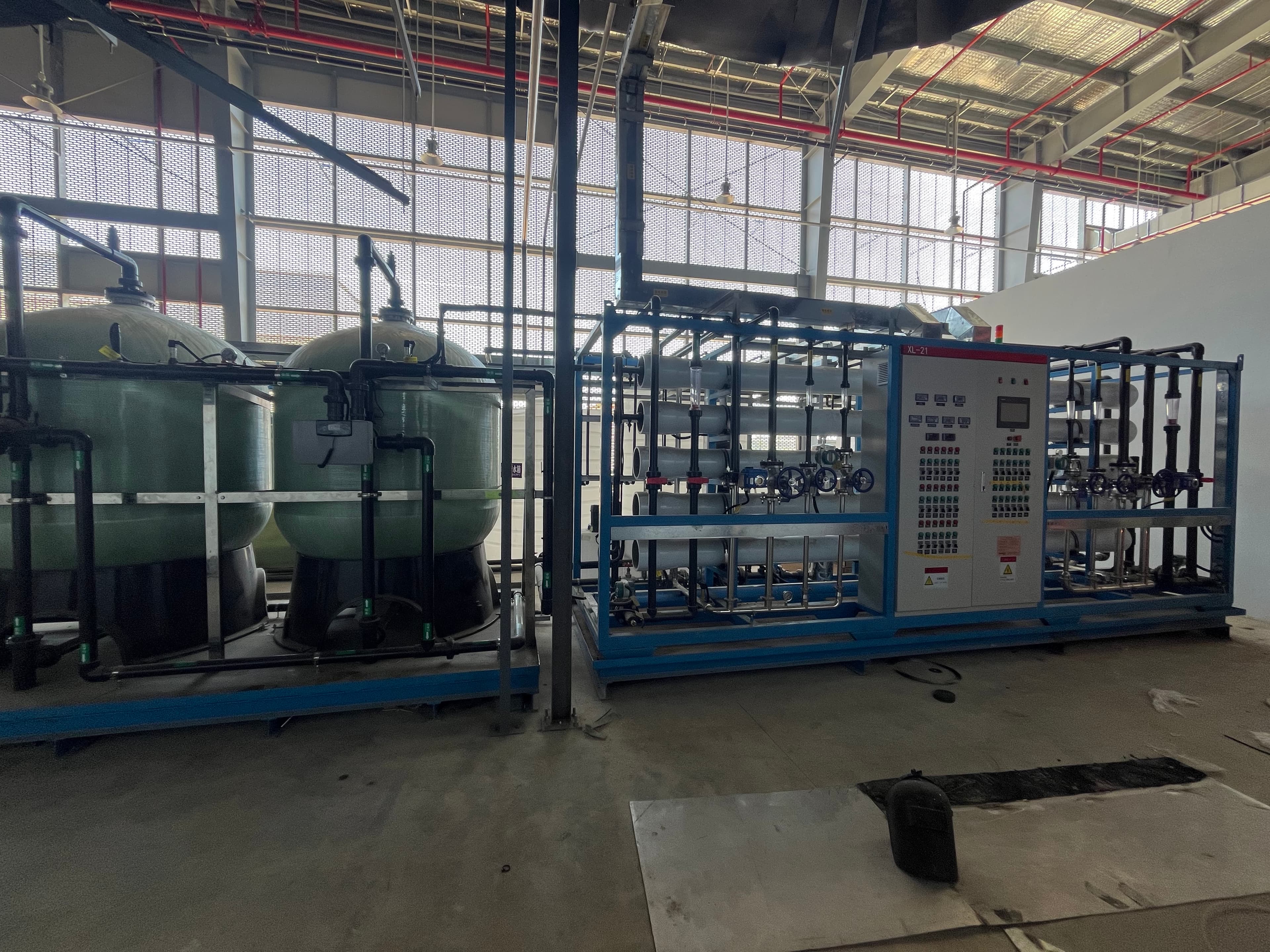
Municipal, groundwater or surface-water supply.
Protects the treatment train around the feed-water condition.
Primary desalination for controlled industrial pure water.
Buffers production and peak plant demand.
Transfers water to the agreed use points.
Delivers the required water quality where it is needed.
There is no single universal specification for “pure water” across all industries. The correct treatment route depends on the product-water specification required by the manufacturing process.
Pretreatment, cartridge filtration and RO treatment.
Pure-water storage and transfer selected around production demand.
Flow, pressure and conductivity monitoring according to scope.
PLC/HMI, automatic sequencing, alarms and interlocks.
Feed, product, drain, electrical and production connections.
Production utilities and stable process-water duties.
Controlled water for washing and cleaning requirements.
Treatment matched to compatibility and operating conditions.
Defined cleaning and production-utility water duties.
Production support water around actual capacity and quality needs.
RO-based water as a controlled upstream utility supply.
General industrial production and utility duties.
RO-based treatment for controlled conductivity and dissolved-solids requirements.
When tighter ionic control is required, additional stages such as EDI may be considered.
Explore RO + EDI Explore Ultrapure Water| Input | Why It Matters |
|---|---|
| Water source | Determines pretreatment requirements |
| TDS | Influences RO configuration |
| Hardness | Affects scaling control |
| Silica | Influences recovery and pretreatment |
| Required capacity | Determines system sizing |
| Operating hours | Affects production and storage strategy |
| Target conductivity | Determines treatment route |
| Peak demand | Influences storage and transfer sizing |
A pure-water system should be sized around both average consumption and actual plant demand patterns.
Raw Water Tank · Feed Pump · Pretreatment
Cartridge Filter · RO System
Pure Water Tank · Transfer Pump · Distribution
PLC / HMI · Monitoring · Interlocks · Alarms
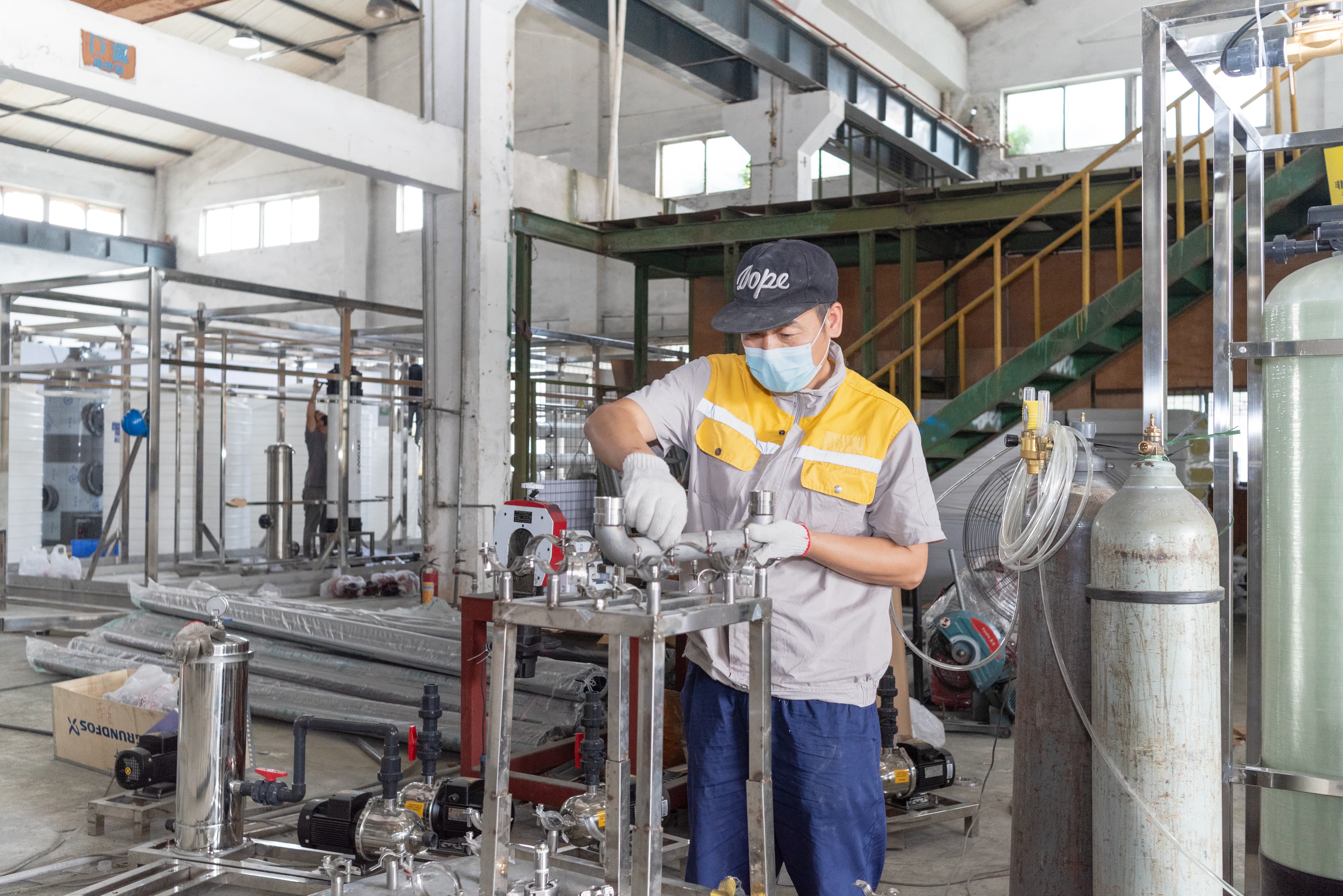
FAT focuses on coordination across the complete production-water line, not only membrane performance.
Pretreatment-to-RO interfaceRO sequencingTank level logicTransfer pump logicConductivity monitoringAlarm functionsPLC / HMIAgreed FAT scopeIt is a complete production-water line integrating pretreatment, RO, storage, transfer, controls and plant interfaces around a defined manufacturing duty.
It produces industrial pure water or process water to the confirmed point-of-use specification. There is no universal grade across all industries.
No. Ultrapure water has a separate critical-purity scope. This page focuses on complete industrial pure-water production and delivery.
The water analysis and target conductivity determine whether a single or second RO pass is appropriate.
Not by default. Where tighter ionic control is required, review the RO + EDI system separately.
Storage is selected from peak demand, operating hours, required reserve and the plant production pattern.
Yes. Tanks, transfer pumps, distribution, monitoring and interlocks are part of the possible system boundary.
Yes. Skid, modular and plant-integrated formats are selected around layout, transport and installation requirements.
Share your feed-water analysis, required capacity and target water quality. Our engineering team will review the treatment route and key design inputs.
Send Your Water Analysis