Heating or cooling industrial RO feed water is a separate equipment duty with its own utility and operating constraints. The heat exchanger should be specified from the required membrane-feed temperature range, seasonal utility conditions and water chemistry. A nominal connection size or heat-transfer area does not establish that the complete package can hold the required operating condition.
Confirm why the RO feed needs temperature conditioning
Start with the membrane design and the measured source-water temperature profile. Identify whether the project needs cooling to respect equipment limits, heating to support a defined production duty or a controlled temperature band for the downstream process. Request the selected membrane supplier's limits and projections rather than adopting a generic operating temperature. Distinguish a preferred process condition from a protective limit that must trigger a different plant response.
Record where the temperature requirement applies. A sensor upstream of a storage tank may not represent the water entering the membrane rack after a long pipe run. Show the heat exchanger, temperature instruments, any buffer vessel and the RO feed point on one diagram. Decide which party is responsible for temperature change between these boundaries. This prevents a thermal package from being accepted at its outlet while the connected plant receives water outside the agreed envelope.
Build a thermal duty matrix from actual operating cases
Provide water flow and inlet and outlet temperatures for each meaningful operating case. Include seasonal extremes, minimum production flow, startup and any period when the utility is restricted. For a sensible-heat duty, the thermal balance relates mass flow, specific heat and temperature change; use consistent units and suitable fluid properties. Ask the supplier to document the calculation basis and any limitations rather than presenting one maximum heat load as the complete specification.
Describe the utility at the exchanger connection, including its supply temperature range, available flow, return constraints and pressure. Cooling water that is satisfactory during cool weather may not provide the required approach temperature in summer. Likewise, a heating utility may be unavailable during a factory shutdown. Ask for a performance table covering the agreed combinations and identify which combinations cannot meet the target. Those limitations need an operating response, not a hidden assumption in the thermal calculation.
Send the feed-water analysis, target quality, required capacity and operating profile. We will help structure the next engineering questions.
Send your project inputsSelect construction from chemistry and maintenance duty
Compare plate and other exchanger arrangements using fluid chemistry, solids, temperature, pressure and service access. Alfa Laval's selection guidance distinguishes constructions for different industrial duties; no single configuration is automatically correct for every water source. Obtain a model-specific review of the proposed water and utility. State chloride exposure and chemical cleaning conditions where relevant, but let the responsible materials specialist confirm suitable plates, tubes, gaskets and other wetted parts.
If a gasketed plate unit is proposed, request the plate and gasket materials, connection arrangement, opening space and approved cleaning method. If an alternative construction is proposed, ask the bidder to explain its maintainability and fouling assumptions on the same duty basis. Do not infer chemical compatibility from a generic stainless-steel description. The cleaning fluid, its temperature and contact time may govern a material choice differently from the normal feed-water conditions.
Allocate hydraulic loss on both sides of the exchanger
Provide the pressure available at each inlet and the allowable pressure loss across the package at the relevant flows. Include strainers, control valves and associated pipework within a clearly stated boundary. The water side must remain compatible with pump suction and downstream requirements, while the utility side must work with the actual site supply. A thermal design that consumes the available pressure margin can prevent the installed plant from reaching its operating duty.
Review minimum-flow operation as well as the maximum case. Ask how control-valve selection and available pressure affect stable temperature regulation. Confirm pressure and temperature ratings for both sides and the credible differential-pressure conditions during operation, isolation and shutdown. Include vents, drains and maintenance isolation on the coordinated drawing. These connections should support approved filling and servicing procedures rather than being added after operators discover that the exchanger cannot be drained or vented conveniently.
Make fouling assumptions and cleaning access explicit
Give the supplier representative water analysis and information on suspended solids, scaling tendency and biological exposure. Ask what fouling allowance or operating assumption is included and what inspection or cleaning is expected. A clean-water calculation is useful only when its basis is understood. If strainers or pretreatment are required, identify who supplies them and how their maintenance affects production. Avoid treating an unspecified fouling allowance as a promise of indefinite operation without attention.
Plan temperature and pressure measurements that allow operators to compare later performance with the commissioning baseline. A changed outlet temperature can result from utility variation, flow changes, fouling or a control problem. Record the conditions needed to distinguish these causes. Provide physical clearance, lifting access where required and a route for cleaning waste. The operating plan should make it possible to restore the intended duty without unnecessary dismantling of surrounding RO equipment.
Review leakage and cross-contamination consequences
Assess what could happen if the heat-transfer barrier leaks. The utility may contain substances that are unacceptable in the RO feed, or the process side may affect a shared utility system. Describe the consequence and ask the responsible engineer to evaluate the required separation and detection arrangement. Pressure relationships can influence leakage direction, but they should be reviewed across startup, shutdown and isolation cases rather than assumed from the normal running condition alone.
Where the consequence justifies additional barriers or monitoring, define them explicitly and obtain a coordinated design review. Options depend on the duty and should not be chosen from a generic checklist. Clarify how a suspected leak is investigated and how affected water is contained. Keep this issue separate from the heat-transfer guarantee: meeting the target outlet temperature does not establish that the selected construction and protection arrangements are appropriate for the factory's contamination risk.
Integrate control, permissives and acceptance tests
Identify the temperature used for regulation and the separate condition used to protect downstream equipment. Specify sensor location, signal validity and the response to a failed sensor or unavailable utility. Define whether the RO stops, diverts water or waits for a stable condition under each case. Review valve fail position and credible thermal overshoot with the controls engineer. Setpoints and delays should follow the approved process assessment and selected equipment, without adopting a universal value.
Agree commissioning evidence that records both water and utility conditions, flow, temperatures and relevant pressures. Test representative load changes within the approved operating envelope and document whether regulation recovers as expected. Where factory utilities cannot reproduce the site duty, record that limitation and retain a site acceptance activity. Mechanical completion, leak checks, temperature control and thermal performance are related but separate acceptance items, and the final handover should identify the evidence for each.
Prepare the heat-exchanger package RFQ
Send Baihuipu the feed-water analysis, thermal duty matrix, utility schedule, allowable pressure losses, site layout and required operating response. Ask for a marked thermal calculation, mechanical datasheet, materials list, instrument arrangement and cleaning scope. Compare offers against identical seasonal cases. An apparently smaller exchanger or lower utility demand may reflect a different assumed inlet temperature, approach condition or maintenance basis that must be resolved before purchase.
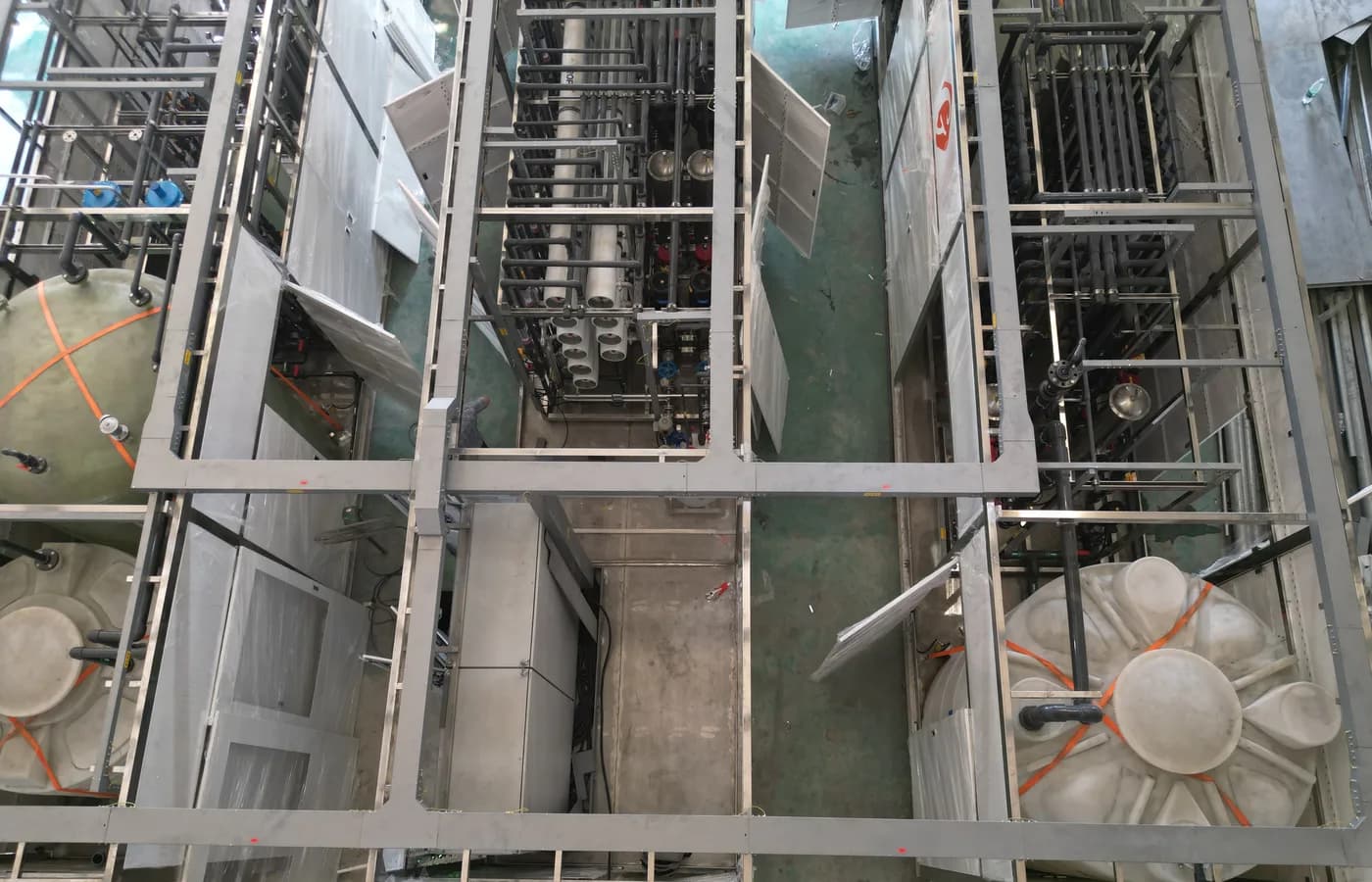
The featured image shows industrial treatment equipment and process piping, not a particular heat-exchanger model or verified thermal result. Use the related sizing and pump resources to coordinate the package with the rest of the RO train. The enquiry should ask the engineering team to connect heat transfer, hydraulics, temperature protection and maintenance in one review. That gives the buyer a practical acceptance boundary and exposes site utility obligations before fabrication begins.
Questions buyers commonly ask
Is a heat exchanger always necessary before industrial RO?+
No. Establish the actual temperature profile and selected equipment requirements first. Temperature conditioning is justified only when the process design and operating cases require it.
Can exchanger size be selected from water flow alone?+
No. Provide inlet and target temperatures, fluid properties, utility conditions, allowable pressure losses and fouling assumptions for all relevant operating cases.
Does a thermal calculation prove summer performance?+
Only for its stated conditions. Require a case using the actual summer utility temperature and available flow, with a defined response if the target cannot be met.
What is needed for a comparable exchanger quotation?+
Request the duty matrix, construction and materials, hydraulic losses, utility demand, cleaning access, controls, protection functions and factory and site acceptance scope.
Turn the guide into a project brief.
Final process selection and performance commitments should follow the complete feed-water analysis, application requirements, site utilities and approved technical agreement.