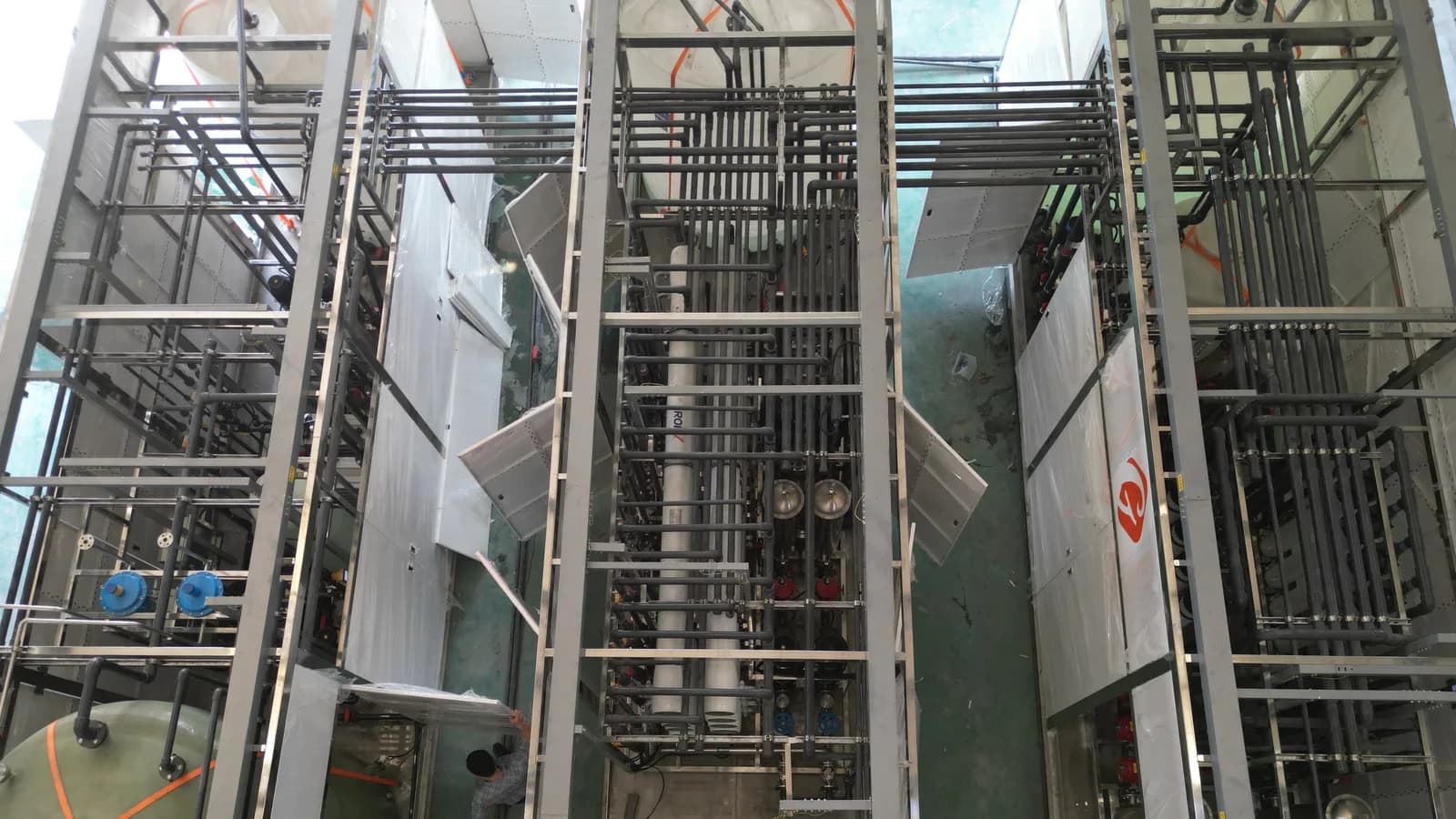
Industrial pure water system design starts with a verified feed-water analysis and a written point-of-use requirement. Capacity, pretreatment, RO recovery, double-pass RO, EDI, mixed bed, ultrafiltration, storage and distribution are then selected as a connected process—not as interchangeable equipment options.
Define the use point, quality target and production profile
An industrial pure water system is selected to serve a production duty, not a generic product category. The first design inputs are the process use point, target water quality, peak and average flow, daily consumption, pressure, operating shifts, permitted interruption and future expansion. A plant owner, engineering manager, procurement manager and EPC contractor may each hold part of this information, so the early technical review should make the ownership of every input visible.
Quality needs to be stated at the relevant point of use. Conductivity, TDS, hardness, silica, specific ions, particles, microbiological condition or other parameters may matter depending on the application. A low conductivity value measured at the skid outlet is not automatically the same condition delivered to a production tool. Storage, distribution materials, recirculation and sampling need to be considered whenever quality is important beyond the generation room.
Avoid allowing a nominal system capacity to stand in for the complete requirement. A m³/h number without source-water conditions, temperature, recovery, demand profile and product-water target cannot define a responsible industrial pure-water plant.
- Confirm use-point quality, flow and pressure.
- Separate average demand from production peaks.
- Identify sampling method and location.
- Record future expansion and interruption tolerance.
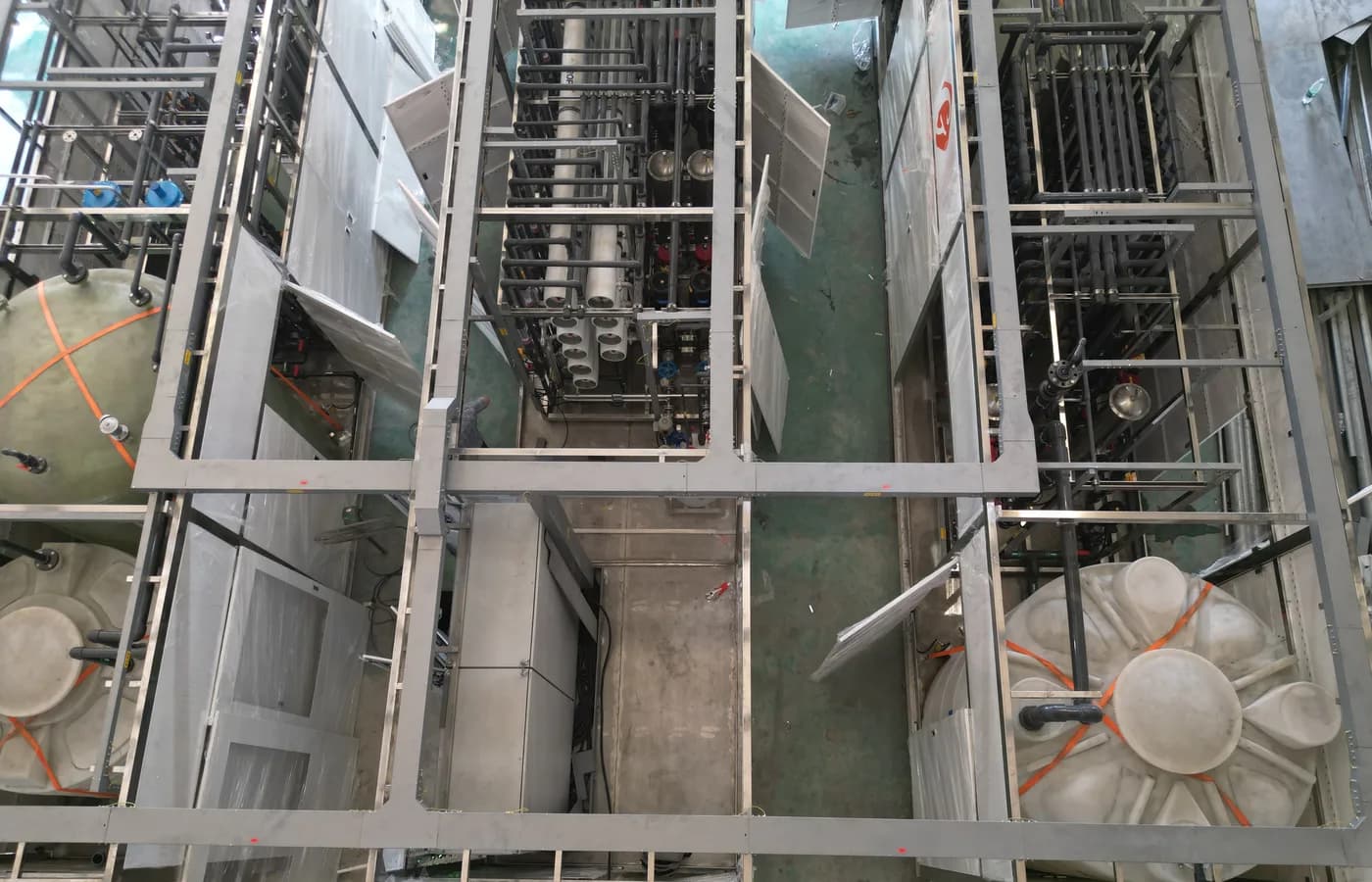
Use feed-water analysis to select pretreatment and recovery
The incoming-water report controls much of the process route. TDS and conductivity indicate overall dissolved loading, but hardness, alkalinity, silica, iron, manganese, turbidity, chlorine, organics and microbiological condition can be equally important. The water source—municipal, well, surface, process or recycled—also affects how much variability needs to be accommodated.
Pretreatment can include media filtration, activated carbon, softening, dosing, ultrafiltration or other measures. The aim is to control the feed conditions that could reduce membrane performance or increase maintenance burden. A complete proposal identifies expected pretreatment duty, outlet monitoring, consumable or regeneration requirements and the operation required when the raw water moves outside the design basis.
RO recovery deserves a similar engineering review. Higher recovery can reduce incoming-water demand and reject volume, but it concentrates scaling species and can increase fouling risk. The selected recovery should be tied to the actual analysis, membrane design, pretreatment and drain or reuse arrangement. It should not be borrowed from an unrelated project.
- Review TDS, hardness, silica, oxidants and turbidity together.
- State water-source stability and seasonal variation.
- Ask for the recovery basis and concentrate-handling plan.
- Do not treat pretreatment as an optional accessory.
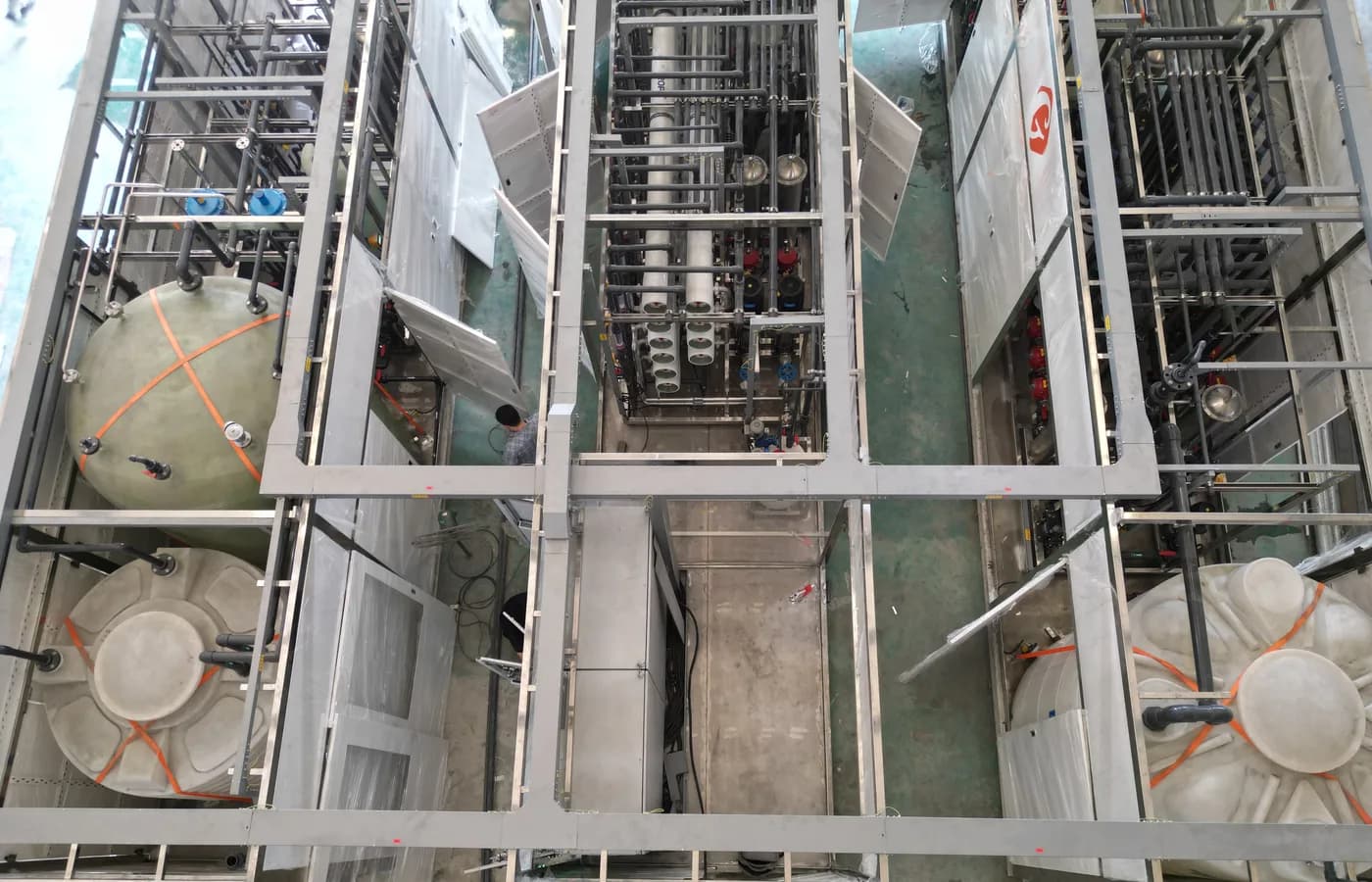
| Stage | Selection question | Project-specific basis |
|---|---|---|
| Pretreatment | What must be controlled before RO? | Feed-water analysis |
| RO and polishing | What quality is needed at use? | Point-of-use specification |
| Storage and delivery | How is quality retained to production? | Demand profile and layout |
Send the feed-water analysis, target quality, required capacity and operating profile. We will help structure the next engineering questions.
Send your project inputsChoose between single-pass RO, double-pass RO, EDI and mixed bed
Single-pass industrial RO is often the main desalting route when the approved quality requirement can be met with RO permeate. It still requires a defined membrane design, recovery, pressure, pretreatment, flushing and cleaning plan. Double-pass RO treats first-pass permeate again to add ionic reduction and margin where the target quality supports the added equipment and operating load.
EDI is considered when a continuous deionization stage is required after properly conditioned RO permeate. It can reduce the routine chemical regeneration associated with a conventional mixed-bed polishing stage, but its feed-water limits, control points and maintenance requirements must be respected. A mixed-bed route can remain relevant in selected applications, especially where the operational strategy, water-quality requirement and chemical-management provisions support it.
The right choice is not a ranking of technologies. It is a project-specific response to feed quality, target water quality, capacity, operating hours, chemical policy, maintenance capability, footprint, energy and expansion plan. A decision matrix is usually more useful than a short claim that one route is always ‘better.’
- Single-pass RO: primary desalting where it meets the duty.
- Double-pass RO: additional ionic reduction and margin.
- EDI: continuous polishing of suitable RO permeate.
- Mixed bed: evaluate against regeneration, quality and operating strategy.
Size generation, tanks and distribution as a water balance
System sizing connects the use-point demand to the production skid. Peak demand, daily volume, operating hours and storage allowance determine whether the plant needs a higher continuous generation rate, a larger tank, an alternative shift strategy or a combination. A system sized only to an average may lack practical resilience; one sized to every short peak without storage may be unnecessarily large.
The RO water balance connects permeate flow, feed flow and reject flow through the selected recovery. For an early design, the calculation is straightforward, but the recovery value must be defensible. Consider flushing, cleaning, auxiliary demand, tank turnover and reject disposal or reuse at the same time. Those utilities affect site layout and operating cost even when they are outside the supplied skid.
Distribution pumps and loop conditions should provide the pressure and flow needed at production while preserving the relevant quality. The piping route, material, branch arrangement and sample points should be included in the engineering scope rather than handed over as an undefined connection after the skid is purchased.
- Provide peak, average and daily consumption.
- Confirm recovery, feed demand and reject handling.
- Define tank duty and acceptable residence time.
- Include distribution interfaces in the project boundary.
Use UF and other barriers where the feed requires them
Ultrafiltration can provide a useful suspended-solids and colloidal barrier ahead of RO when the source-water risk supports it. It is not automatically required for every municipal-water project, and it does not replace all other pretreatment controls. The choice should be based on actual turbidity, SDI or similar feed characteristics, source stability and the downstream protection objective.
When UF is selected, review backwash water, cleaning procedures, membrane integrity monitoring, drain routing and how the system behaves during upstream variation. Similarly, activated carbon, softeners and chemical dosing need realistic regeneration or consumable planning. Good pretreatment is visible in the P&ID, operating procedures and service access—not merely in a generic equipment list.
A process can also be staged. A project may reserve space or interfaces for an additional RO pass or EDI future upgrade if the initial production duty does not yet need it. That is only sensible when the future trigger, utility allowance and connection points are defined; vague ‘upgrade-ready’ language is not an engineering plan.
- Select UF from feed-water risk and downstream protection need.
- Plan backwash, cleaning and drainage in the utility review.
- Verify service access around every pretreatment stage.
- Define future-upgrade triggers and interfaces if expansion is planned.
Create a procurement package that can be tested and commissioned
A complete RFQ includes feed-water analysis, target quality, demand profile, source-water variation, site utilities, drainage, available space, preferred materials, documentation, inspection, shipment and commissioning requirements. It should define whether the supplier is responsible for the generation skid only or for an integrated package including tanks, pumps, distribution, final filtration and controls.
FAT is most useful when agreed early. The checklist may cover physical completion, equipment tags, panel operation, pumps, signals, alarms, interlocks, piping, available test-water operation and documentation. The test report should identify the water basis and limitations. Site commissioning then establishes baseline pressures, flows and relevant quality results at agreed sample locations.
Use the Industrial Pure Water System product page, Industrial RO System, RO + EDI System and the published North American Industrial Pure Water System case as connected technical references. The Case Studies hub and enquiry form then give buyers a direct path to submit a project-specific brief.
- Define supply boundary and responsibility matrix.
- Agree FAT, inspection and commissioning documents.
- Record baseline operation after stable site start-up.
- Use a complete technical brief for final supplier comparison.
Make proposal comparison an engineering review, not a price table
Industrial pure-water proposals can appear similar while applying different assumptions. One bid may include pretreatment, tanks, controls and a defined FAT; another may quote a membrane skid only. One capacity may be based on a nominal water temperature and stable feed; another may include seasonal allowance. Procurement should compare the complete treatment and delivery boundary before concluding that one configuration is more economical.
Ask every bidder to identify feed-water basis, target quality, design recovery, expected feed and reject interfaces, instruments, materials, pumping duty, electrical requirement, consumables, maintenance assumptions, excluded civil work and documentation. Where proposals use terms such as pure water, deionized water or high purity, require the actual parameter, location and measurement method behind the term. This protects the buyer from accepting an ambiguous specification.
The same review should cover expandability. A future capacity increase may need more than a new membrane vessel; it can require pretreatment, pumps, tank capacity, electrical distribution, controls, floor space and drain capacity. Making those interfaces visible now allows the plant to decide whether to reserve provisions or procure a complete first-phase solution.
- Compare the same scope, design basis and interface boundary.
- Require stated water-quality measurement methods.
- Review utilities, maintenance and documentation alongside price.
- Define expansion interfaces rather than using generic upgrade language.
Keep operating data connected to design decisions
Once the system is operating, collect the measurements that explain its performance: representative feed-water results, pretreatment status, RO pressure and flow, recovery basis, product-water values, tank level, cleaning activity and relevant maintenance events. A controlled trend record is more useful than isolated readings because it helps the plant recognize gradual change before it becomes a production problem.
The record also supports future process decisions. A factory may add a production line, change the water source, alter its shift pattern or evaluate reuse of a related stream. With the original design basis, commissioning data and operating history available, the engineering team can determine whether existing pretreatment, RO, storage and distribution have real capacity or need a defined upgrade.
This is why the technical specification should require usable documents and training, not only an equipment list. The owner needs enough information to operate, maintain and modify the system safely after the supplier’s initial commissioning scope is complete.
At each planned review, compare actual demand, feed-water history and maintenance records with the approved design assumptions. If the operating window has changed, assess the complete treatment train and distribution system before adjusting recovery, increasing flow or adding a polishing stage. Controlled changes preserve the reliability expected from an industrial water utility.
- Trend feed, process and product-water indicators together.
- Keep commissioning data with the approved design basis.
- Review production or source changes before modifying the route.
- Include documentation and training in the project handover.
Questions buyers commonly ask
How do you size an industrial pure water system?+
Start with approved point-of-use quality, peak and daily demand, operating schedule, representative feed-water analysis, storage allowance and the required delivery pressure.
When is double-pass RO needed?+
It is considered when the product-water target requires more ionic reduction or operating margin than a single pass can reliably provide under the stated design conditions.
Is EDI always required after RO?+
No. EDI is selected when continuous high-purity polishing is justified and correctly conditioned RO permeate can meet its feed requirements.
What is needed before requesting a proposal?+
Provide water analysis, quality target, flow profile, operating hours, site utilities, location, layout constraints and inspection or documentation requirements.
Turn the guide into a project brief.
Final process selection and performance commitments should follow the complete feed-water analysis, application requirements, site utilities and approved technical agreement.