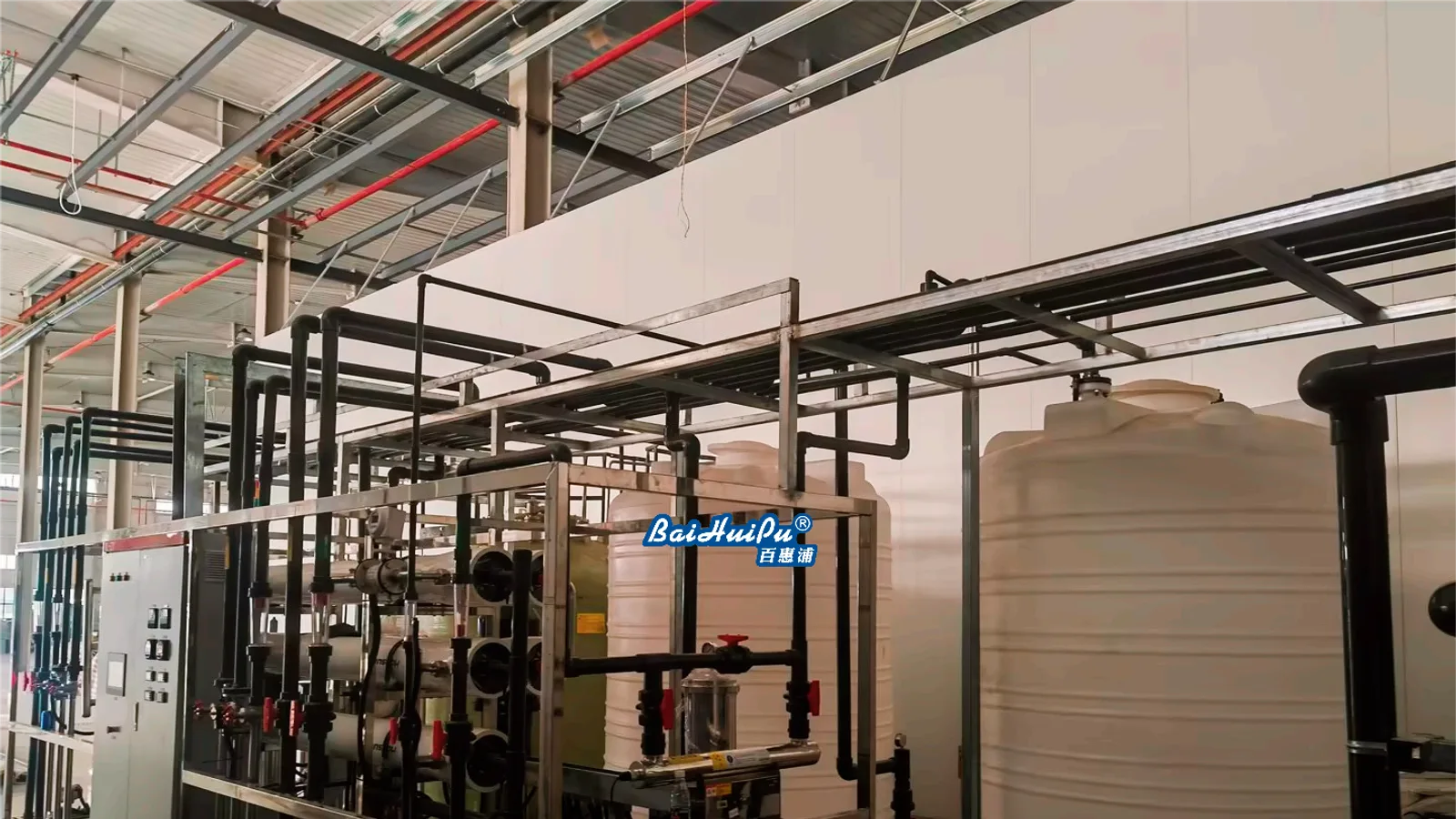
An RO + EDI water treatment system can support lithium battery manufacturing where the confirmed use point needs stable, low-conductivity water and the upstream RO permeate can meet the EDI feed conditions. The correct configuration follows production use, water analysis, demand pattern and control requirements; it is not an automatic upgrade for every battery process.
Map battery production use points before selecting treatment technology
Lithium battery plants use water for different duties, including selected process preparation, cleaning, rinsing, utility supply and other production-support activities. Those duties should not be grouped under one generic purity label. The water-system design needs an approved list of use points, their quality criteria, required pressure, normal and peak flow, operating hours and the impact of a temporary interruption.
This map provides the basis for deciding whether industrial pure water, a double-pass RO route, RO + EDI or a further polishing configuration is appropriate. It also prevents over-specification. A process that needs dependable RO permeate does not necessarily need EDI; a process with a tighter ionic or conductivity requirement may need a more controlled route and distribution plan. Engineering choices should reflect the actual process specification rather than product marketing terminology.
Procurement teams can improve early proposals by asking the production and quality groups to identify which limits are controlled at each point and how they are measured. This creates a meaningful water-treatment enquiry instead of a request for a generic ‘battery ultrapure water machine.’
- List each water use point and its quality requirement.
- Record normal, peak and future demand separately.
- Clarify whether water is process-critical or a supporting utility.
- Use a controlled specification instead of a generic purity label.
Establish the feed-water and pretreatment basis
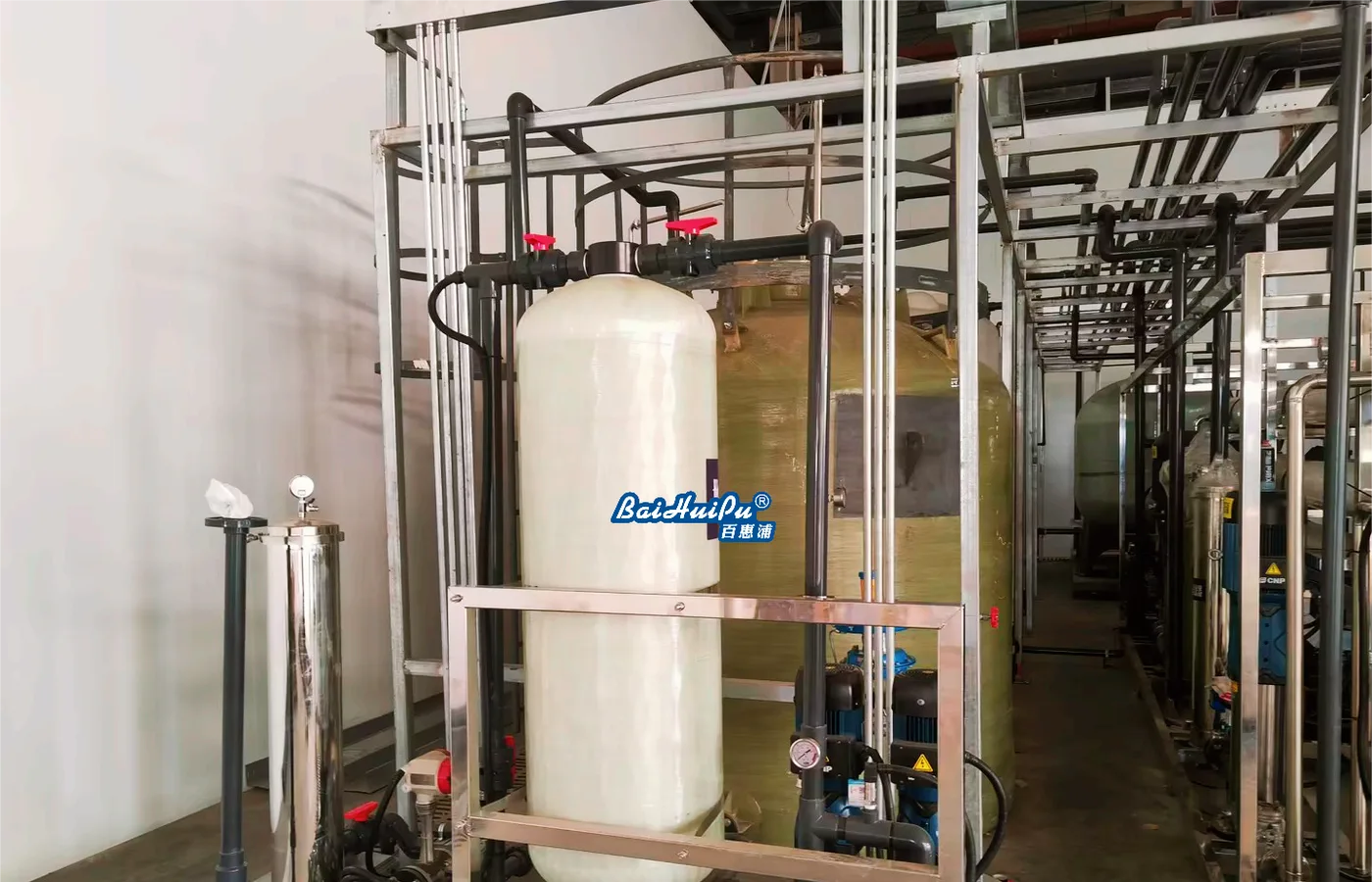
RO + EDI starts with the incoming water, not at the EDI module. Municipal, well and recycled feeds can have different turbidity, hardness, alkalinity, silica, oxidants, organics and seasonal variation. A representative analysis is needed to select pretreatment, RO recovery and membrane protection. If the source changes seasonally or between municipal supplies, that variation should be visible in the design review.
Pretreatment may include filtration, activated carbon, softening, chemical dosing, ultrafiltration or other barriers, depending on the feed and the required downstream protection. The design should show monitoring points, backwash or regeneration expectations where applicable, cartridge filtration, chemical storage and the action required if an upstream condition falls outside the operating basis.
An EDI proposal should state its feed-water requirements clearly. EDI is normally supplied with properly conditioned RO permeate, not raw water. Hardness leakage, oxidants, carbon dioxide and other feed conditions can affect EDI performance, so the upstream train, instruments and alarms need to be designed as part of one connected system.
- Provide dated laboratory results and source description.
- Confirm oxidant-control and hardness-control strategy.
- State RO permeate conditions expected at the EDI inlet.
- Define alarm and bypass response when feed quality changes.
| Input | Engineering decision | Project evidence |
|---|---|---|
| Battery use point | Required treatment level | Approved production requirement |
| RO permeate quality | EDI suitability and protection | Water analysis and control plan |
| Demand profile | Generation and storage duty | Production schedule |
Send the feed-water analysis, target quality, required capacity and operating profile. We will help structure the next engineering questions.
Send your project inputsUnderstand what RO + EDI contributes to the treatment train
RO is the principal desalting stage. It reduces dissolved salts and many dissolved contaminants when membrane selection, recovery, pressure and pretreatment match the source water. EDI acts as a continuous polishing stage after suitable RO permeate. Its resin, membranes and electric field remove residual ions without the routine acid and alkali regeneration associated with conventional mixed-bed polishing.
This difference can be valuable where the project seeks continuous operation and reduced regeneration chemical handling. It does not remove the need for maintenance, monitoring or upstream protection. The site still needs membrane cleaning strategy, consumables planning, instrument calibration, alarm response and written procedures for abnormal operating conditions.
A route should be evaluated against the product-water requirement and operating context. If a conventional RO route meets the approved use-point specification, an EDI stage may not be needed. If quality stability or a lower-conductivity target requires a polishing stage, RO + EDI may be a stronger engineering option than adding repeated manual regeneration duties. The decision must remain tied to project data.
- RO and EDI have different roles in the same treatment train.
- EDI requires RO permeate within defined operating limits.
- Reduced regeneration chemicals does not mean zero maintenance.
- Select polishing only when the use-point requirement justifies it.
Size generation, storage and distribution around production demand
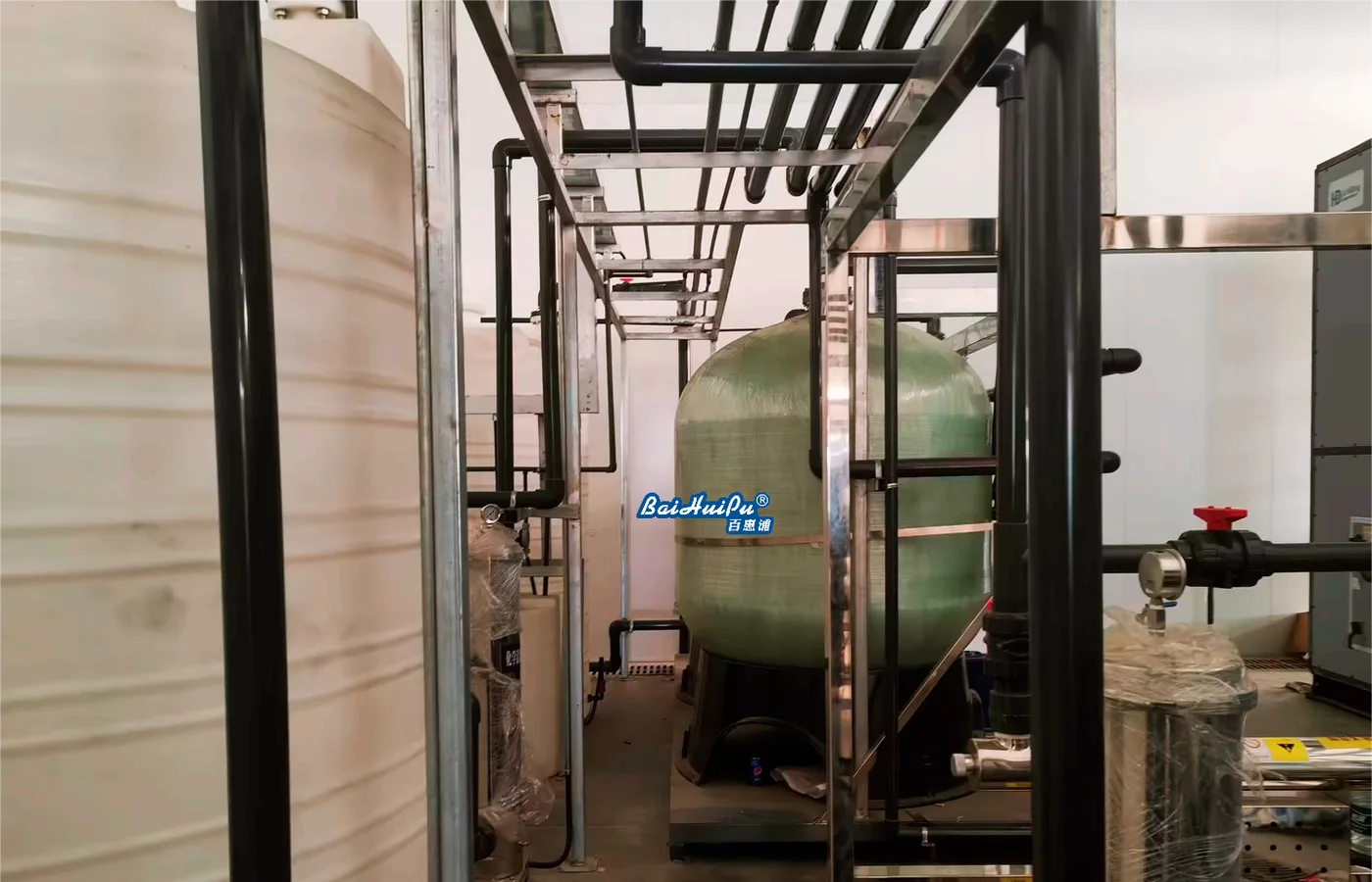
A water-system capacity is more than a stated m³/h number. The design must account for normal consumption, peak events, batch cycles, shift pattern, cleaning periods, storage volume and future line expansion. Storage can buffer short demand peaks and allow the generation system to operate more steadily, but the tank and loop must be designed around acceptable residence time and water-quality control.
Distribution requires equal attention. Materials, recirculation, branch layout, pressure control, sample points and final filtration are chosen around the approved water quality and the physical route to production. A stable value at the skid outlet does not prove that the same condition is delivered at a remote use point. The commissioning plan should include sampling and baseline records at agreed locations.
The published Vietnam Lithium Battery Pure Water Project and the documented 6 m³/h and 3 m³/h battery project pages can be used as case-study references. They support a discussion about configuration and project delivery, while their public pages deliberately avoid unverified performance claims or customer-identifying detail.
- Define average and peak process demand.
- Set storage and distribution boundary clearly.
- Include sample points at skid outlet and relevant use points.
- Treat published project data as reference, not a universal specification.
Specify automation, quality control and factory evidence
Automation should make the process understandable to operators. Typical control points can include flow, pressure, conductivity, tank level, pump status and selected alarm conditions. The final list depends on the approved P&ID and operating philosophy. Operators need to know which alarms require process response, which indicate maintenance attention and when water should be isolated from a defined use point.
Factory acceptance testing should be agreed before manufacturing is complete. The test may cover equipment tags, piping completion, panel function, instrument signals, alarms, interlocks, pump direction and operation with available test water. The report should identify the test-water basis and any limitations; it should not convert a factory run into a claim about final site water quality.
Before site start-up, confirm water, power, drains, external piping, sample vessels, consumables, operator availability and the commissioning sequence. Collect baseline pressure, flow and quality records after stable operation so later troubleshooting has a reference point.
- Use a documented control narrative and alarm list.
- Agree FAT acceptance points before the test date.
- Record actual test-water conditions and limitations.
- Create commissioning baseline records at approved samples points.
Prepare a useful lithium battery water-treatment RFQ
A strong RFQ gives the supplier enough information to identify the correct treatment boundary. Include current water analysis, intended production use, required quality at the use point, hourly peak and daily demand, operating schedule, future expansion, site utilities, plant location, layout constraints and required documents. If any value is not known, identify it as provisional rather than inventing a precise target.
The Lithium Battery Water Systems solution page provides the industry context; the RO + EDI System, EDI System and Industrial RO System pages describe the relevant equipment routes; the Case Studies hub gives access to documented project records. Linking these assets to an enquiry lets the engineering team review a complete decision path rather than receive an isolated product request.
Final configuration, capacity, materials, controls, quality target and guarantees should be established only after technical review and the approved agreement. This protects both the production owner and the water-treatment supplier from treating an early educational article as a site-specific design commitment.
- Attach laboratory water analysis to the enquiry.
- State expected quality and sampling point.
- Provide demand profile and site utilities.
- Confirm documentation, FAT and commissioning expectations.
Coordinate production, facilities and quality stakeholders
Battery water-system projects often cross several teams. Production owns the actual use profile and process window; quality defines the controlled requirement; facilities owns water, power, drainage and maintenance access; an EPC contractor may coordinate the building interfaces; procurement needs a comparable scope and delivery schedule. Bringing these inputs together early is more valuable than asking one department to choose a complete treatment route in isolation.
A concise decision register is useful during engineering. List each open item, the owner, due date, effect on equipment selection and decision needed. Examples include source-water confirmation, final use-point target, storage location, external pipe materials, reject routing, electrical supply, documents and the selected FAT witness scope. This record reduces the risk that a late site change becomes an untracked supplier variation.
Handover should be planned in the same way. The project team should identify training attendees, maintenance responsibility, consumables, spare-parts strategy, sample-plan owner and the process for reviewing water-quality or alarm trends. Continuous EDI polishing only adds value when the surrounding RO, storage and operating processes can support stable, accountable production water.
- Confirm technical inputs with each project stakeholder.
- Track open decisions and their equipment impact.
- Coordinate water, power, drains and external distribution early.
- Assign operating, sampling and maintenance responsibilities before handover.
Plan utilities and site interfaces before shipment
A factory-assembled RO + EDI package still relies on site readiness. Confirm incoming-water pressure and flow, electrical supply and protection, floor or skid support, drainage, reject connection, external pipe materials, product-water tank interface, ventilation and access for delivery or lifting. These items are often assigned to different parties, so they should appear in one controlled interface list before shipment release.
Site installation should not rely on equipment photographs alone. Use approved general arrangement drawings, P&IDs, electrical documents, connection schedules and a clear definition of loose items. Before commissioning, check that all external pipes are clean, labelled and pressure tested as appropriate; that drains are available; and that sample points, operators and required consumables are ready.
A structured readiness review avoids avoidable starts and stops. It also ensures that an issue such as low incoming pressure, blocked reject pipework or an unfinished distribution loop is identified as a site interface rather than incorrectly attributed to an EDI module. The result is a more credible handover to production.
Before release, hold a short interface review with the buyer, EPC and supplier. Close the utility list, list exceptions, assign each open action and confirm that changing an interface will be reported through controlled drawings. This small project-control step prevents a packaging, civil or installation assumption from becoming an unplanned water-quality or commissioning risk.
- Confirm water, power, drain and delivery access before shipment.
- Use controlled drawings for all site interfaces.
- Complete external pipe and sampling readiness before start-up.
- Record open site items before commissioning begins.
Questions buyers commonly ask
Does every lithium battery plant need RO + EDI water treatment?+
No. The route should follow the approved use-point quality requirement, demand profile and feed-water conditions. Some duties may be served by a different treatment level.
Can EDI receive raw municipal water?+
No. EDI is normally fed with correctly conditioned RO permeate. Its feed-water limits should be reviewed as part of the system design.
What data should be sent for an RO + EDI proposal?+
Send current water analysis, target quality, use points, peak and daily demand, operating hours, utilities, location and documentation requirements.
What does factory testing prove?+
FAT documents the agreed factory checks and available operating run. Final site performance must still be confirmed against the approved feed-water and commissioning basis.
Turn the guide into a project brief.
Final process selection and performance commitments should follow the complete feed-water analysis, application requirements, site utilities and approved technical agreement.