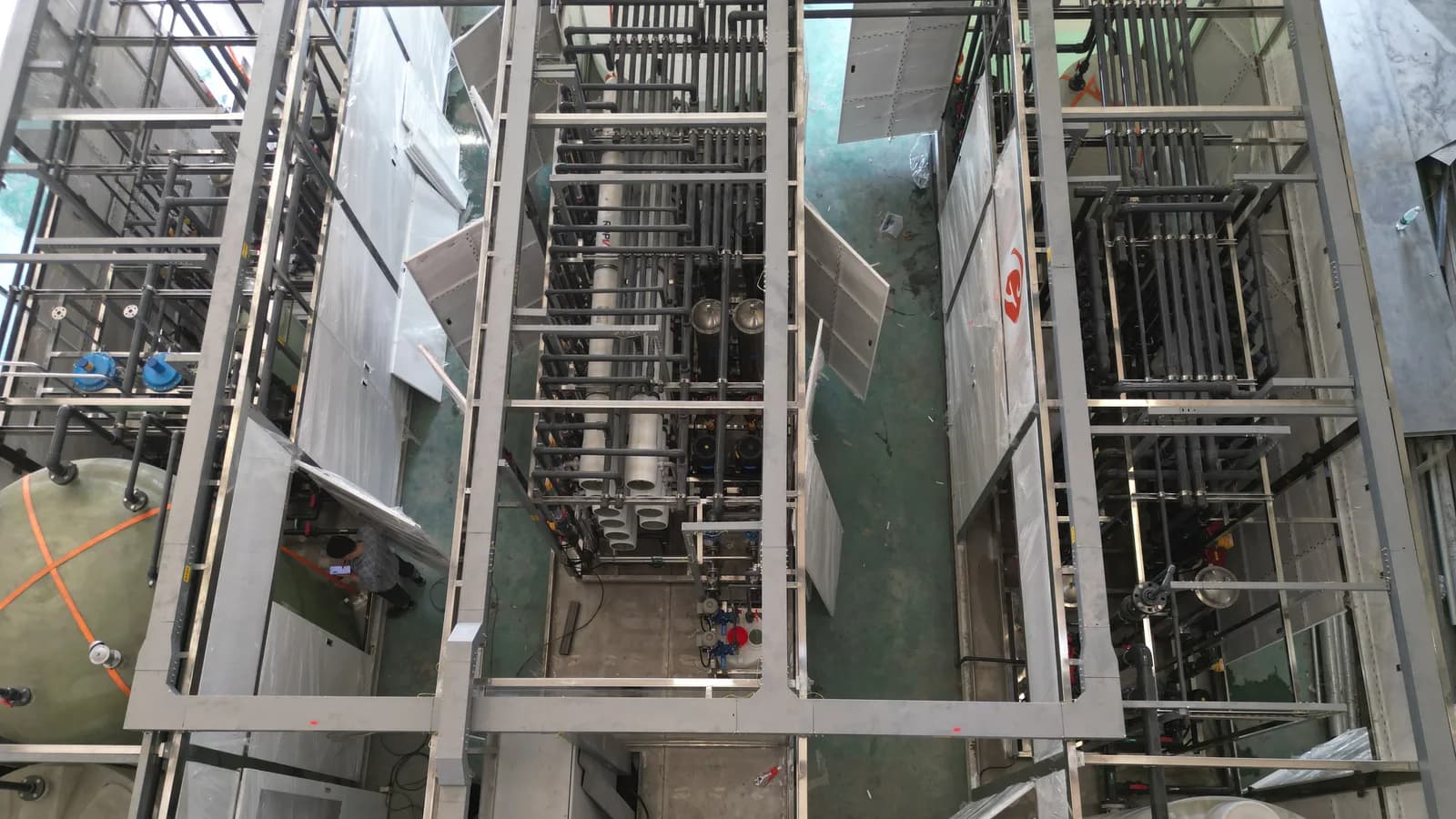
An EDI water treatment system uses ion-exchange media, ion-selective membranes and direct current to continuously polish correctly conditioned RO permeate. It is a high-purity water stage, not a raw-water treatment method. Good results depend on upstream RO performance, feed-water limits, monitoring, distribution design and the agreed product-water requirement.
What an EDI water treatment system is designed to do
Electrodeionization, usually called EDI, is a continuous deionization process used after an upstream purification train. An EDI module combines ion-exchange media, ion-selective membranes and an electrical potential to remove remaining ions from suitable feed water. In industrial systems, that feed is commonly RO permeate that has already been conditioned to protect the module and provide stable operation.
The commercial value of EDI is not simply a low number on a product brochure. It is the ability to provide continuous ionic polishing without routine acid and caustic regeneration of a conventional mixed-bed unit. Whether that advantage is meaningful depends on the required product-water quality, operating hours, local chemical-handling policy, feed-water stability, maintenance capability and complete cost of the treatment train.
An EDI package should therefore be discussed as part of an RO + EDI process route. Treating it as a standalone raw-water device leads to poor assumptions about feed conditions, maintenance and expected output quality.
- EDI is a continuous polishing stage, not raw-water treatment.
- It normally receives correctly conditioned RO permeate.
- The upstream RO and EDI controls must be engineered together.
- Product-water requirements must be defined at the approved sample location.
How EDI removes ions continuously
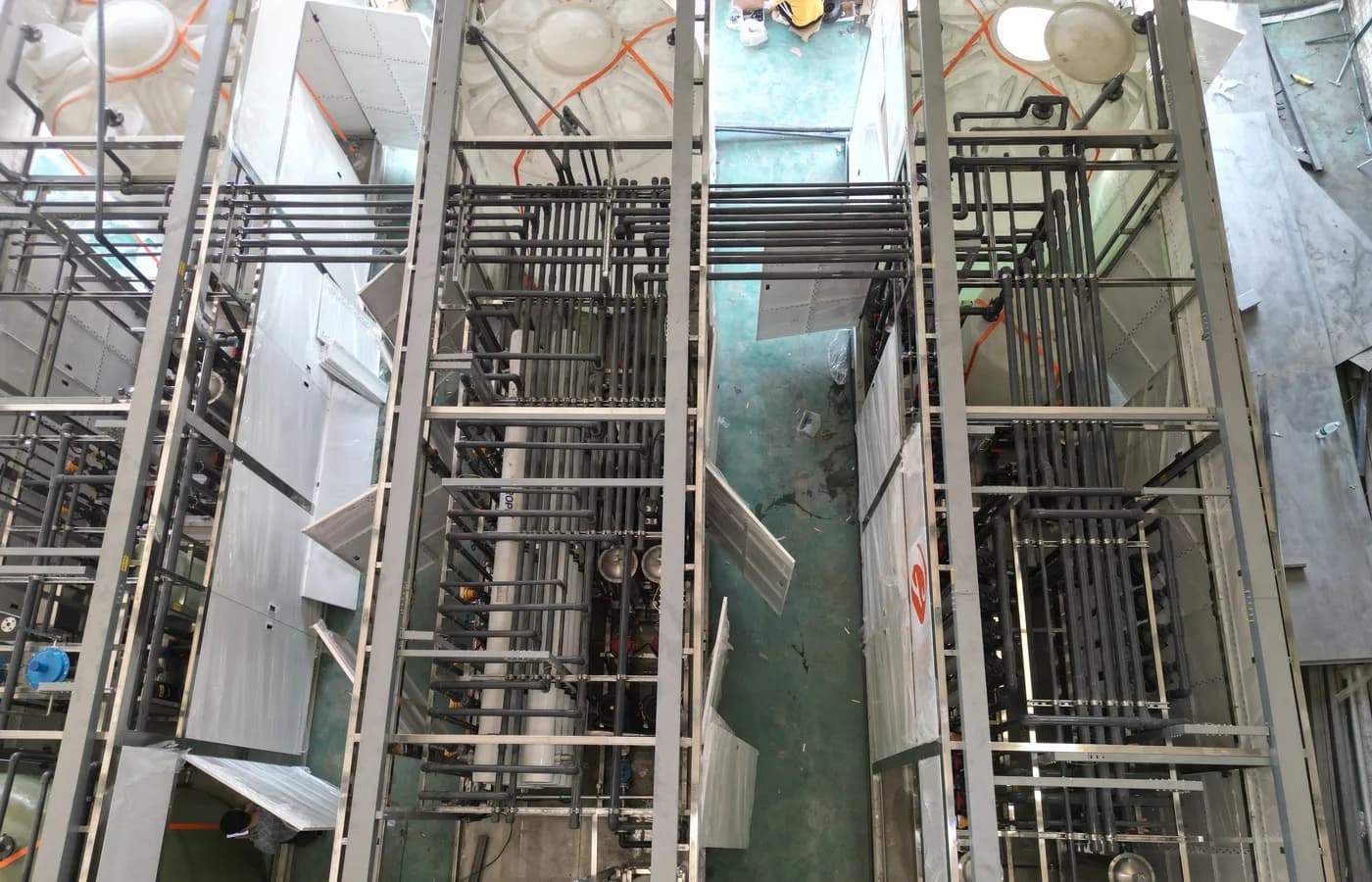
Within the module, ion-exchange media provide conductive pathways and ion-selective membranes direct cations and anions under an electrical field. The configuration allows ions to migrate out of the diluting compartments while water splitting supports regeneration of the media in operation. The exact internal arrangement is determined by the module supplier, but the project engineering question is simpler: can the incoming water remain inside the published operating envelope under normal and upset conditions?
That is why an EDI system needs upstream monitoring and interlocks. Conductivity, flow, pressure, temperature where relevant and other safeguards can help prevent unsuitable feed from reaching the polishing stage. The final design should state the normal control sequence, alarm conditions, response actions and whether any diversion or shutdown arrangement is needed during abnormal upstream quality.
Continuous operation does not mean unattended operation. Operators still need to inspect trends, maintain instruments, follow preservation procedures during outages and investigate pressure or quality changes. Engineering documents should make those responsibilities practical rather than presenting EDI as maintenance-free.
- Review the module supplier’s feed-water limits.
- Use relevant upstream instruments and alarm actions.
- Define operating, shutdown and preservation procedures.
- Keep trend and calibration records for troubleshooting.
| Area | Question to answer | Evidence to review |
|---|---|---|
| Feed water | Can RO permeate meet EDI limits? | Water analysis and RO design |
| Operation | How are upsets detected and managed? | P&ID and control narrative |
| Product water | Where and how is quality verified? | Use-point specification and sampling plan |
Send the feed-water analysis, target quality, required capacity and operating profile. We will help structure the next engineering questions.
Send your project inputsSet EDI feed-water requirements through the upstream RO design
EDI feed requirements are one of the first questions in a serious project review. Hardness leakage, oxidants, excessive carbon dioxide, suspended solids, organics and other constituent limits can affect performance or life. The exact acceptable range comes from the selected equipment supplier and should be listed in the approved design documentation rather than inferred from a generic website.
The RO system is therefore designed as a protective stage as well as a desalting stage. Pretreatment must control the incoming water risks that could impair RO operation, and the RO must provide stable permeate at the EDI inlet. In some projects, additional interstage treatment or degassing may be evaluated, but the need is determined by water chemistry and the product-water specification—not by a standard diagram.
A proposal should identify what happens when the water analysis is incomplete. It can present a preliminary route, but it should mark assumptions, required confirmation tests and any limits that could change equipment selection. This is more valuable to procurement than an apparently fixed promise based on unknown source conditions.
- Do not feed EDI with untreated raw water.
- Confirm hardness, oxidant and carbon-dioxide control strategy.
- State EDI inlet monitoring and response actions.
- Separate preliminary assumptions from approved design conditions.
Compare EDI with double-pass RO and mixed-bed polishing
Double-pass RO adds a second membrane desalting barrier and may be selected when the water-quality requirement needs further ionic reduction and operating margin. RO + EDI adds a continuous deionization stage after suitable RO permeate. The two routes are not identical and should not be compared only by a generic conductivity claim. Feed-water composition, quality target, capacity, recovery, utilities, footprint and operational preference all matter.
A conventional mixed-bed stage can provide a different polishing approach. It may be appropriate in selected applications, but the project should evaluate resin handling, regeneration chemicals, wastewater, safety, automation and service requirements. EDI can reduce routine regeneration chemical handling, yet it still needs compatible feed water and planned maintenance.
The most useful selection method is a requirement matrix. Put feed-water confidence, product-water limits, sample points, operating hours, chemical policy, maintenance resources, expansion plan and acceptance criteria on one page. Then evaluate double-pass RO, RO + EDI and mixed bed against that same basis. This avoids choosing a route because it sounds more advanced than the process requires.
- Double-pass RO and EDI provide different forms of quality margin.
- Mixed bed requires deliberate regeneration and waste-handling planning.
- Compare routes against the same written requirement matrix.
- Avoid declaring one route universally best.
Apply EDI to the right industrial duties
EDI is often considered for industrial high-purity water duties in electronics, lithium battery manufacturing, pharmaceutical support utilities, power and other processes where a continuous polishing stage is justified. The application name alone does not determine suitability. For example, a battery plant can have several water duties with different quality needs, and only selected points may justify RO + EDI or additional polishing.
Published semiconductor and lithium battery case studies can provide useful context. The Semiconductor Ultrapure Water System 150 m³/h project, Vietnam Battery Pure Water project, 6 m³/h battery pure-water project and 3 m³/h battery ultrapure-water project are presented as documented references. They do not convert their project-specific conditions into a universal water-quality, recovery or performance claim.
Where product water will be stored or distributed, the route continues beyond EDI. Tank venting, recirculation, piping material, sampling, final filtration, sanitization and point-of-use controls can affect the delivered condition. Define that boundary before using EDI product-water data as the entire project requirement.
- Assess every use point rather than the industry name alone.
- Use published cases as references, not design guarantees.
- Include storage and loop controls in high-purity scope.
- Define final quality at the point of use.
Size, operate and maintain the full RO + EDI system
Sizing begins with normal and peak product-water demand, daily volume, operating hours, storage allowance, redundancy philosophy and future expansion. The upstream RO recovery and EDI product flow must be reconciled with feed-water availability, reject handling, flushing, cleaning and distribution demand. Nominal capacity alone does not describe the operating design.
Maintenance planning includes pretreatment service, membrane cleaning and replacement strategy, instrument calibration, EDI operating checks, electrical inspection, spare parts, preservation during shutdown and operator training. The schedule should be based on actual operating conditions and manufacturer guidance. It is not responsible to promise a fixed maintenance interval without these inputs.
EDI is not suitable when its feed-water requirements cannot be met economically or reliably, when the selected duty does not need high-purity polishing, or when the operating environment cannot support the required monitoring and maintenance. In those cases, another treatment route may be more defensible. A technical proposal should state the reason rather than force EDI into every pure-water project.
- Size against peak and daily demand, not a headline flow alone.
- Plan RO, EDI, instruments and storage as one system.
- Maintain calibration, preservation and spare-parts records.
- Do not select EDI where compatible feed cannot be maintained.
Move from the guide to a project-specific engineering review
For an initial review, provide a representative feed-water analysis, target product-water quality, use point, peak and daily demand, operating profile, utilities, location and expected project schedule. The EDI Water Treatment System and RO + EDI System product pages show the relevant equipment context, while the Semiconductor and Lithium Battery solution pages help position the system around an actual industrial application.
The Case Studies hub provides documented project references, and the enquiry form creates the final step in the internal path: guide to product or solution, product to case study, and case study to technical proposal. This path helps an engineering team ask the right questions before a final configuration is committed.
Final performance, materials, capacity, automation and acceptance criteria remain project-specific. They should be confirmed through the approved water analysis, technical review, drawings, FAT scope and commissioning plan—not inferred from an educational article.
- Send current water analysis and use-point requirement.
- Identify peak flow, operation and expansion needs.
- Review product, solution and project pages together.
- Confirm final commitments in the technical agreement.
Protect EDI continuity through operating discipline
A continuous process benefits from predictable normal operation and a clear response to abnormal conditions. The operating procedure should describe start-up, normal production, alarms, temporary shutdown, long-term preservation, restart, sample collection and escalation. It should also identify which conditions require immediate isolation or investigation before water is released to a controlled production use point.
Instrument calibration and recordkeeping are central to that discipline. A conductivity or resistivity trend is only useful when the instrument is maintained, the sample location is understood and the process condition is known. Combine quality trends with flow, pressure, tank level, pretreatment status and maintenance activity so a change can be assessed in context rather than by a single isolated value.
Service planning should be agreed before handover. Confirm recommended spare parts, consumable lead times, membrane cleaning or replacement approach, EDI module support, electrical inspection, operator training and access for routine work. These ordinary controls are often what determine whether an RO + EDI system remains a stable plant utility throughout changing production schedules.
- Write procedures for start-up, alarm, shutdown and preservation.
- Maintain calibrated instruments and meaningful trend records.
- Link quality review to actual operating conditions.
- Plan service access, spares and operator training before handover.
Use a controlled commissioning baseline for later troubleshooting
After stable start-up, record the feed source and conditions, pretreatment condition, RO and EDI flows, operating pressures, product-water readings, tank and distribution condition, instrument calibration status and sample locations. These records do not create a generic performance guarantee; they establish the actual baseline for that installation under the documented conditions.
If a quality or operating change is reported later, compare it with the baseline and review recent source-water, production, maintenance and utility changes. A disciplined sequence can avoid unnecessary module replacement or treatment changes by identifying whether the cause is upstream feed, sample method, distribution condition, instrumentation or an actual equipment issue.
The baseline should be handed to the operating team with the drawings, alarm list, maintenance plan and contact process. That allows the facility to use the EDI system as a managed utility rather than depend on undocumented institutional knowledge.
- Record source and operating condition at stable commissioning.
- Investigate trends with upstream and distribution context.
- Do not treat one isolated reading as a root cause.
- Handover baseline records with drawings and maintenance plans.
Questions buyers commonly ask
What is an EDI water treatment system?+
It is a continuous deionization polishing stage that uses ion-exchange media, ion-selective membranes and electricity to remove residual ions from correctly conditioned feed water.
What feed water does EDI require?+
EDI normally requires properly conditioned RO permeate within the selected module supplier’s published limits. It is not intended for untreated raw water.
Is EDI better than mixed bed?+
Neither is universally better. Compare the required quality, feed condition, chemical policy, maintenance capability, regeneration requirements and project operating model.
When is EDI not suitable?+
It may not be suitable where compatible feed-water conditions cannot be reliably maintained, where the duty does not require high-purity polishing, or where monitoring and maintenance resources are not available.
Turn the guide into a project brief.
Final process selection and performance commitments should follow the complete feed-water analysis, application requirements, site utilities and approved technical agreement.