An industrial RO membrane pressure vessel is a mechanical pressure boundary as well as a membrane housing. Selecting it by diameter and headline pressure alone leaves important interfaces unresolved. Buyers should agree the operating envelope, element connections, support arrangement and replacement space before the skid layout and purchase order are released.
Define the vessel boundary separately from the membrane projection
Start with the approved RO arrangement: number of stages, vessels in each stage and elements in each vessel. Identify feed, concentrate and permeate connections for every vessel position. The membrane projection establishes process duties, while the vessel drawing establishes mechanical interfaces. Keep both documents under revision control so a late element change does not leave incompatible adapters or an incorrect housing length in the fabricated rack.
Request an equipment schedule identifying manufacturer, exact model, element count, port configuration and drawing revision. A generic description such as an industrial membrane tube is insufficient for purchase or replacement. Record which party supplies end adapters, interconnectors, seals, thrust components and retention hardware. These small items determine whether the delivered element and housing actually form a complete assembly, and whether replacement parts can be ordered without reverse engineering the installation.
Select ratings from all credible operating conditions
Give the vessel supplier the maximum permitted process pressure, liquid temperature, cleaning conditions and relevant transient cases. Review the relationship between the pump shutoff condition, control system and protective devices with the skid engineer. A normal feed-pressure reading is only one operating case. Require the vendor to identify the applicable rating at the specified temperature and any restriction associated with cleaning, cyclic service or the proposed liquid chemistry.
Treat the permeate connection as its own rated interface. Ask how downstream pressure, isolation or a trapped liquid volume is managed during production and shutdown. The shell rating does not automatically establish the permitted pressure of every port, adapter or connected component. Use the manufacturer's current model-specific documents for these limits. Do not substitute a qualification test pressure or a burst-related value for the allowable operating pressure shown on the approved equipment documentation.
Send the feed-water analysis, target quality, required capacity and operating profile. We will help structure the next engineering questions.
Send your project inputsCheck materials and documentation for the actual installation
Request the materials of the shell, heads, metallic ports, seals and wetted adapters. Submit the complete fluid and chemical exposure schedule for written compatibility review. Include cleaning and preservation fluids where relevant, because these can differ from production water. The external environment also matters: outdoor exposure, washdown and nearby chemicals should be described before a standard coating or external fitting material is accepted for the rack.
Ask the supplier to identify the documentation supplied for the exact model being purchased, including any applicable nameplate, inspection records and destination requirements. Certification available for a product family does not establish the status of every model or supplied item. Put required evidence in the purchase specification and check the delivered identification against it. This article makes no claim that a particular Baihuipu package holds a certificate or approval that has not been documented.
Resolve ports and manifolds before releasing the rack drawing
Compare side-entry and end-entry layouts using the real piping arrangement. Specify connection sizes, orientations, materials and joining methods on a coordinated drawing. Include feed and concentrate manifolds, permeate collection and sampling points. A port that is accessible on a loose vessel may become obstructed after the rack is assembled. Review neighbouring vessels, frame members, cable trays and valve handles together rather than checking each vendor drawing in isolation.
Agree which piping loads the housing connections can accept and how the manifolds are independently supported. Installation tolerances should not be corrected by pulling rigid piping into alignment against a vessel port. Ask for a connection inspection before final assembly and shipment. Identify practical access for inspecting seals and removing adapters. Where several vessel ports share a manifold, show how one vessel can be isolated for approved maintenance without creating an undocumented pressure path through another connection.
Match the complete element assembly and loading arrangement
Confirm compatibility with the selected membrane element model, including product-water tube dimensions, end adapters, interconnectors and any required spacers. Nominal element diameter alone does not settle all these interfaces. Request an assembly drawing or manufacturer-approved parts list that shows the installed sequence. Distinguish items supplied with the membrane from those supplied with the vessel, and identify any responsibility for measuring the installed element stack before fitting adjustment components.
Obtain the approved instructions for loading direction, thrust arrangement, closure assembly and inspection. These instructions belong in the equipment handover package. The procurement review should establish that a trained technician can identify the correct parts and procedure; it should not replace the model-specific service instructions. Mixed spare parts that appear physically similar can have different functions or dimensions, so require traceable part identification instead of treating the end closure as an interchangeable generic cap.
Design supports and replacement access as part of supply
Locate supports using the vessel manufacturer's instructions, including saddle positions and the method of retaining the housing. Review allowances for movement and ensure the frame does not impose unintended restraint. Mark vessel identification where it remains visible after installation. A support detail copied from a different model should be checked again, even if the two shells have a similar diameter. Ask the rack fabricator to confirm these details on the general arrangement.
Show the space required to remove the closure and extract elements along the vessel axis. Include the technician's working position, handling route and temporary placement of removed parts. Permanent walls, other equipment and future pipework must be considered at the site layout stage. If the layout relies on removing a manifold or another component first, state that task and its isolation requirements explicitly. A compact rack loses value when routine membrane replacement requires unplanned dismantling of surrounding equipment.
Define acceptance evidence without inventing a test procedure
Build an acceptance checklist around identification, condition, drawing compliance, connection completeness, support installation and accessible closures. Ask for the manufacturer's supplied inspection or test documentation and agree any additional assembled-system test with the responsible engineer. Do not apply an arbitrary test multiplier to a composite vessel or use compressed gas as an improvised pressure test. The approved procedure must respect every component limit and the supplier's instructions for the assembled equipment.
Keep mechanical acceptance separate from membrane process acceptance. A leak-free housing does not prove permeate quality, and a satisfactory permeate sample does not prove that supports and closure hardware are correct. Record exceptions with a responsible party and a closure date. Before startup, confirm that trained personnel have completed the required assembly checks and that the system has an approved isolation and depressurization procedure for later maintenance, including the possibility of pressure remaining in connected lines.
Prepare a comparable pressure-vessel RFQ and spare-parts scope
Send bidders the vessel schedule, process envelope, chemistry, port drawing, support arrangement and maintenance-space requirement. Request a marked deviation list and a complete bill of supplied components. Ask for the lead time and availability of closure kits, seals, adapters and other model-specific wear or service parts. Compare the delivered assembly rather than a bare shell price, because omitted adapters, supports or documentation can change both installation cost and readiness for commissioning.
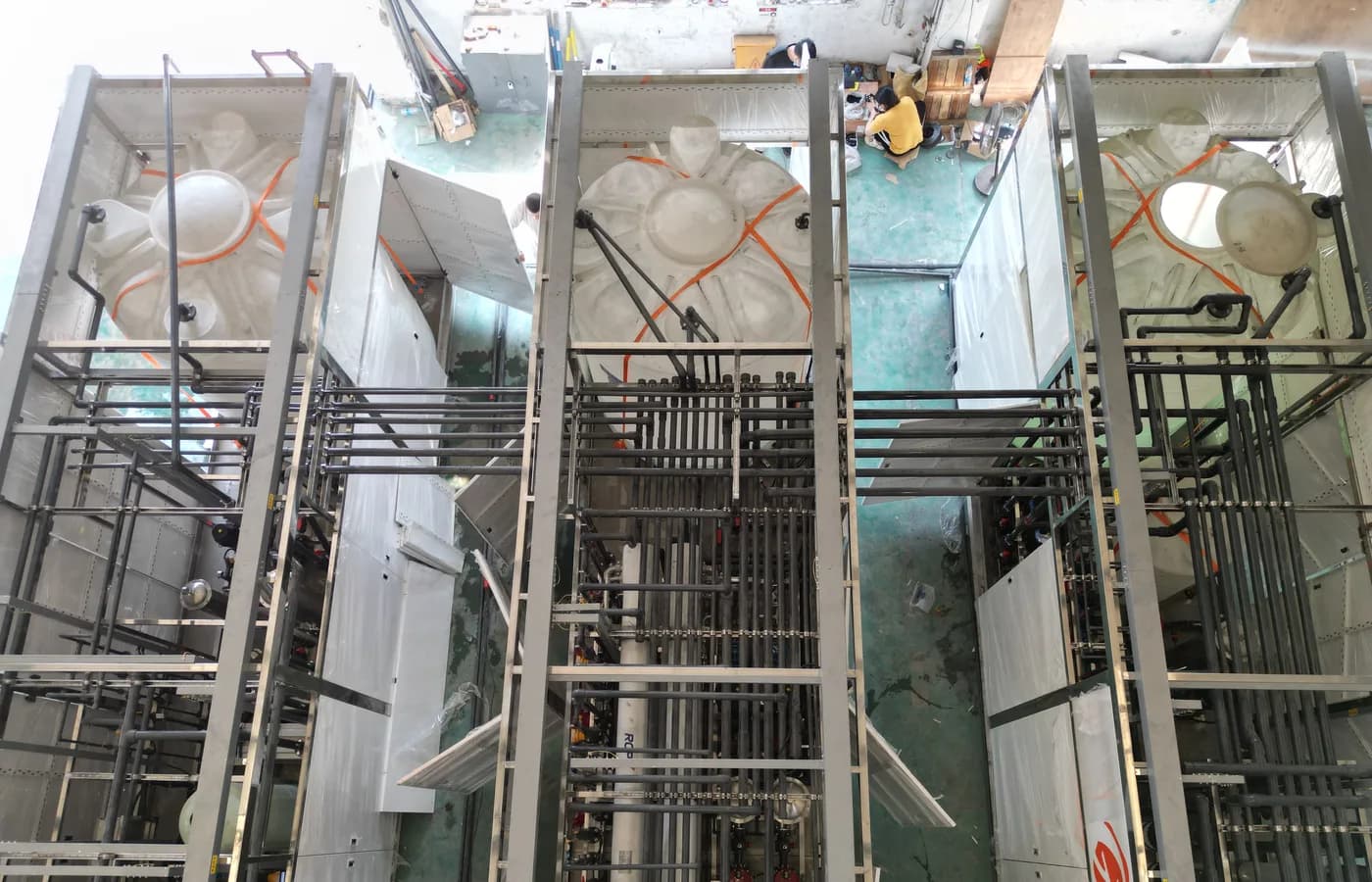
The featured image provides industrial RO equipment context; it is not a detailed drawing of a quoted closure or a promise about a supplied vessel model. Send Baihuipu your membrane arrangement, feed-water analysis, pressure and temperature cases, destination requirements and site layout for a coordinated review. A useful proposal should connect the selected vessel and membrane interfaces to the skid drawing, replacement method and documented acceptance scope before fabrication begins.
Questions buyers commonly ask
Is a membrane pressure vessel selected only by RO feed pressure?+
No. Review the full pressure and temperature envelope, relevant transients, chemical exposure, port limits and manufacturer restrictions. The exact model documentation governs the permitted duty.
Can any element with the same nominal diameter fit the housing?+
Nominal diameter is only a starting point. Confirm element length, product-water tube interfaces, adapters, interconnectors and the installed stack arrangement with the equipment suppliers.
How much clearance is needed for membrane replacement?+
Determine it from the selected housing, closure and element-handling procedure. Show axial extraction space and technician access on the site drawing before approving the rack position.
What should a pressure-vessel quotation include?+
Request the exact model, operating limits, drawings, connection and support details, complete assembly parts, supplied documentation, replacement instructions and a model-specific spare-parts list.
Turn the guide into a project brief.
Final process selection and performance commitments should follow the complete feed-water analysis, application requirements, site utilities and approved technical agreement.