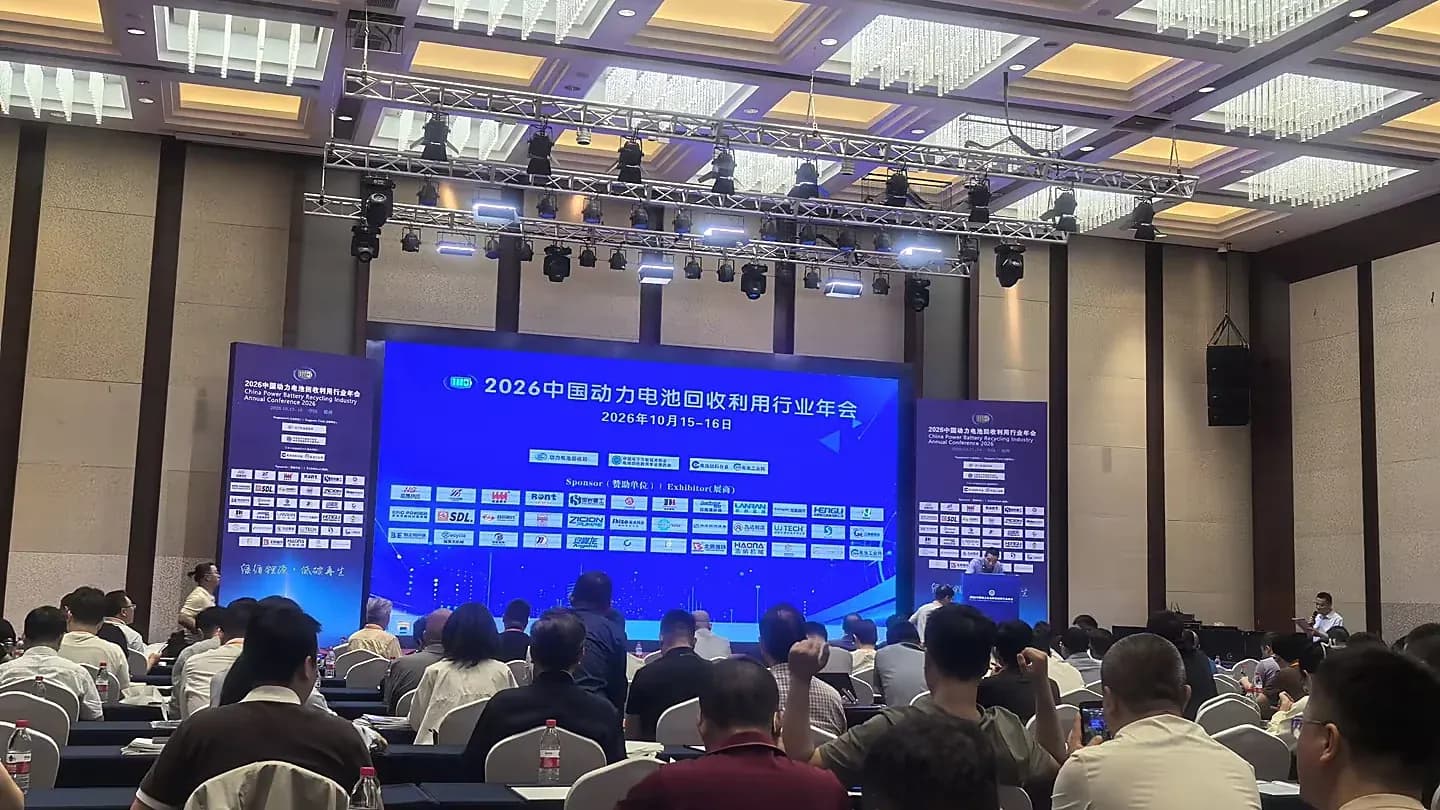
BHP Water Treatment attended the 2026 China Power Battery Recycling Industry Conference in Ganzhou, Jiangxi Province, China, on 15-16 October 2026 and took part in the new member unit plaque presentation held by the Battery Recycling Committee of the China Electronic Energy Saving Technology Association. This page records that participation and sets out the water treatment duties battery recycling projects typically have to resolve: combined metal-bearing effluent, rising salinity, reuse targets and zero liquid discharge requirements.
BHP at the 2026 China Power Battery Recycling Industry Conference
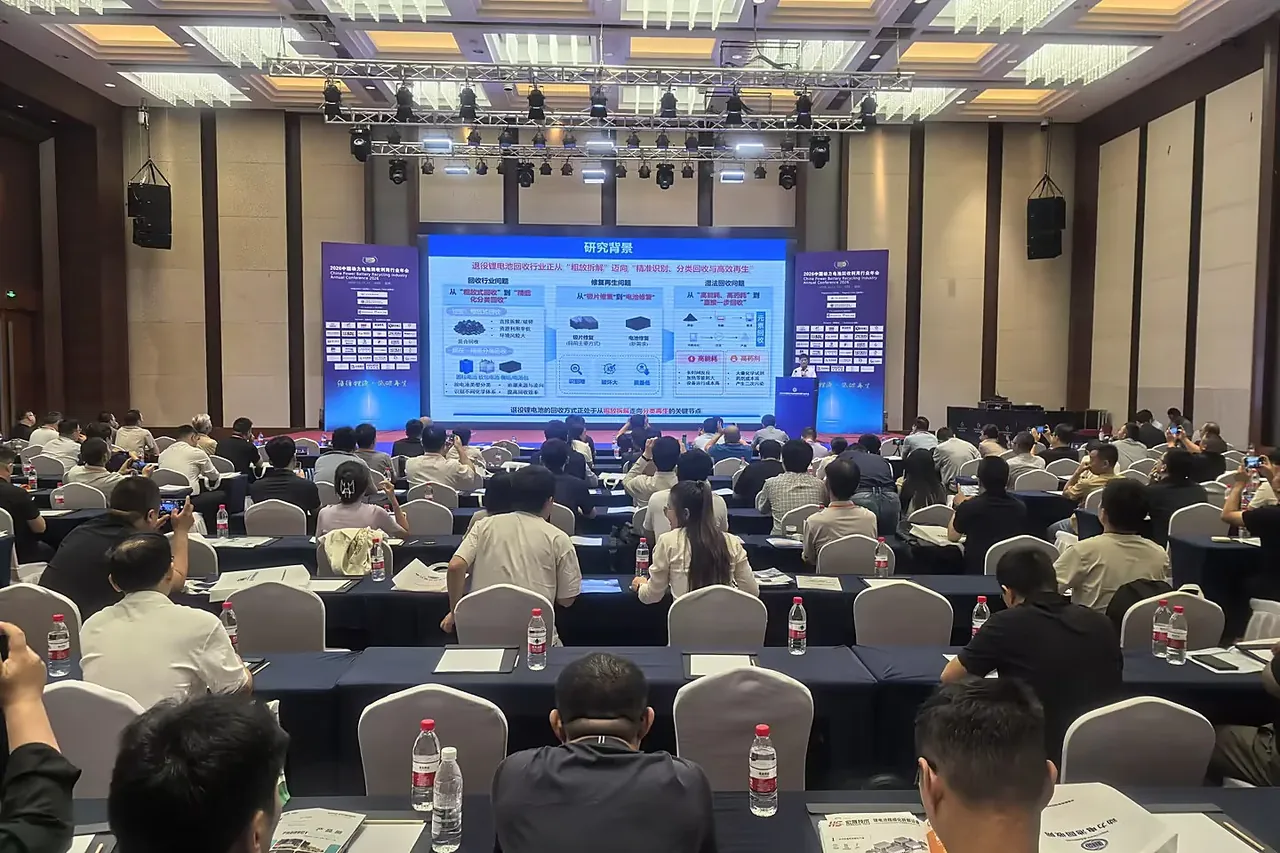
The 2026 China Power Battery Recycling Industry Annual Conference was held in Ganzhou, Jiangxi Province, China, on 15-16 October 2026. It brought together battery recycling operators, lithium battery manufacturers, recycling equipment suppliers, research teams and engineering companies around one subject: how retired power batteries are collected, dismantled and returned to the material cycle as usable raw material.
Guangdong Baihuipu Environmental Protection and Energy Saving Development Co., Ltd., which trades internationally as BHP Water Treatment, took part in the conference. Participation reflects the water-side question that follows every recycling line. Once cathode material, aluminium, copper and electrolyte residues have been separated, the plant still has to decide what happens to the rinse water, the scrubber effluent and the salt-bearing process liquid the line produces.
The program covered power battery recycling, resource circular utilization and green development of the new energy industry. For a water treatment supplier that is not a distant topic. Battery recycling plants combine hydrometallurgical chemistry, chemical dosing and discharge limits within one site, so the water balance is usually where process decisions and environmental obligations meet.
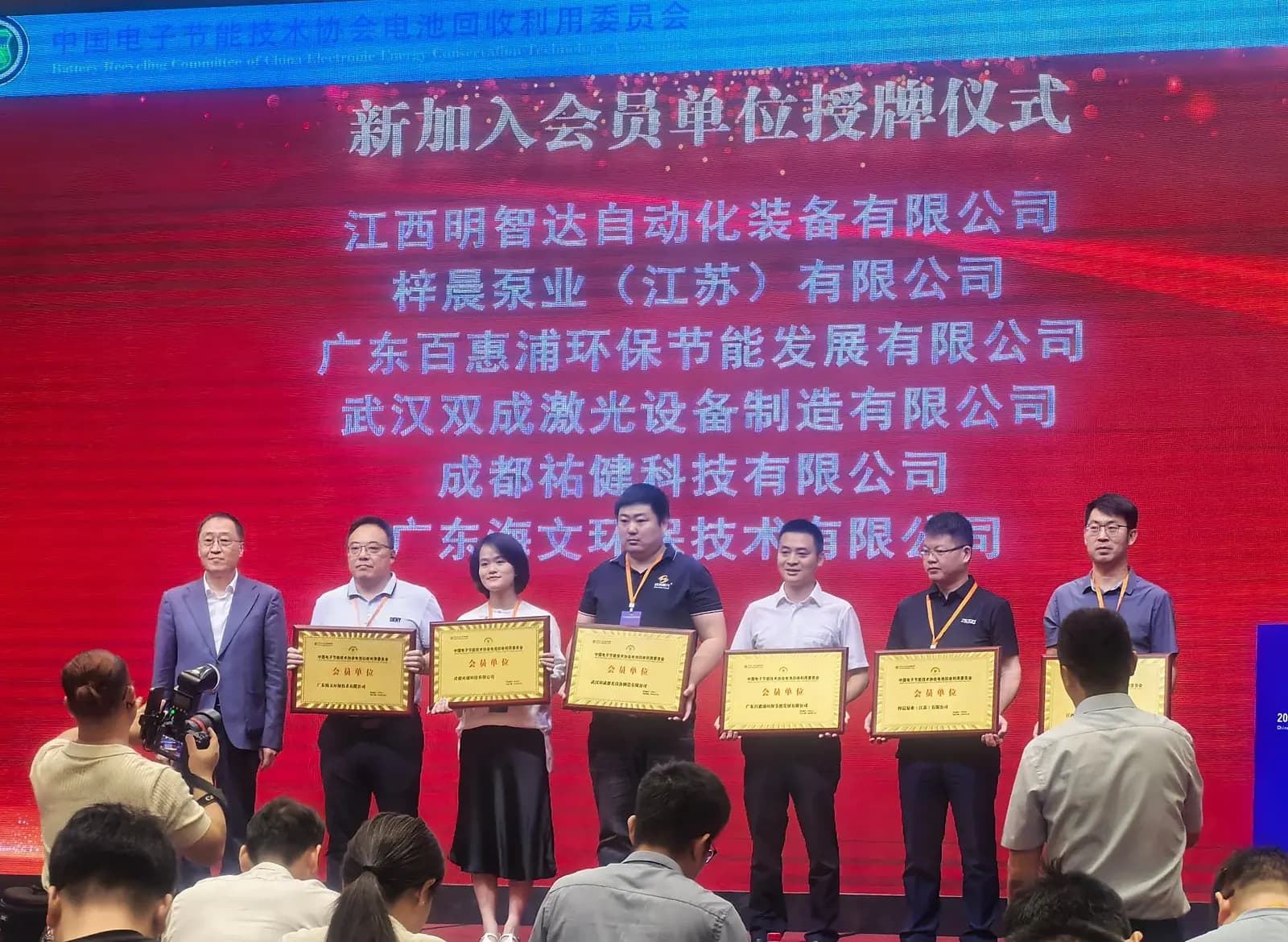
BHP Joins the New Member Unit Plaque Presentation
During the conference, BHP took part in the new member unit plaque presentation ceremony organized by the Battery Recycling Committee of the China Electronic Energy Saving Technology Association. BHP was presented alongside other equipment and technology suppliers serving the battery recycling industry.
Membership places the company inside the industry conversation rather than outside it. Battery recycling routes are still developing, and the effluent profile of a plant changes as separation, leaching and recovery steps are adjusted. Keeping that dialogue open is part of how a supplier stays useful when a client water quality report no longer matches the assumptions made a year earlier.
- BHP attends the 2026 China Power Battery Recycling Industry Conference in Ganzhou, Jiangxi Province, China, on 15-16 October 2026.
- BHP takes part in the new member unit plaque presentation of the Battery Recycling Committee, China Electronic Energy Saving Technology Association.
- No commercial agreement, supply contract or project award is announced in connection with the conference.
Send the feed-water analysis, target quality, required capacity and operating profile. We will help structure the next engineering questions.
Send your project inputsBattery Recycling and Industrial Wastewater Challenges
A battery recycling plant is not one process but a sequence of them: discharging and dismantling, mechanical separation of cathode and anode material, and, on hydrometallurgical routes, leaching, impurity removal and precipitation. Each step leaves its own trace in the water balance.
Effluent is normally combined rather than single-source, because rinse water, scrubber blowdown, laboratory drains and floor washings are often routed to one equalization tank. Metal-bearing fractions have to be separated before the water can be discharged or recovered. Salt content rises steadily wherever acids, alkalis and precipitation reagents are used, and once dissolved solids reach a certain level, biological treatment stops being the controlling step.
Discharge standards add a second constraint. Limits are written per parameter, sometimes per receiving water body or municipal treatment plant, and different parameters peak on different days. Operating targets are therefore fixed from the water quality report and the required discharge standard together, not from a single design assumption.
- Combined streams from dismantling, leaching, rinsing and scrubbing duties
- Metal-bearing fractions that must be separated before discharge or recovery
- Rising salinity where acids, alkalis and precipitation reagents are used
- Water efficiency targets that compete with discharge limits
- Evidence required for stable compliance, not a single passing sample
Industrial Wastewater Treatment Systems
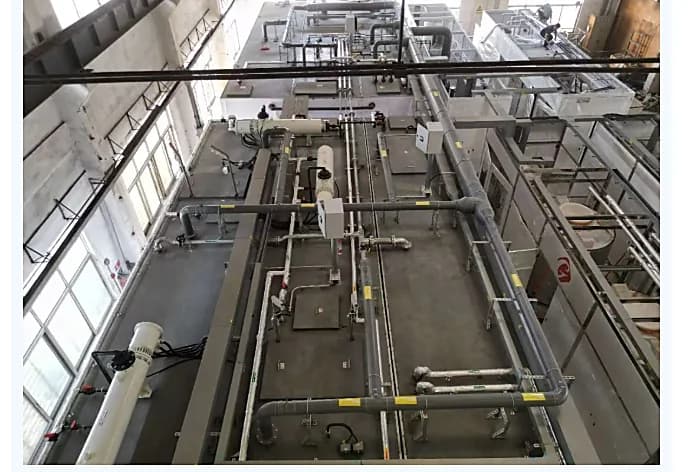
BHP configures industrial wastewater treatment systems around the composition of the effluent rather than a standard package. The first step is normally segregation and equalization: keeping streams that need different chemistry apart, then buffering flow and concentration so downstream units see a stable feed.
Physical-chemical treatment then carries most of the load on battery recycling projects. Chemical precipitation, coagulation and flocculation convert dissolved metals into separable solids, while sedimentation, dissolved air flotation or filtration remove them, and sludge dewatering turns the resulting slurry into a manageable solid stream. Where effluent quality varies widely, a treatability test on a representative sample is a more reliable basis for design than an assumed removal rate. Control instrumentation matters as much as the process train, because pH, oxidation-reduction potential and flow determine whether dosing is applied to the water in front of it or to a setpoint that no longer matches reality.
Lithium Battery Wastewater Treatment, RO and EDI Systems
Lithium battery wastewater treatment covers a wide range of streams, from dilute rinses to concentrated mother liquors, and the correct route depends on where a project sits in that range. BHP works from the actual stream list, the target discharge or reuse quality and the capacity profile the plant operates on.
On the supply side, battery plants often need purified water as well. Reverse osmosis (RO) removes dissolved salts, organics and particles by forcing water through a semi-permeable membrane. Electrodeionization (EDI) then removes residual ions continuously, without the acid and caustic regeneration that mixed-bed ion exchange requires. BHP supplies RO water purification systems, EDI systems and combined RO + EDI arrangements as skid-mounted or integrated units selected per project.
Treating wastewater and pure water scope as one package removes an interface where water quality, drain routing and capacity assumptions tend to disagree.
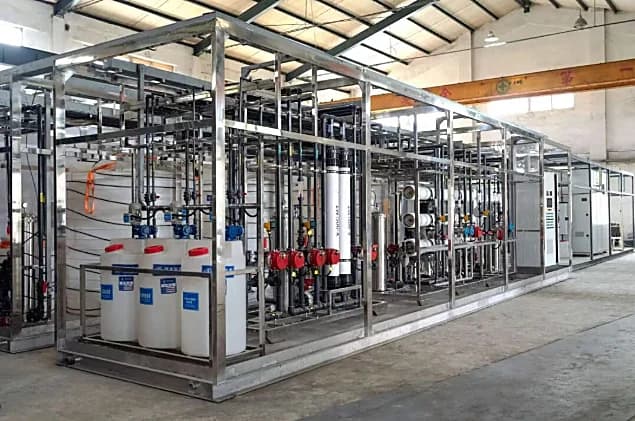
High-Salinity Effluent, MVR Evaporation and Zero Liquid Discharge
Where dissolved solids are high, membrane processes reach their practical limit and evaporation takes over. A mechanical vapor recompression (MVR) wastewater evaporator uses a compressor to raise the pressure and temperature of the vapor released by boiling, then returns that vapor to the heating side of the same unit, so the system recovers most of its own latent heat instead of relying on a separate steam boiler.
For battery recycling projects this matters twice. The condensate is usually clean enough to return to the process as reuse water, which reduces raw water intake, and concentrating the brine produces a salt or mixed-salt stream that can be handled as a solid rather than as liquid waste.
Zero liquid discharge (ZLD) is the design intent that follows from the same logic: instead of discharging liquid effluent, the plant recovers water for reuse and leaves behind dewatered solids. ZLD is a system decision rather than a single piece of equipment, because the evaporation and crystallization duty determines what upstream pretreatment has to achieve.
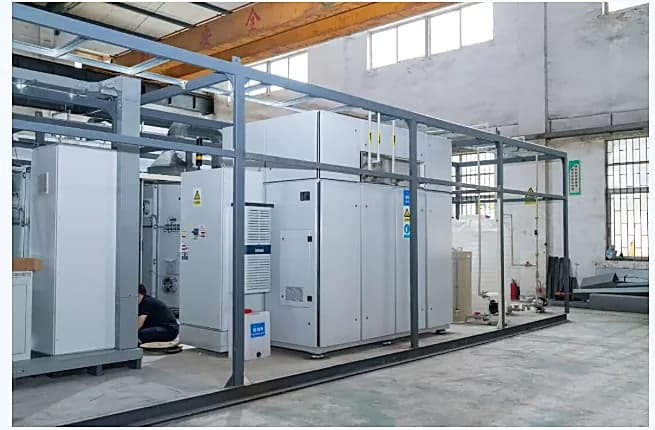
Industrial Water Reuse in Battery Recycling Plants
Industrial water reuse systems move water from one duty to another instead of treating everything to discharge standard. Rinse water from a lower-grade step can often serve floor washing or scrubber make-up after limited treatment, while RO permeate and MVR condensate can be returned to higher-grade duties.
Reuse is assessed around three questions: what quality the receiving duty actually needs, how variable the source stream is, and what the plant will do when the reuse path is unavailable during maintenance. Answering those at design stage is cheaper than answering them with an emergency tanker later.
Industry Engagement and Sustainable Development
BHP participation in the 2026 conference is part of a broader practice of following how the new energy industry environmental requirements develop. Recycling capacity is expanding quickly, and the standards, testing methods and discharge expectations that apply to these plants continue to be revised.
Staying in that conversation has a practical effect on the engineering the company delivers, because assumptions are tested against what plant operators report: which streams are hard to separate, which parameters drift, and which operating targets hold across a full production month rather than a single campaign.
About BHP Water Treatment
Guangdong Baihuipu Environmental Protection and Energy Saving Development Co., Ltd. (BHP Water Treatment) is a water treatment equipment manufacturer based in Dongguan, China. The company supplies industrial wastewater treatment systems, lithium battery wastewater treatment systems, industrial water reuse systems, RO and EDI water purification systems, MVR and low-temperature evaporators, and zero liquid discharge configurations.
The work covers both sides of the battery industry water balance: effluent treatment for manufacturing and recycling plants, and purified water supply for production utilities. Systems are engineered per project from the wastewater source, treatment capacity, water quality report and required standard.
Contact BHP for Industrial Water Treatment Projects
For battery recycling wastewater treatment, industrial water reuse or zero liquid discharge projects, send the following inputs to BHP Water Treatment and the engineering team will come back with the questions that follow.
- Wastewater source, and which streams have to be treated together
- Treatment capacity, with the operating profile if it varies
- Water quality report, including metals, dissolved solids and any parameter of concern
- Required discharge standard, or the reuse water quality target
- Project location, and the site conditions that affect delivery or installation
- Website: https://www.baihuipuwatersystems.com/ | Email: baihuipu003@gmail.com | WhatsApp: +86 13631765076
Questions buyers commonly ask
When and where did the 2026 China Power Battery Recycling Industry Conference take place?+
The conference was held in Ganzhou, Jiangxi Province, China, on 15-16 October 2026.
What did BHP participate in at the conference?+
BHP attended the 2026 China Power Battery Recycling Industry Conference and took part in the new member unit plaque presentation held by the Battery Recycling Committee of the China Electronic Energy Saving Technology Association. No commercial agreement, supply contract or project award was announced in connection with the event.
Why does battery recycling wastewater need dedicated treatment?+
Effluent from battery recycling lines is usually a combination of dismantling, leaching, rinse and scrubber streams, so metals, suspended solids and rising salt content appear together. Treatment routes are therefore selected from the water quality report and the required discharge standard rather than from a single design assumption.
What inputs should be submitted for a battery recycling wastewater enquiry?+
Send the wastewater source, treatment capacity, water quality report, required discharge standard and project location so the treatment route and equipment scope can be assessed.
Turn the guide into a project brief.
Final process selection and performance commitments should follow the complete feed-water analysis, application requirements, site utilities and approved technical agreement.