Condensate polishing should follow a documented assessment of the returned water and the steam-cycle requirement. Specify the contaminants, temperature envelope and protection strategy before selecting a resin package, and keep unacceptable process returns from becoming an assumed polishing duty.
Define which condensate returns are eligible
Map the steam users and returned-condensate sources with their operating schedules. Identify streams that can contact process material and distinguish them from returns whose quality has been demonstrated under the approved monitoring programme. Establish the required feedwater condition with the steam-cycle specialists. A polishing package should have a defined acceptable inlet; it should not be assumed capable of correcting any contamination that a factory may send into the return header.
Agree the response to unsuitable condensate before sizing treatment. Some contamination events may require immediate diversion and investigation rather than continued passage through resin. Identify available storage, return isolation and the destination of rejected water. Keep this decision at the system level, including the effect on makeup-water demand and boiler operation. The polishing enquiry should state which events are within its treatment envelope and which require another plant response.
Characterize ions, solids and process chemicals
Provide analyses that distinguish dissolved ionic contamination, suspended corrosion products and other constituents relevant to the return stream. Include production and startup events, not only a stable normal sample. Identify treatment chemicals and possible process contaminants by actual product and composition where available. Bulk conductivity alone cannot describe every fouling or compatibility risk. Ask the resin and package suppliers which additional information is needed to support the proposed application.
Record the expected temperature and pressure range, flow variation and dissolved-gas or chemistry conditions important to the assessment. DuPont's condensate-polishing input guidance includes application-specific parameters such as amines and corrosion-related solids. That supports collecting a more complete feed description than a simple makeup-water analysis. Do not infer a suitable resin duty from another installation's water purity label; require the proposed design to address the actual returned-water matrix and operating envelope.
Send the feed-water analysis, target quality, required capacity and operating profile. We will help structure the next engineering questions.
Send your project inputsSelect the polishing configuration deliberately
Ask whether the application needs deep-bed ion exchange, a powdered-resin filtration approach or another justified arrangement. These are different configurations with different operating and residual requirements. The proposed process should explain how it handles the identified ionic and particulate loads. Compare alternatives on the same return quality and final requirement, with any pretreatment or downstream duty included. A generic mixed-bed quotation may not describe all of the functions expected by the steam plant.
Request the selected resin grades, ionic forms, inventory and technical basis. Review the relationship between cation and anion duties and the chemistry used in the cycle. Manufacturer condensate guides discuss specialized resin choices, which is a reason to obtain application support rather than assume a standard ambient-water resin is interchangeable. Ask suppliers to identify assumptions and limitations clearly, including where the available operating history is insufficient to establish a defensible cycle estimate.
Check thermal and chemical compatibility
Evaluate the complete temperature envelope against the selected resins and every contacted component. Include startup, abnormal returns and any proposed cooling or bypass arrangement. Temperature limits depend on the actual product, chemical form and application conditions; do not publish or procure against a universal resin temperature rule. Obtain manufacturer-supported requirements and state how the design prevents operation beyond the approved envelope when the return-stream condition changes.
Review oxidants, oil, organics and other possible foulants with the resin supplier. Determine which are allowed, which need monitoring and which require diversion. A resin's ionic capacity does not establish resistance to an unrelated contaminant. Include cleaning and regeneration chemicals in the materials review. If cooling is required, account for its utility demand, integrity and effect on the site's energy recovery, rather than adding a heat exchanger as an unpriced assumption outside the package boundary.
Account for corrosion solids and hydraulics
Request the basis for handling particulate loading, including pressure-drop development and any cleaning or backwash sequence. Startup corrosion products may create a different duty from normal steady operation. Provide available plant data and identify uncertainty. Ask the supplier how the design distinguishes increasing solids restriction from ionic exhaustion. Different observations can call for different actions, so the operating philosophy should not force every loss of service into the same regeneration response.
Specify flow distribution, retention components and the pressure conditions of the installed return path. Review the effect of taking one unit out of service and the ability of the remaining system to support operation. Include the consequence of unintended media carryover and how the selected arrangement manages that risk. Draw relevant isolation, sampling and bypass connections. A process balance and nominal vessel size cannot establish the detailed hydraulic protection of a connected condensate system without those interfaces.
Make breakthrough and diversion decisions specific
Identify the measurements that represent the required steam-cycle water condition, using the owner's chemistry basis. Conductivity, selected ionic analysis and particulate observations can have different roles. Define sample systems and method capability for the actual temperature and concentration range. A trend is useful only if it represents the water and arrives in time for the intended decision. Include instrument quality, stale values and maintenance states in the control interface.
Write separate responses for gradual exhaustion, suspected process contamination and unavailable analysis. Identify which events switch duty, trigger regeneration or divert the return stream. Determine where potentially affected water is located when a result becomes available and what can be done with it. An automatic valve command cannot retrieve water already delivered to the cycle. The approved strategy should account for timing and storage rather than imply that any analyzer and diversion valve combination guarantees protection.
Define regeneration and residual responsibilities
Compare in-place and external regeneration or replacement approaches against the selected configuration and site arrangements. Request the full chemical, water and waste scope, with responsibilities assigned to the supplier or owner. Include separation and handling requirements where the chosen mixed-bed process depends on them. Service-cycle claims should be supported by the stated feed and regeneration basis; a fresh-resin trial does not establish recurring operation without adequate evidence of restoration and rinse quality.
Specify where regeneration waste, backwash water and rejected condensate go. Review both composition and intermittent flow with the receiving system. Include transfer equipment, holding capacity and return-to-service checks. If an off-site service is proposed, confirm logistics, spare inventory and the quality documentation supplied with replacement media. Compare quotations on the complete recurring process so a low equipment price does not omit the chemical handling or external support needed to keep the polishing duty available.
Set acceptance and prepare the enquiry
Agree mechanical inspection, functional tests and process acceptance as separate deliverables. Verify media identity, flow paths, monitoring and diversion before returning water to the protected cycle. Demonstrate required quality and hydraulic duty under representative conditions with records of inlet composition and temperature. Send Baihuipu the return-source map, contamination history, chemistry programme, operating envelope and residual destinations so the proposal can identify remaining trials and any duty that requires separate treatment.
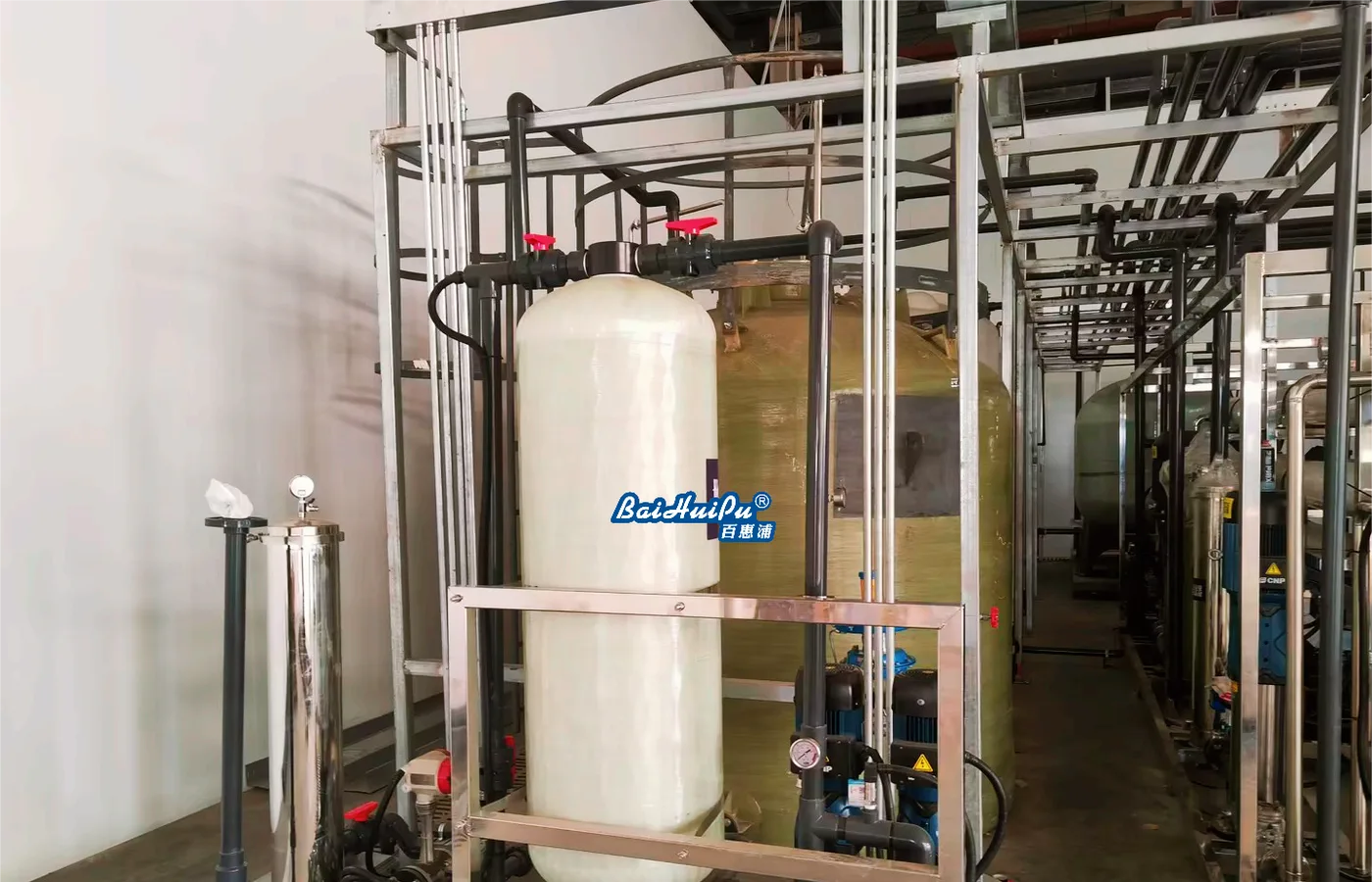
The photograph shows industrial treatment vessels and storage as context; it does not identify a condensate polisher or document a steam-cycle result. Confirm the actual offer with resin specifications, approved drawings and acceptance evidence. The related EDI comparison concerns another polishing decision, while evaporator condensate reuse has different contamination mechanisms. A complete purchase respects those distinctions and defines which returned water can be polished, which must be rejected and how the package remains operable between service cycles.
Questions buyers commonly ask
Is all returned condensate suitable for polishing?+
No. Define an acceptable feed envelope and divert contamination that the selected process cannot reliably handle.
Can ambient makeup-water resin be substituted automatically?+
No. Verify the actual resin grade, ionic form, temperature and chemical compatibility with the manufacturer.
Does ionic exhaustion explain every pressure-drop increase?+
No. Corrosion solids and other fouling can create a different hydraulic limitation and require a different response.
Is MVR condensate reuse the same design duty?+
No. Define the actual source and contamination mechanisms; steam returns and evaporator condensate can require different treatment boundaries.
Turn the guide into a project brief.
Final process selection and performance commitments should follow the complete feed-water analysis, application requirements, site utilities and approved technical agreement.