Adding moving biofilm carriers to an industrial wastewater tank is a process retrofit with hydraulic, aeration and solids interfaces. Evaluate the biological duty and the existing structure before purchasing media volume or treating a carrier surface-area figure as guaranteed capacity.
State the retrofit objective before selecting carriers
Identify the load that the existing plant cannot reliably treat and the condition required after the proposed biological stage. A retrofit might address biodegradable organics, ammonia conversion or another defined duty, but those goals require different supporting evidence. Do not specify carrier volume before deciding what the retained biofilm is expected to do. Include seasonal flow, temperature and production changes that explain the current limitation rather than relying on one average plant analysis.
Map the existing treatment train and available tank functions. An equalization tank already performing essential buffering may not be available for conversion without replacing that duty elsewhere. Review the effect on storage, downstream loading and site operating flexibility. Ask the supplier to define the proposed biological boundary and identify other modifications needed to make it workable. The purchase should describe an integrated upgrade rather than an isolated delivery of plastic media to an unsuitable tank.
Establish biological suitability and loading evidence
Veolia describes MBBR as a process where biofilm grows on carriers suspended in wastewater. That mechanism explains the importance of carrier motion and biomass condition, but does not establish capacity on a new industrial stream. Provide chemical inventories and evidence of biodegradability or inhibition. Include the cleaning products and intermittent discharges that could reach the tank. A carrier manufacturer's application list cannot replace an assessment of those actual constituents.
Request a trial or justified design assessment covering the proposed treatment objective and temperature envelope. Record the seed or startup strategy and the conditions under which the evidence was obtained. If ammonia conversion is the objective, explain the supporting oxygen, alkalinity and inhibition assessment. Distinguish conversion of ammonia to other nitrogen species from complete nitrogen removal. The final process diagram should identify any additional stage needed to meet the owner's actual outlet requirement.
Send the feed-water analysis, target quality, required capacity and operating profile. We will help structure the next engineering questions.
Send your project inputsCompare carrier claims on the same basis
Ask which surface-area definition is being quoted and how it relates to the proposed biological loading basis. Nominal total area, protected area and effective application performance are different concepts. Request the specific carrier grade, dimensions, material and approved handling instructions. Compare media inventory and proposed filling fraction with tank hydraulics and retention design. A larger catalogue area figure alone is not a defensible way to select between retrofit proposals.
Identify how media quantity is measured at delivery and how the installed inventory is documented. Include storage, transfer and commissioning requirements so carriers are not damaged or lost before operation. Ask whether the proposed grade has restrictions related to temperature, chemical exposure or maintenance procedures. Preserve media identity and spare requirements in the handover package. This makes subsequent replacement review possible and prevents an apparently similar carrier substitution from silently changing a reviewed process design.
Survey the existing tank and hydraulic path
Obtain dimensions, levels, structural information and the location of all inlets, outlets, drains and overflow routes. Review how these interfaces behave at peak flow and during a power loss. Existing drawings may omit a bypass or an unused penetration that could release carriers. Survey the installed arrangement before finalizing the retrofit. Coordinate any structural modification with the responsible discipline rather than assuming a process vendor's media proposal verifies the tank construction.
Review short circuits, dead zones and the position of aeration or mixing equipment. The design must keep the selected carrier inventory moving as intended throughout the operating range. Reduced-load conditions can be as important as maximum flow. Ask for the technical basis behind the mixing arrangement and a practical site demonstration plan. Include maintenance access and drain-down provisions so the tank can be isolated and serviced without an uncontrolled release of media or wastewater.
Engineer carrier retention and screen maintenance
Provide retention devices at every relevant outlet and escape route, including abnormal water levels and maintenance connections. Request screen geometry, material, allowable hydraulic conditions and the basis for its openings relative to the selected carriers. Review resistance to damage and the effect of blocked surfaces. Retention is not complete merely because a screen appears on the normal outlet drawing; walk through overflow, bypass and drain states with the site operating team.
Specify how screens are inspected and cleaned while preserving treatment continuity. Identify instrumentation or observations that warn of rising restriction and the response before a level upset occurs. Include access, lifting requirements and spare components. If carriers must be removed for a task, define temporary storage and return procedures. A reliable retrofit needs an achievable maintenance sequence; asking operators to clear a submerged screen without suitable isolation leaves a significant part of the supply unresolved.
Coordinate oxygen transfer and carrier movement
Separate biological oxygen demand from the energy required to maintain appropriate carrier motion. The same air system may contribute to both, but the governing condition can change with load and operating state. Ask the supplier to state its assumptions about diffuser arrangement, depth, wastewater characteristics and available blower pressure. Review turndown and the response to unavailable equipment. Nameplate blower flow alone does not show that the installed tank will receive the required process conditions.
Confirm that dissolved-oxygen measurement is representative and accessible for maintenance. Define how instruments are checked and how control responds to unreliable signals. Include the effect of fouling or changing wastewater properties on the proposed aeration strategy. Where existing blowers are reused, obtain actual operating information rather than assuming their original duty remains available. State any limitations clearly so the retrofit does not depend on unverified utility capacity or an unsupported claim of reduced energy use.
Keep downstream solids capacity in scope
Biofilm growth and sloughing create solids that must be handled beyond the reactor. Identify the downstream separation route and evaluate its ability to receive the changed load. An MBBR does not inherently deliver membrane-filtered water. If clarification or filtration is added, include its hydraulic and solids assumptions in the same review. Ask how downstream performance will be monitored during startup and load transitions, when the solids behaviour may differ from the established baseline.
Account for sludge transfer, storage and dewatering, including returned liquors. Review whether the upgrade shifts the limiting duty from biological treatment to a downstream clarifier or sludge system. A process balance should show both acceptable water and residuals. Compare proposals using the capacity of the whole modified train rather than a reactor-only loading statement. This makes it possible to identify enabling works before purchasing media that cannot be used effectively within the existing plant.
Plan commissioning and prepare the enquiry
Agree the installation outage, initial carrier loading, startup support and the evidence required before acceptance. Demonstrate retention, mixing and functional controls separately from biological performance. Process acceptance should use a defined feed envelope, appropriate stabilization and documented sampling. Retain operating records and identify unresolved seasonal conditions. Send Baihuipu the tank survey, current treatment results, production history and downstream constraints so a proposed upgrade can be assessed against the real plant boundary.
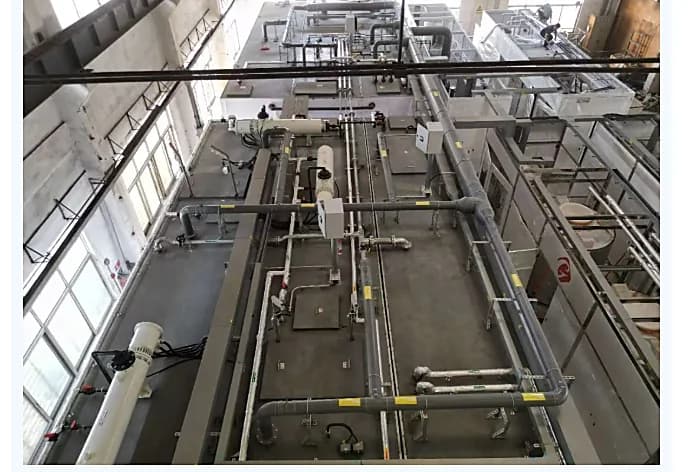
The photograph illustrates industrial wastewater equipment as context; it does not show biofilm carriers or document an MBBR outcome. Confirm the offered carrier and retrofit scope through drawings, product records and trial evidence. A useful enquiry asks which existing duties must change and how the modified plant will be maintained. This helps the buyer compare an operable biological upgrade with the simpler commercial appearance of purchasing media volume alone.
Questions buyers commonly ask
Is an MBBR outlet equivalent to MBR permeate?+
No. MBBR effluent contains solids that require an appropriate downstream separation strategy.
Does carrier surface area alone establish retrofit capacity?+
No. Biological suitability, loading, temperature, oxygen conditions and hydraulics must support the proposed duty.
Must overflow and drain paths retain carriers?+
Review every relevant escape route and operating state, including maintenance and abnormal levels.
Can an equalization tank simply become an MBBR?+
Only after reviewing the biological design, structure and hydraulics, and replacing any essential buffering duty that would be lost.
Turn the guide into a project brief.
Final process selection and performance commitments should follow the complete feed-water analysis, application requirements, site utilities and approved technical agreement.