A streaming current monitor can support coagulation control when its sample and baseline represent the actual treatment process. Treat it as a specific process signal with defined limits, alongside jar tests and downstream observations, rather than a universal coagulant-dose calculator.
Define the control problem and evidence needed
Identify whether the project needs detection of changing coagulation conditions, assistance with operator adjustment or bounded automatic chemical control. These uses require different commissioning evidence. Describe the feed variation and the observed treatment problem before choosing the instrument. A streaming current signal is one observation of the sampled process; it does not directly report the complete removal performance of the downstream clarifier or flotation stage. Retain those outlet requirements as separate acceptance criteria.
List the coagulants, polymers and conditioning chemicals in the proposed train, with injection locations and mixing arrangements. Include changes between production campaigns and any feed that may be unsuitable for the selected instrument. Ask the supplier to explain the signal's intended relationship to the site's chemistry. Avoid adopting a universal target simply because a familiar numerical display appears in another installation. The baseline must be established for the actual application and its operating objective.
Check suitability on representative industrial water
Provide suspended material, pH, conductivity, organic loading and process-chemical information relevant to the proposed method. Ask which conditions can influence the signal or foul the measurement system. Industrial wastewater may differ substantially from the cleaner water used in some published instrument examples. Request a representative trial where that difference creates uncertainty. Keep the trial's sample preparation and any exclusions visible, so a successful bench demonstration is not extended beyond the conditions it actually examined.
Use parallel observations to establish whether signal changes track useful treatment decisions. Record jar tests, chemical settings and downstream water condition at matched times. Identify periods when the signal behaves differently and investigate the operating context. The objective is not to force every result into an assumed relationship; it is to establish where the measurement can support control and where another operating response is needed. Document those boundaries before enabling automatic dose adjustment.
Send the feed-water analysis, target quality, required capacity and operating profile. We will help structure the next engineering questions.
Send your project inputsSelect the sampling location with the process team
Locate the sample relative to chemical injection and mixing, using the instrument manufacturer's guidance for the application. Mark the point on the process diagram and explain what reaction state it represents. Samples taken before adequate mixing or after an uncontrolled delay can tell a different story from the intended control boundary. Ask how the proposed location will behave at both maximum and reduced flow, particularly when mixing energy or process residence changes.
Review sample-line length, materials, flow control, drainage and access for cleaning. The path should deliver a representative sample without selectively losing or accumulating the material being measured. Include a practical indication of sample availability and a response when flow stops. If conditioning is proposed, ask how it affects the measured property. Treat the sample panel as part of the instrument scope rather than assuming any hose connected during commissioning will remain suitable for routine plant control.
Establish a defensible operating baseline
The Hach instructions relate baseline adjustment to an independently established coagulation condition, including jar-test or other appropriate evidence. This supports a commissioning approach in which the instrument follows a demonstrated process state; it does not supply a transferable dose or numerical target. Agree how baseline conditions will be selected, who approves them and which downstream observations confirm they are useful. Preserve the raw signal and operating context before applying a display offset.
Repeat baseline assessment when the feed or chemical programme changes materially. A new coagulant, pH regime or production mix may alter the useful relationship. Record the reason, author and date of every baseline change so the trend remains interpretable. Avoid routine adjustment merely to make the display look normal during a treatment upset. Operators should investigate whether the process changed or the measurement became unreliable before redefining the condition that the controller is trying to maintain.
Bound automatic dosing and coordinate other loops
Describe how the streaming current signal will influence chemical feed and identify independent limits on that command. Include pump capacity, flow proportionality and any relevant minimum or maximum approved operating setting. Review the interaction with pH control and polymer addition rather than allowing separate loops to respond to the same disturbance without coordination. The control narrative should identify which variable each loop governs and how operators recognize a conflict between them.
Account for transport and reaction delay when selecting control behaviour. A command can affect the sampled result only after the changed dose travels through the process. Aggressive adjustment based on a delayed signal may create instability. Require a commissioning method that verifies response under representative flow and chemistry. Keep automatic operation bounded by approved conditions, with a defined manual or fallback state when the signal, sample or other essential process measurement becomes unavailable.
Keep downstream quality as an independent check
Monitor the treated-water conditions that matter to the next stage, using suitable methods and representative sample points. A stable charge-related signal cannot prove acceptable suspended solids, dissolved contaminants or every reuse requirement. Include observations of floc and solids separation where they support diagnosis. When outlet quality deteriorates despite a stable signal, operators need a defined investigation path rather than an assumption that the downstream result must be wrong.
Retain time-aligned records of inlet conditions, chemical commands, instrument signal and outlet measurements. Note sampling and process delays so comparisons represent the same operating event. Use those records to refine the justified operating envelope and maintenance response. Do not claim a universal reduction in chemical consumption from installing the instrument. Any commercial benefit must be established from the site's own comparable data, with production and feed variation accounted for in the interpretation.
Specify cleaning and invalid-signal handling
Ask for the full maintenance procedure, replaceable parts and accessible inspection points. Discuss fouling modes expected from the actual solids and chemicals. Define how cleaning mode and unstable recovery are communicated to the PLC. A signal can remain numerically plausible while the sample or sensing mechanism is unsuitable. Diagnostics and operating observations should help distinguish that condition from a genuine process change that requires chemical adjustment.
Demonstrate sample interruption, failed communication, cleaning, restart and manual control during acceptance. Confirm what the chemical feed does in each state and how a valid measurement is restored. Include operator permissions for baseline changes and bypasses, with visible indications and an audit record where the project requires them. The supply should include enough documentation and training for the owner to maintain the established relationship after the instrument supplier's commissioning specialist leaves the site.
Prepare a coagulation-monitoring enquiry
Send Baihuipu the chemical programme, mixing diagram, feed analyses, flow profile and available jar-test records. Include the downstream acceptance requirement and the intended degree of automation. Request a representative suitability assessment, sampling package, baseline procedure and bounded control narrative. Use the related flotation guide to review the separation stage that receives the conditioned water, while retaining the distinct role of pH measurement and neutralization where those functions are needed.
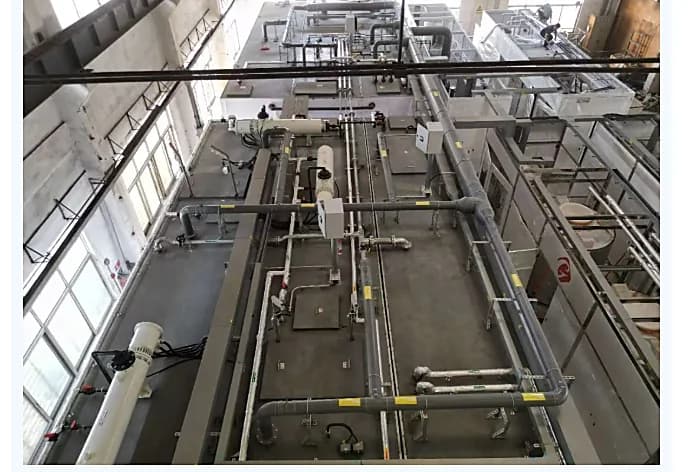
The featured photograph shows industrial wastewater equipment as context; it does not depict a streaming current monitor or prove optimized coagulation. Confirm the actual measurement package and control scope through drawings, trials and acceptance records. A useful purchase establishes when the signal is representative, how its baseline is justified and which independent observations confirm the treatment outcome. Those boundaries let the instrument support operators without hiding process uncertainty behind a stable display.
Questions buyers commonly ask
Does a streaming current value directly measure removal efficiency?+
No. Verify downstream treatment quality independently using the required process measurements.
Can a baseline be copied from another plant?+
No. Establish and document a baseline against representative chemistry and independent coagulation evidence.
Why consider sample and process delay?+
The controller responds to water affected by an earlier chemical command; unaccounted delay can destabilize adjustment.
Should baseline changes be recorded?+
Yes. Preserve the reason, operating conditions and authorization so later trends and control decisions remain interpretable.
Turn the guide into a project brief.
Final process selection and performance commitments should follow the complete feed-water analysis, application requirements, site utilities and approved technical agreement.