Electrodialysis reversal is a candidate for selected brackish-water and reuse duties where removal of dissolved ions is the main objective. Compare it with RO using the required product composition, feed envelope and waste route, while making electrical and reversal controls part of the purchase scope.
Define the product ion requirement first
Begin with the receiving process and its allowable ionic composition. Record required flow, temperature, conductivity and individual constituents that affect the application. A total dissolved solids target is useful for a preliminary comparison, but it may conceal a controlling limit for chloride, sulfate, hardness or another species. Ask the process owner to approve the actual release specification before requesting a desalination proposal, so all bidders evaluate the same delivered-water requirement.
Distinguish ionic removal from removal of particles, microorganisms and uncharged organic compounds. EDR is not a universal barrier to every contaminant in a reuse stream. List constituents requiring separate treatment and show where those barriers sit in the process. If the final application needs high-purity polishing, assess that downstream stage independently. A proposal can meet a conductivity target and still miss an important quality condition that conductivity does not describe.
Understand the electrical separation boundary
Electrodialysis uses an electrical driving force to move ions through alternating selective membranes, producing a more dilute stream and a more concentrated stream. Reversal changes the electrical and hydraulic operating arrangement as specified by the equipment design. Veolia describes this technology for brackish-water desalination and selected industrial reuse applications. Those principles establish a candidate route; they do not establish recovery, energy use or product quality for a new factory's water.
Request a process description identifying stack arrangement, power supplies, product and concentrate circuits and any electrode-rinse interfaces. Require the proposed vendor to explain where each stream goes during normal operation and reversal. Avoid confusing EDR with EDI, which serves a different polishing duty and uses a different internal process arrangement. A clear diagram makes it possible to compare equipment scope and identify utilities that a simplified sales illustration may leave outside the quoted package.
Send the feed-water analysis, target quality, required capacity and operating profile. We will help structure the next engineering questions.
Send your project inputsCharacterize feed variability and limiting constituents
Supply complete ionic analyses for representative feed conditions, with pH, temperature, conductivity and relevant nonionic contaminants. Describe suspended solids, organics, oil and residual chemicals that could affect the selected stack. Identify the origin of variability: changing wells, process batches or upstream treatment sequences. Ask for explicit feed exclusions and a review of scaling and fouling risks. Reversal should not be interpreted as permission to ignore pretreatment or operate beyond approved membrane conditions.
Review the worst credible feed cases rather than an average laboratory sample alone. Request calculations or trials showing how product quality changes across those cases and what controls respond. If a specific ion is the purchasing driver, require its result in the assessment instead of inferring it from overall desalination. Record the assumptions behind any model and define which uncertainties need pilot evidence. This gives the project a practical basis for selecting the next engineering step.
Compare RO and EDR on a common basis
Set a common feed analysis, product-water boundary, available utilities and concentrate destination. Compare alternatives using net acceptable product over the same operating schedule. Include pretreatment, cleaning, off-specification diversion and maintenance in that balance. Neither a membrane-area comparison nor an isolated equipment recovery figure establishes the better project route. Ask each supplier to show assumptions and exclusions so a lower quoted package price is not simply a smaller treatment scope.
For operating cost, request the electrical, chemical, consumable and labour basis over the same scenarios. Distinguish installed power from actual consumption and identify which auxiliary pumps or systems are included. Avoid universal claims that one technology is always cheaper or more tolerant. Local feed, required desalination, waste charges and uptime requirements determine the comparison. Where uncertainty could change the purchase decision, compare a bounded trial programme with committing immediately to a full-size system.
Specify concentrate and auxiliary streams
Prepare a water and salt balance showing product, concentrate, flushing, cleaning and other relevant discharges. Identify whether the concentrate is recycled internally or leaves the package and what limits apply at its destination. Include the effect of treatment chemicals and cleaning residues where relevant. A high reported water recovery is not useful if the receiving waste system cannot accept the resulting stream or if a hidden purge is omitted from the proposal.
For electrode-rinse and other auxiliary circuits, require the vendor's approved arrangement, utilities and operating procedures. Ask how chemical supply, ventilation, drains and maintenance access are addressed for the selected equipment. These interfaces should be designed by the responsible engineering team, with the manufacturer's requirements visible in the scope. Do not prescribe a generic auxiliary arrangement based on a different stack. The purchase needs a complete boundary drawing and a list of site responsibilities.
Verify reversal and quality diversion controls
Request a control narrative covering normal separation, reversal, start-up, shutdown and recovery from a failed sequence. Identify which valves move, how their positions are confirmed and when product may be released. Any transition that can send unsuitable water toward the receiving process needs a defined monitoring and diversion response. The vendor should explain how the sequence handles missing signals, interrupted power and a valve that does not reach its required position.
Test the complete quality decision using the actual instruments and destination valves. A correct conductivity display does not prove that off-specification water is routed correctly. Record signal validity, response delays and release conditions. Include the plant's supervisory system and operator alarms where they form part of the protection arrangement. Agree which tests are demonstrated in the factory and which require site water, while keeping the results traceable to the approved cause-and-effect document.
Build a practical maintenance and trial scope
Review stack access, electrical isolation, service space and the method for replacing approved components. Request a spares and consumables list with availability at the installation location. Define what process data the supplier needs for troubleshooting and which records the operator must retain. Maintenance planning belongs in the purchase decision because an apparently compact package may require working space or lifting access beyond the equipment outline shown on a sales drawing.
Where a pilot is needed, specify feed representation, run duration, analytical methods and transition tests. Record product and concentrate quality, utilities, cleaning events and unavailable periods. State how a changed feed affects interpretation of the trial. Do not convert a limited demonstration into a guarantee for untested process wastewater. The deliverable should identify demonstrated conditions, unresolved risks and the additional work required before a commercial performance commitment can be evaluated.
Prepare an EDR route-assessment enquiry
Send Baihuipu the feed analyses, product ion limits, demand profile, existing treatment diagram and concentrate disposal constraints. Request an assessment identifying whether EDR merits specialist evaluation alongside RO and other routes. Ask for clear responsibilities for stack supply, integration, power, controls and testing. Keep technology suitability separate from claims about a supplier's installed references unless those records are actually provided and verified for the proposed application.
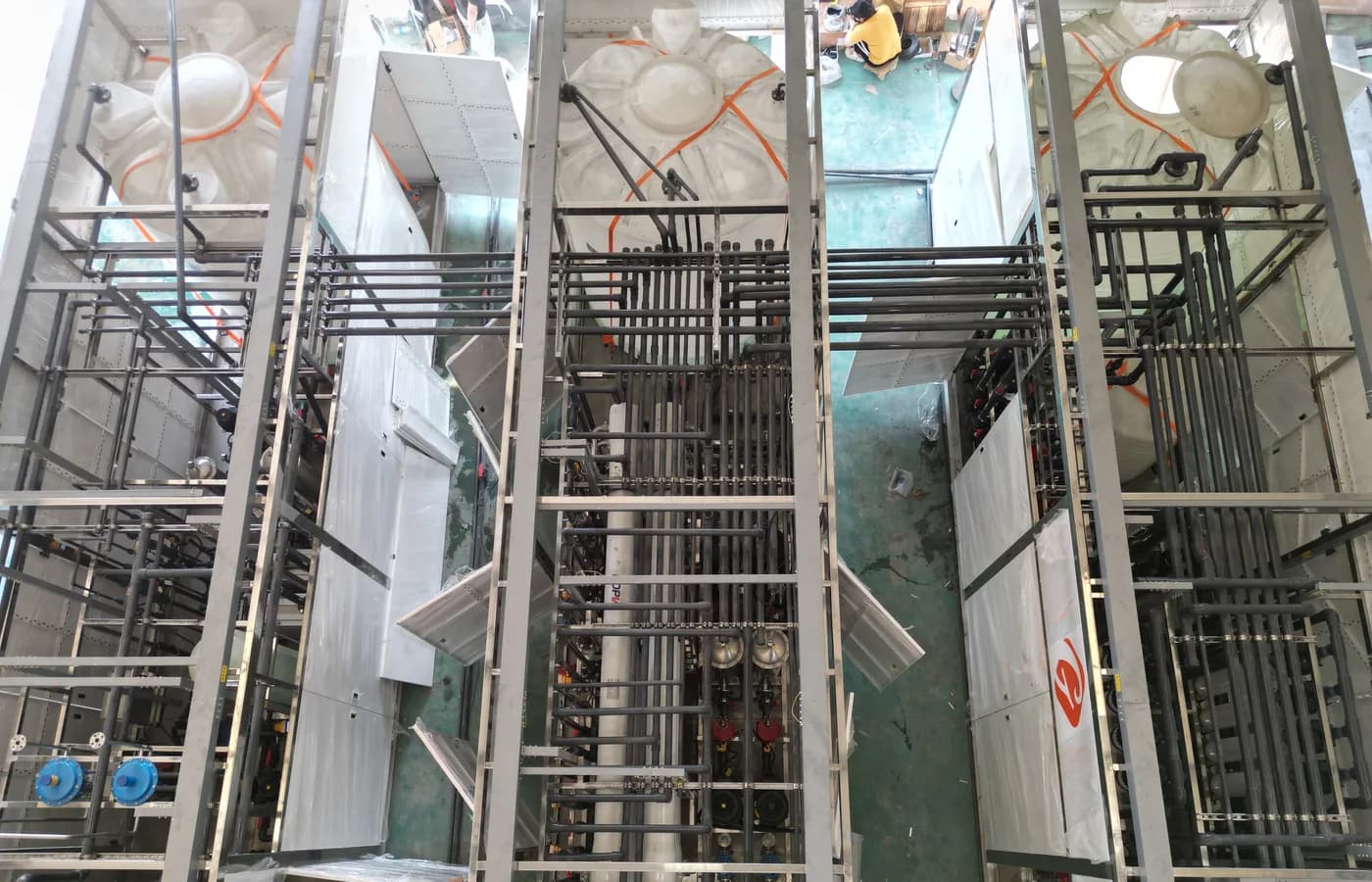
The featured photograph illustrates industrial treatment piping and equipment; it does not identify an EDR stack or prove an EDR installation. Use the linked reuse and nanofiltration articles to frame adjacent process choices without treating them as interchangeable technologies. A useful enquiry makes ion targets, operating transitions and waste boundaries explicit. That allows competing routes to be compared on delivered duty, with assumptions visible and site-specific performance left to engineering evidence.
Questions buyers commonly ask
Is EDR the same as EDI?+
No. EDR is an ionic desalination route with reversal operation; EDI is generally used for high-purity polishing under different feed requirements.
Will EDR remove all organic contaminants?+
Do not assume that. Identify nonionic and other contaminants requiring separate treatment and acceptance measurements.
Does reversal eliminate pretreatment?+
No. Define feed requirements and fouling risks for the selected stack and provide appropriate upstream protection.
What should be compared when choosing EDR or RO?+
Use the same feed envelope, product specification, operating schedule, net water balance, waste route and total equipment boundary.
Turn the guide into a project brief.
Final process selection and performance commitments should follow the complete feed-water analysis, application requirements, site utilities and approved technical agreement.