An industrial nanofiltration system should be purchased against a required ion profile, not a general promise of softer water. The useful engineering question is which constituents must be reduced, which may remain and what happens to the concentrate. Separate hardness and sulfate targets make competing membrane proposals easier to evaluate.
Define the selective separation duty
Write a table for the feed, required permeate and downstream use point. List calcium, magnesium, sulfate, alkalinity, sodium, chloride and any process-specific contaminants separately. State concentration units and whether hardness is reported as calcium carbonate. A conductivity limit alone cannot describe the distribution of these ions. A factory may accept some dissolved salts while needing a tighter limit on a particular scale-forming constituent, but that decision must come from the process owner.
Identify whether the treated water feeds another membrane stage, a rinse process or a utility network. These boundaries affect the acceptable residual hardness and the importance of salt passage. Specify the sampling point after any blending or storage so the proposed guarantee can be connected to actual use. Also identify conditions where the plant must divert water, reduce output or stop production. A selective membrane should not be described as a universal replacement for every desalination and polishing duty.
Use membrane-specific evidence for ion passage
Nanofiltration can provide different rejection of different dissolved constituents. DuPont describes NF as a selective membrane technology with applications including partial softening. That principle supports evaluating NF, but it does not establish the result for a chosen element on a particular feed. Ask the supplier to identify the proposed membrane and provide an ion-specific projection. Keep the projection version, feed analysis and design assumptions attached to the proposal.
Request predicted permeate values for the constituents that matter to the factory. Ask how the calculation treats chemical equilibrium, charge balance and concentration within each stage. Do not transfer a rejection percentage measured on one test salt to a mixed industrial stream. Where the proposed model cannot represent an important contaminant or interaction, require a justified test programme. Label uncertain results as requiring confirmation instead of presenting a complete analysis from an incomplete calculation.
Send the feed-water analysis, target quality, required capacity and operating profile. We will help structure the next engineering questions.
Send your project inputsEstablish a representative feed envelope
Collect samples that cover the intended water sources and meaningful operating variation. Include pH, temperature, major ions, suspended matter, organics and upstream chemical additions. Record sampling dates and production conditions. A single clear-water sample collected during a quiet shift may omit the feed condition that determines membrane fouling or concentrate scaling. Explain any missing analytical result before requesting a fixed process guarantee.
Ask bidders to review the analysis for internal consistency and identify additional information they need. A large discrepancy between measured conductivity and the listed ions should prompt investigation. Describe upstream filtration, residual oxidants and changes caused by existing treatment. Pretreatment must meet the selected membrane's requirements, including chemical compatibility. Do not assume that a package suitable for one RO membrane or one groundwater source automatically protects a different NF element on a reuse stream.
Close the water and ion balances
Require a water balance identifying fresh feed, permeate, concentrate, recycle and flushing streams. Define recovery on the same system boundary for every offer. If a supplier recycles part of the concentrate, show the resulting membrane-feed composition and avoid counting internal flow as fresh-water production. Compare the net product delivered to the factory under the agreed operating schedule, including downtime needed for maintenance or cleaning.
Review concentrate chemistry separately from permeate quality. Selective passage can make a simple total-dissolved-solids estimate misleading when assessing individual scaling risks. Require the designer to evaluate relevant precipitating species at the proposed operating conditions. Identify the chemical programme, monitoring and operating limits used in that assessment. A higher quoted recovery is useful only when the supplier can connect it to a credible concentrate envelope and a manageable residuals route.
Compare NF with softening and full desalination
Place NF, ion-exchange softening and RO on the same duty sheet. A sodium-cycle softener changes the ionic composition associated with hardness removal, while a membrane produces permeate and concentrate. RO is generally selected when broader desalting is required. Their utility needs, residual streams and product-water profiles differ, so compare delivered water against the actual use-point limits rather than ranking technology names in isolation.
Include chemicals, waste handling, consumables, instrumentation and required downstream treatment in the comparison. Avoid universal claims that one option always uses less energy or costs less. The result depends on the feed, target, pressure, recovery and site arrangement. Where NF remains only a candidate, ask for a documented route assessment or pilot scope. This is especially valuable when the purchase depends on selective ion passage that has not been demonstrated on the intended feed.
Specify controls around the quality decision
List feed and permeate flow, pressure, temperature and conductivity measurements with the decisions they support. Use laboratory ion results to verify the constituents that a general conductivity signal cannot identify. Define alarm responses for feed changes and abnormal differential pressure. Make operating limits traceable to the selected membrane and design review rather than copying settings from an unrelated skid.
Agree how operators normalize and trend performance so seasonal temperature changes are distinguished from deterioration. Record membrane replacement and cleaning history alongside the water analysis. Include start-up diversion and the conditions for returning product to service. The controls narrative should also explain what happens when an instrument fails or a sample result is unavailable. A valid-looking number from an unhealthy measurement channel must not silently authorize release.
Make tests and supply boundaries reviewable
For acceptance, require stabilized operating conditions, calibrated measurements and representative paired feed and product samples. Identify the analytical methods, reporting limits and responsibility for sample transport. Factory tests using different water can verify assembly, signals and operating sequences, but cannot establish site ion selectivity by themselves. State what remains for site commissioning and who resolves an out-of-specification result.
Include drawings, membrane loading information, material compatibility, cleaning connections, access clearances and spare-part identification in the delivery package. Confirm whether chemical preparation, concentrate storage and upstream pretreatment are included. Price comparisons should show these exclusions beside the quoted package. The objective is a defined separation service with accountable interfaces, rather than a collection of components whose combined water quality is left unresolved.
Prepare the nanofiltration enquiry
Send Baihuipu the required ion profile, complete feed analysis, flow schedule, source variation and downstream-use description. Include the concentrate destination and any existing treatment drawings. Request a membrane-specific assessment and a proposal that separates projected values from site acceptance obligations. Use the linked recovery and softener guides to review the wider system interfaces while keeping selective NF performance as its own decision.
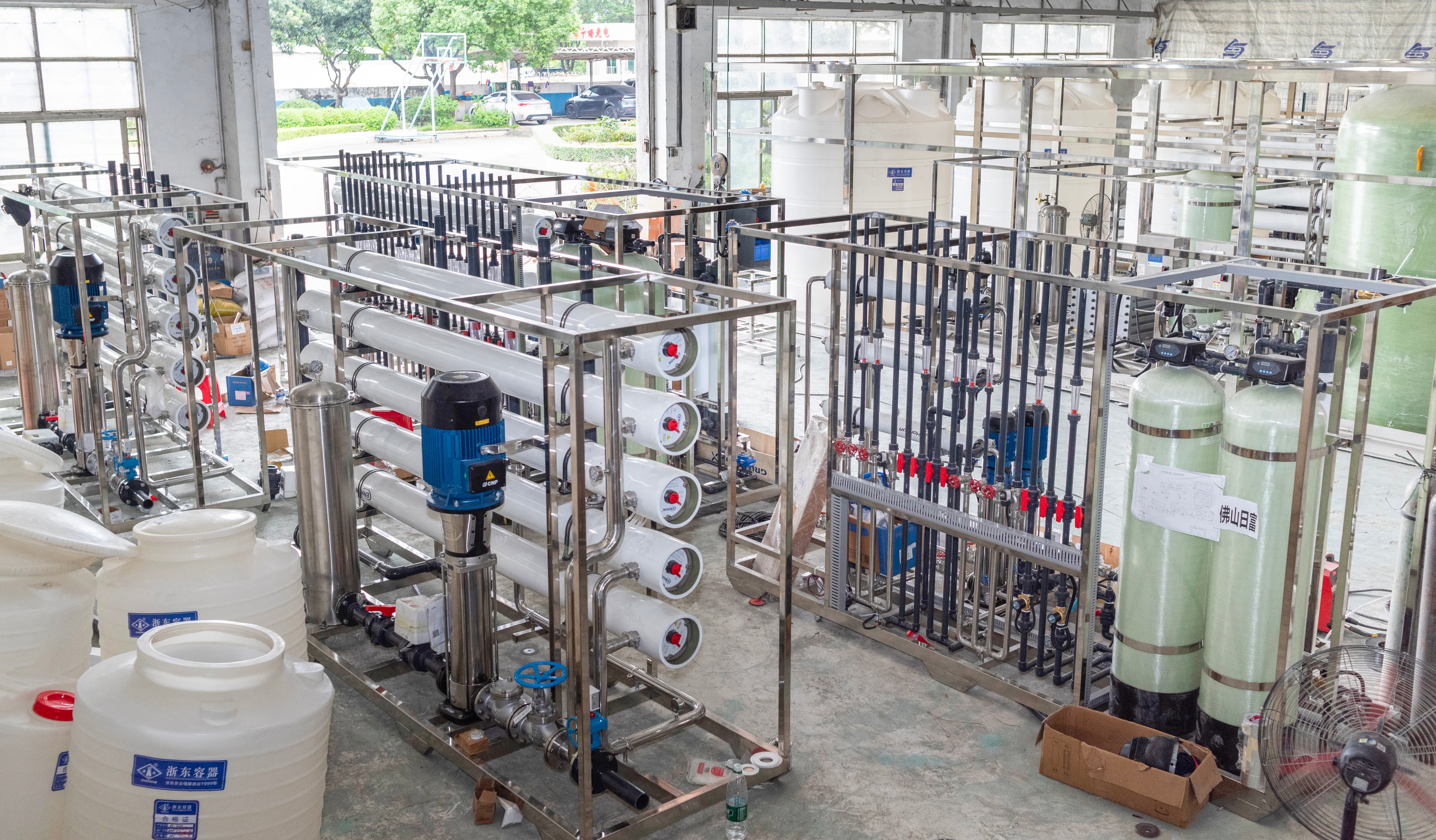
The featured image shows industrial RO equipment as membrane-system context; it does not identify a nanofiltration installation or prove selective removal. During proposal review, connect each water-quality target to a sample point, operating case and acceptance method. That discipline lets the buyer ask useful questions about scale risk, residual salts and delivered water without assuming that a generic softening claim defines the final process result.
Questions buyers commonly ask
Can conductivity alone verify NF hardness removal?+
No. Verify calcium and magnesium or the agreed hardness method at the defined sample point. Conductivity provides supporting operating information.
Does every NF membrane pass sodium and chloride equally?+
No. Require an element-specific projection or test using the actual feed and operating conditions.
Can NF replace a sodium-cycle water softener?+
It may be a candidate, but compare the required product ion profile, concentrate route, pretreatment and operating scope before selecting it.
What belongs in an industrial NF enquiry?+
Include feed chemistry, individual product-water limits, flow and temperature cases, downstream use, concentrate destination and the required acceptance evidence.
Turn the guide into a project brief.
Final process selection and performance commitments should follow the complete feed-water analysis, application requirements, site utilities and approved technical agreement.