Export packing is an engineering interface between factory release and usable equipment at site. A complete specification should cover transport and handling loads, support and securing, moisture protection, component-specific preservation and receipt checks that show whether the shipped condition has been maintained.
Define the complete delivery journey
Record the intended route from factory release to final installation, including road handling, port operations, sea transport and temporary storage. Identify equipment that travels assembled and components shipped separately. Include destination unloading and the period before commissioning. A description such as seaworthy packing leaves too much undefined. The supplier needs the actual handling and storage assumptions before selecting packaging, supports, preservation and the documentation required to establish an acceptable delivered condition.
Clarify ownership at each interface using the agreed commercial and logistics arrangements. Identify who selects transport equipment, performs securing, receives the shipment and maintains preservation during storage. Keep those responsibilities separate from the factory acceptance decision. Passing a factory test establishes a defined condition before dispatch; it does not show that the same condition survives an unreviewed journey or prolonged outdoor storage. The procurement package should bridge that evidence gap with practical responsibilities and inspection points.
Establish weights, centres of gravity and handling points
Obtain verified shipment dimensions, mass and centre-of-gravity information for each package and lifting configuration. Identify removable components and how their removal changes the handling basis. Require approved lifting and support arrangements from the responsible designers. A process-skid frame is not automatically suitable for every lifting or transport load merely because it carries the equipment during stationary factory operation. Show the intended points and any restrictions clearly on drawings and shipment markings.
Review access at both factory and destination. Include crane or forklift constraints, clearance, lifting accessories and support during temporary placement. Confirm that handling forces do not pass through piping, instruments or vessels that were not designed as structural members. Avoid an improvised plan based solely on equipment appearance. The buyer should receive a reviewable handling method and package identification so logistics personnel can connect the real shipment to its correct mass, orientation and lifting instructions.
Send the feed-water analysis, target quality, required capacity and operating profile. We will help structure the next engineering questions.
Send your project inputsEngineer support and restraint for transport
Ask the responsible packing and transport specialists to define the load cases and securing arrangement for the selected transport mode. Include the skid frame, package base, blocking and restraints as a coordinated system. The IMO CTU Code provides a recognized framework for cargo handling and packing, but using its name is not evidence that a particular skid's restraints have been designed or installed correctly. Retain the actual securing plan and the inspection record for the loaded unit.
Identify fragile or cantilevered components that need additional support or separate packing. Review tanks, long pipe runs, instrument assemblies and heavy accessories under transport movement rather than only static operation. Distinguish temporary transit restraints from permanent equipment supports. Record their locations and removal requirements. A hidden shipping brace left in place can affect operation, while a removed brace not reinstated before transport can leave a component unsupported during the journey. Both conditions need clear documentation.
Coordinate internal preservation by component
Review each component manufacturer's storage and transport requirements, including membranes, resins, instruments, pumps and seals where applicable. Some items require dry conditions, while others rely on an approved wet-preservation state. Do not apply one general drying instruction to the whole skid. Define compatible preservation materials, permitted duration and any required inspection or renewal. The linked RO layup guide addresses membrane preservation as a separate process requirement that must remain coordinated with external packing.
Identify liquids that remain after testing, their suitability for transport and how leaks or freezing exposure are managed. Include drains, vents and sealed connections in the packing checklist. Record what was removed, retained or added and the procedure needed before startup. Avoid using unapproved protective chemicals merely because they are readily available. The receiving team needs enough information to maintain the intended condition and remove preservation correctly without introducing an unknown contaminant or damaging a sensitive component.
Control moisture using a defined packaging system
Assess moisture exposure from cargo, packing materials, ambient conditions and the route. Hapag-Lloyd's guidance highlights the importance of dry cargo and packing materials and the role of climatic conditions. Request a suitable barrier, ventilation or moisture-control approach for the actual shipment. A plastic wrap alone is not an engineering assessment of condensation, especially if water is trapped inside at packing or if the package will experience substantial temperature changes during transport and storage.
Where desiccant or indicators are used, define their selection, placement, enclosure and inspection purpose through the packing design. Avoid arbitrary quantities or unsupported storage-duration claims. Clarify what happens when the package is opened for inspection or customs handling and who restores protection. Include the destination storage environment and any required renewal. The moisture strategy should remain achievable across real interfaces, rather than depend on an unopened package remaining in ideal conditions that the commercial delivery arrangement does not provide.
Protect connections, instruments and loose items
Specify suitable closure and identification of process, utility and electrical connections. Protect surfaces and ports against contamination and mechanical damage using component-compatible materials. Include detached instruments and small parts in a traceable packing list with their installation locations. A box labelled miscellaneous can create lengthy uncertainty at site. Each separately shipped item should be connected to the drawing, tag and reinstatement task needed to complete the accepted plant configuration.
Review cable ends, panel conditions and shock-sensitive components with their suppliers. If monitoring indicators are proposed, state what they can establish and how an indicated event will be investigated. An untriggered indicator does not prove the entire skid is undamaged, and a triggered one needs a defined response rather than an automatic unsupported conclusion about equipment condition. Preserve packing photographs and component records so receipt inspection can compare meaningful evidence rather than rely on memory of the factory layout.
Define receipt, storage and reinstatement checks
Prepare a receipt checklist covering package identity, visible damage, restraint condition, moisture evidence and completeness. Identify when inspection should stop and a discrepancy be referred for review. Document observations before dismantling packing that may be needed to understand a problem. Include a clear route for reporting missing or damaged parts. The receiving team should know what can be checked externally and what requires the equipment supplier's guidance before protective closures or preservation are disturbed.
Establish storage requirements after receipt and the inspection interval or triggers defined by component instructions. Record responsibility when commissioning is delayed. Provide a reinstatement list for transit supports, detached parts, preservation removal and checks before energizing or introducing water. Receipt does not automatically establish operational readiness. A controlled return to the accepted equipment configuration connects shipment records to commissioning and helps avoid startup with a blocked vent, forgotten brace, unverified instrument or component whose storage condition has expired.
Prepare the export-packing enquiry
Send Baihuipu route and handling information, destination constraints, storage duration, unloading arrangements and the required component-preservation records. Request package drawings, mass and lifting information, securing evidence, packing lists and receipt instructions. Agree the inspection hold points before dispatch and the discrepancy process after arrival. Include any destination packing-material requirements through the responsible logistics specialists rather than assuming one generic export marking establishes compliance for every route and receiving country.
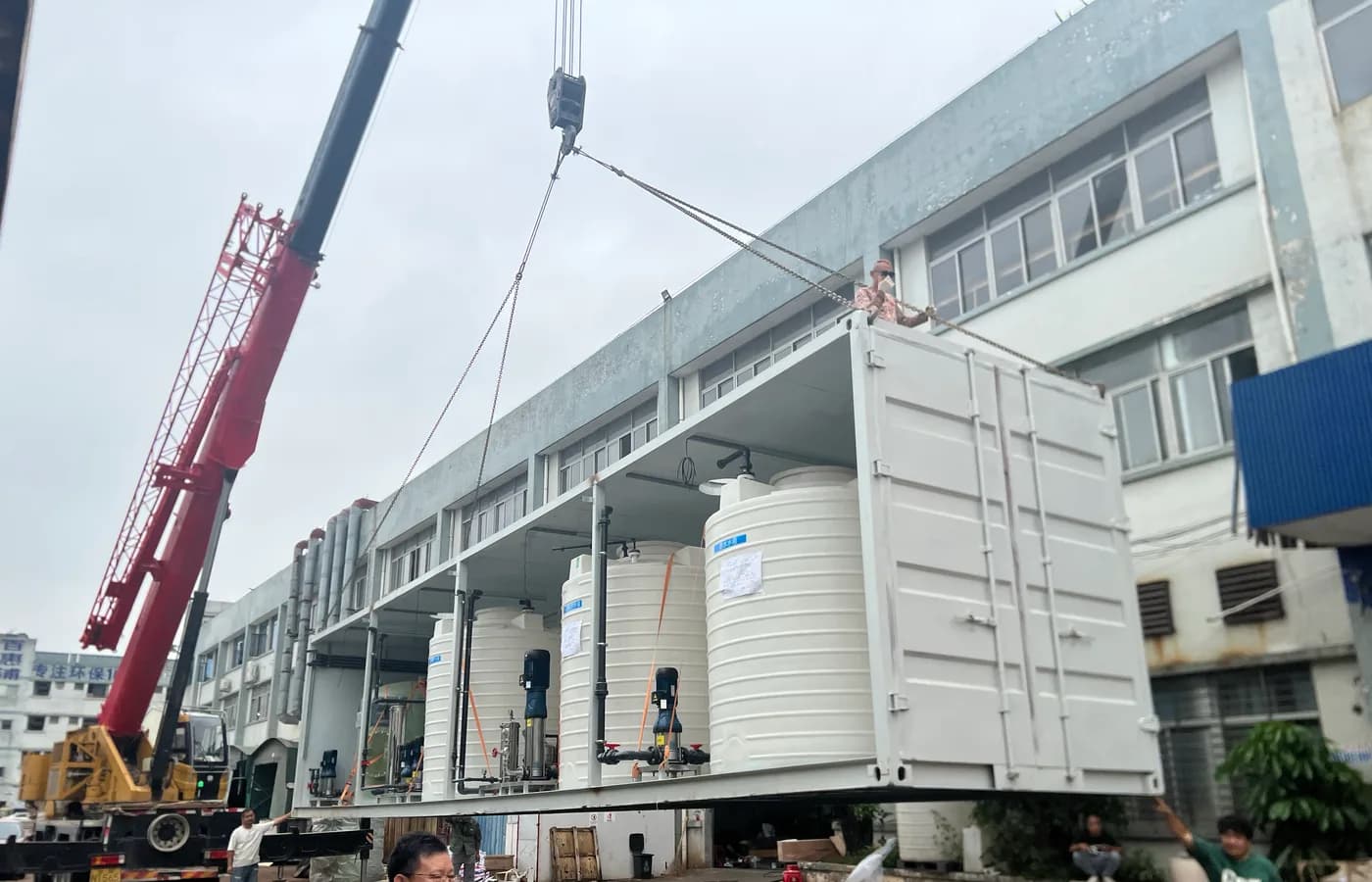
The featured photograph shows containerized water-treatment equipment prepared for delivery as context; it does not prove a particular securing calculation or preservation duration. Use the actual shipment records and receipt observations for acceptance. The linked FAT and membrane-preservation guides describe adjoining boundaries. A complete delivery specification connects factory condition, packing, transit, storage and reinstatement without claiming that a finished skid or a sealed container automatically guarantees damage-free arrival or immediate readiness for process-water production.
Questions buyers commonly ask
Does passing FAT establish the delivered condition?+
No. Maintain evidence through packing, transport, receipt, storage and reinstatement before commissioning.
Should every component be shipped dry?+
Follow component-specific instructions. Membranes, resins and other equipment may require different approved preservation states.
Does plastic wrapping alone prevent condensation?+
Not necessarily. Assess trapped moisture, packing materials, climate, enclosure and the actual storage and handling route.
What should accompany separately packed components?+
Provide traceable tags, packing-list entries, installation locations and reinstatement instructions connected to the accepted equipment configuration.
Turn the guide into a project brief.
Final process selection and performance commitments should follow the complete feed-water analysis, application requirements, site utilities and approved technical agreement.