Buying activated carbon for industrial organic removal requires contaminant-specific breakthrough evidence and a practical media service plan. A vessel described as a carbon filter does not establish which dissolved compounds it will control or how long an acceptable outlet will last.
Name the organic compounds behind the duty
Write the required outlet condition for the compounds that matter to the reuse point. Bulk COD, TOC, colour and a list of individual organic chemicals describe different things. A decrease in one aggregate measurement does not demonstrate removal of every target molecule. Gather the process chemical inventory and ask the analytical laboratory which compounds its methods actually quantify. This helps avoid ordering a carbon package around a water-quality label that hides the real purchasing requirement.
Document the range of incoming concentrations, water temperature and flow. Include occasional cleaning chemicals, solvents or production additives that may reach the same drain. Ask whether any stream can be segregated before it reaches the adsorber. Removing an unsuitable concentrated discharge at source may change the package duty substantially. Keep the carbon enquiry focused on measured separation needs rather than assuming that adsorption is an economical sink for any organic material the factory produces.
Distinguish adsorption from other carbon duties
Activated carbon may be used in several treatment roles, but a successful dechlorination application does not establish organic adsorption life. This article concerns the movement of target organics from water onto an adsorbent and the resulting outlet breakthrough. The linked dechlorination guide addresses a different upstream membrane-protection decision. Ask suppliers to state explicitly which duty their proposal covers, particularly when one vessel is expected to perform several functions at once.
Carbon selection depends on the contaminant mixture and water matrix. Published supplier discussions identify contact time as a factor in breakthrough behaviour, which is a reason to test the actual application rather than copy a familiar vessel arrangement. Request a technical basis for the proposed carbon grade and compare relevant trial results. Do not reduce the choice to a single catalogue indicator or assume that a carbon manufactured for one target will perform identically on another stream.
Send the feed-water analysis, target quality, required capacity and operating profile. We will help structure the next engineering questions.
Send your project inputsUse column evidence to support run length
Agree a trial protocol with representative water and a defined sampling schedule. Batch screening can help compare candidates, while a column programme addresses the progress of breakthrough under flowing conditions. Ask the trial provider to explain any scale relationship used to predict operation and the uncertainty attached to it. Record the actual feed composition throughout the run so a change in outlet concentration can be interpreted against a changing inlet rather than attributed automatically to the media.
Measure the contaminants that drive acceptance at the inlet, intermediate locations where provided, and final outlet. Define the action point before reviewing the results. Competitive adsorption can make a simple estimate based on one compound misleading in a mixed stream. Request curves and raw laboratory data, not only a claimed number of service months. If the trials are incomplete, identify the remaining operating assumption and an initial sampling plan that can establish a defensible site baseline.
Specify vessels around contact and distribution
State carbon inventory, bed dimensions, hydraulic range and the basis for contact time in the quotation schedule. Review distributors, collectors and support layers with the supplier. A large media volume has limited value if water bypasses part of the bed. Ask how the design manages commissioning, air removal, settling of fresh media and hydraulic transitions. Include pressure drop at the relevant operating conditions and describe the consequences for upstream pumping and downstream equipment.
Where lead-lag vessels are proposed, show sample points between stages and identify the planned rotation sequence. Define which vessel protects the final outlet while the exhausted bed is serviced. A parallel arrangement has a different operating purpose and should not be treated as equivalent simply because the total carbon mass is similar. Evaluate minimum flow, standby conditions and continuity during changeout. The flow diagram should make the proposed protection strategy understandable to an operator without relying on verbal explanation.
Control solids and biological side effects
Assess incoming suspended solids and determine whether pretreatment is needed to protect adsorption hydraulics. Solids accumulation and organic capacity exhaustion are different reasons for declining service. Provide pressure measurements and sampling that help distinguish them. If backwashing is included, identify its water source, expansion basis, sequence and waste destination. Backwash can restore a hydraulic condition in some applications, but it should not be represented as regenerating exhausted adsorption capacity without a justified process.
Review stagnation, biological growth and downstream water-quality needs. Carbon beds can provide an environment where biological activity becomes relevant, particularly in warm organic-bearing water. Decide how this affects monitoring, shutdown practice and any downstream barrier. Avoid adding an incompatible sanitization recipe without reviewing the carbon, vessel and process requirements. The appropriate response belongs to the actual application and should be documented as part of the operating envelope rather than inferred from a drinking-water example.
Make breakthrough monitoring actionable
Specify which online measurements provide trends and which laboratory tests confirm the target contaminants. TOC can support some monitoring strategies, but a low bulk result may not resolve a trace contaminant requirement. Identify analytical reporting limits, sample turnaround and the time available before the final outlet becomes unsuitable. The operating plan should include a response to a missing sample or delayed laboratory result, not only a response to a confirmed exceedance.
Relate sampling frequency to the developing breakthrough profile and the consequence of failure. Keep inlet and outlet records together with flow totals, carbon batch identity and operating events. If an adsorber is changed early, preserve the reason so subsequent service-life estimates do not mix unlike runs. Define who authorizes bed rotation or water diversion. This converts monitoring from a collection of laboratory certificates into a practical decision process that protects the reuse point.
Resolve spent-media handling before purchase
Ask how fresh carbon is delivered, transferred, wetted and commissioned, and how spent material is removed. Show hose routes, lifting arrangements, drainage and access for the proposed service equipment. Determine whether handling can occur while another bed remains in duty. Include waste characterization and the receiving facility's acceptance requirements in the project scope. A replacement-media price alone does not describe the cost or feasibility of completing a changeout at the actual site.
Evaluate off-site reactivation, replacement and disposal according to the contaminants and available authorized routes. Do not assume that every spent carbon can follow the same recovery pathway. Request documented responsibility for packaging, transport, residual water and service records. Retain the media identity and bed loading history with the transfer documentation. Commercial comparisons should state which activities are included so a low initial quotation does not depend on an unresolved waste stream or inaccessible service connection.
Request a proposal tied to the reuse target
Send Baihuipu the contaminant analysis, flow history, upstream treatment arrangement and final-water requirement. Include available trial data, analytical methods, site access and the proposed spent-media destination. Ask for an adsorption assessment that identifies uncertainties, operating protection and changeout responsibilities. Compare lifecycle assumptions on the same water and acceptance basis, and request additional trials where a claimed run length cannot be supported by relevant evidence.
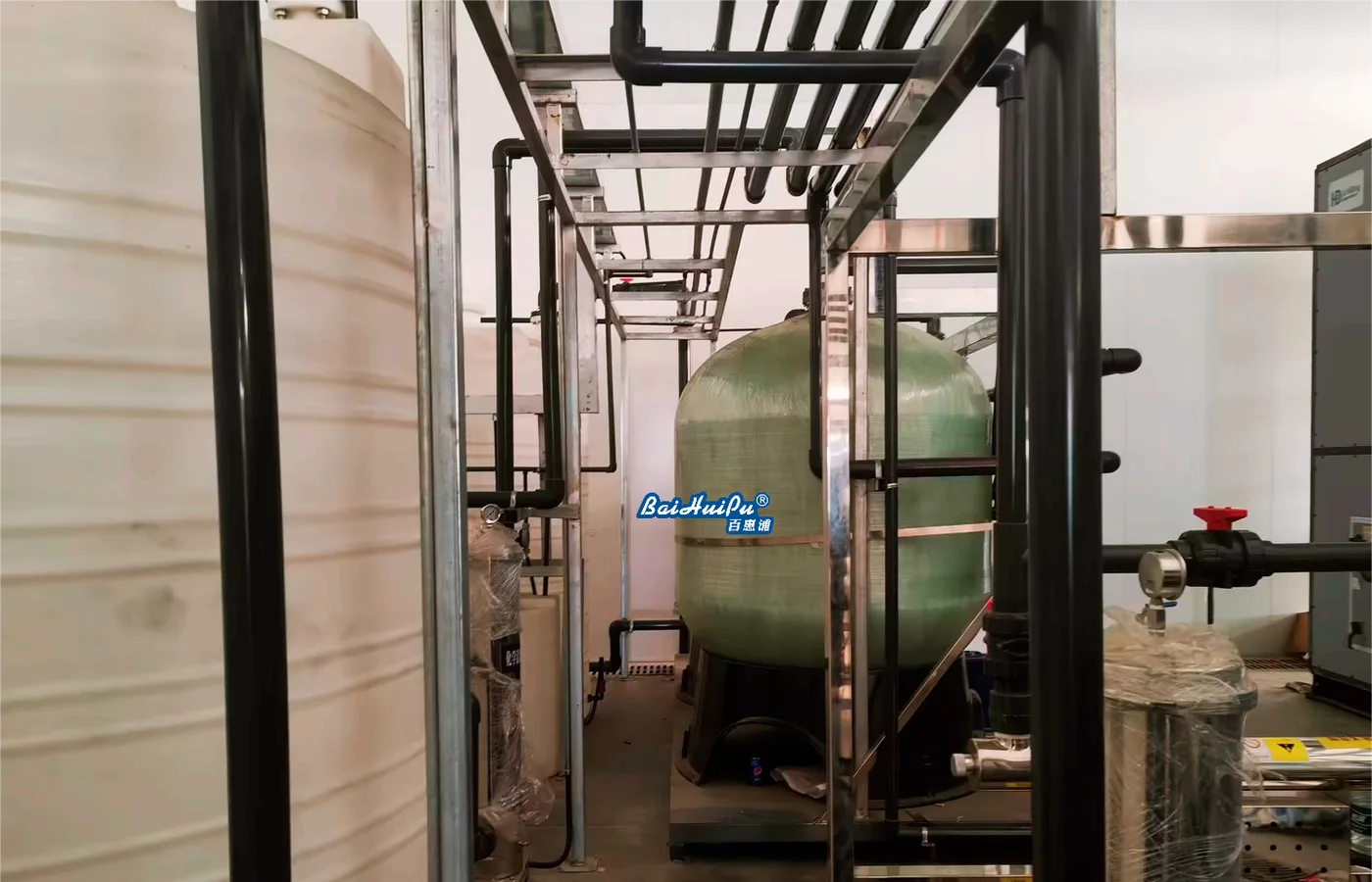
The featured image shows treatment vessels and piping as process context; it does not identify the carbon grade or demonstrate organic removal. Confirm the actual adsorber scope through approved drawings and media records. A sound purchase establishes what will be monitored, when a bed will be changed and where its contaminants will go. Those decisions allow adsorption to become a controlled part of industrial reuse rather than an undefined promise attached to a carbon-filled vessel.
Questions buyers commonly ask
Does a lower TOC result prove every target organic is controlled?+
No. Use contaminant-specific analysis where the reuse requirement concerns individual compounds.
Will backwashing restore exhausted carbon capacity?+
Do not assume so. Backwashing addresses hydraulic solids loading; capacity restoration requires an appropriate, separately justified route.
Why use lead-lag adsorbers?+
A monitored first bed and protecting second bed can support planned rotation, provided the actual hydraulic and sampling arrangement is suitable.
Can any spent carbon be reactivated?+
The receiving facility must assess the contaminant load and its own acceptance conditions before that route is assumed.
Turn the guide into a project brief.
Final process selection and performance commitments should follow the complete feed-water analysis, application requirements, site utilities and approved technical agreement.