An industrial lamella clarifier purchase should connect settling evidence with flow distribution and a workable sludge outlet. Plate area alone cannot establish the performance of a package handling changing wastewater, chemical floc or intermittent solids loads.
Establish whether the solids will settle
Separate the question of producing settleable particles from the question of removing them. A clarifier receives the outcome of upstream chemistry and mixing; it cannot correct every failure in precipitation or floc formation. Ask which suspended materials are present before treatment and which solids will be created by chemical addition. Record emulsified oil, fibres and buoyant material separately because these can change the suitability of gravity separation.
The manufacturer's Multiflo description identifies lamella settlement as a gravity separation stage. That limited principle is useful context, rather than a performance promise for another supplier's equipment. For the actual project, define the clarified-water destination and its allowable solids condition. A downstream UF plant, discharge connection and equipment-washing branch may each require different evidence. Keep those requirements visible when requesting trials instead of accepting a generic clear-water photograph as proof.
Build a representative settling programme
Collect samples across the operating conditions that drive solids loading, including production campaigns, cleaning events and source changes. Label sample age and temperature, and explain whether the laboratory adjusted pH or added reagents. Ask the trial provider to document floc formation, settling observations and the characteristics of settled sludge. A test using a convenient dilute sample may conceal a limitation that appears only during a concentrated production discharge.
Use a trial plan that evaluates both outlet quality and solids accumulation. Discuss whether floc remains stable during transfer into the proposed inlet arrangement. Where simple laboratory settling does not resolve hydraulic uncertainty, request a larger continuous trial or another justified design basis. Agree who interprets the evidence and which feed conditions remain outside the proposal. This makes subsequent quotation comparisons more defensible than selecting a loading value from an unrelated installation.
Send the feed-water analysis, target quality, required capacity and operating profile. We will help structure the next engineering questions.
Send your project inputsCompare useful area and hydraulic distribution
Ask the supplier to identify how effective settling area is calculated from plate dimensions and orientation. Compare that basis consistently between quotations; total material surface and projected settling area are different descriptions. Request the proposed hydraulic loading envelope together with the evidence supporting it. The specification should also identify bypass conditions, operating water level and the route from inlet distribution to clarified-water collection, rather than listing tank dimensions alone.
Review inlet energy, distribution across plate channels and the arrangement of collection launders. Local short circuits can undermine a package even when its nominal area appears adequate. Show upstream pipe elevations, available head and downstream restrictions on the interface drawing. If several modules operate in parallel, ask how flow is balanced and how one module is isolated. Include minimum operating flow because an arrangement selected only at maximum duty may behave differently during reduced production.
Make sludge withdrawal part of the purchase
Estimate solids production from measured suspended load and any precipitate or coagulant contribution. Distinguish dry solids from the wet sludge volume that the outlet must handle. Request hopper geometry, withdrawal connection sizes, valve suitability and any scraper or flushing provision. A small discharge opening can become the operational constraint when sludge thickens or compacts, even though the clear-water side of the clarifier meets its nominal hydraulic duty.
Coordinate withdrawal with storage and dewatering downstream. Specify whether transfer is continuous, timed or controlled by a measured condition, and identify the consequence of a blocked outlet. Provide a way to inspect the withdrawal route without exposing personnel to an operating hopper. Ask how the package detects or manages accumulation before it reaches the settling zone. Include returned liquor in the site water balance so clarification does not merely move an uncounted load between tanks.
Specify plate materials and maintenance access
Select wetted materials against actual chemistry, temperature and cleaning agents. Include plate supports, fasteners, seals and coatings in that review. Fine solids can lodge in narrow passages, while biological deposits or sticky precipitates may demand a different maintenance approach. Ask the vendor to explain how the proposed spacing and surface arrangement relate to these solids. A material declaration without a cleaning procedure leaves a significant part of the operating scope unresolved.
Review plate removal, lifting space, walkway access and the route for wash water. Draw the maintenance envelope within the installed building, including any crane or portable lifting equipment. Establish how isolated modules are drained and how operators verify a safe condition before access. The washing system must send contaminated water to a defined destination. Compare practical maintenance time and required utilities alongside purchase cost, without assuming every fouling condition can be removed by a simple rinse.
Integrate instruments and upset responses
Identify the measurements needed to recognize deterioration: feed flow, relevant chemistry, clarified-water condition and sludge behaviour. Choose instrumentation for the actual stream and provide accessible representative sample points. An outlet turbidity trend can help identify a change, but it does not by itself establish compliance for every contaminant. Specify how results are reviewed and when water is diverted, retained or passed to the next stage under the approved operating philosophy.
Write responses for excessive flow, failed chemical feed, abnormal sludge withdrawal and loss of an essential instrument. Determine whether a temporary interruption should stop incoming wastewater, use upstream storage or route water elsewhere. Interlocks need a real available destination; naming a diversion valve does not create capacity. During design review, walk through a production discharge arriving while one clarifier module is unavailable and confirm that operators have an achievable response.
Agree acceptance around the feed envelope
Separate mechanical checks from process acceptance. Before shipment, inspect dimensions, materials, plate installation, drives, valves and instruments against approved documents. At site, verify distribution, operating levels and withdrawal with the installed interfaces. Then demonstrate outlet quality under agreed representative conditions using an approved sampling plan. State the required stabilization period and laboratory methods in the contract, rather than deciding them after the first difficult sample appears.
Define how excursions outside the feed envelope are documented and how defects are distinguished from unsuitable chemistry. Retain raw observations, flow records, chemical settings and sludge-transfer events with each acceptance sample. Test module isolation and return to duty as well as steady operation. Ask for a clear statement of exclusions and any remaining pilot work, so the purchase order describes the actual confidence available instead of treating all uncertainty as a supplier guarantee.
Prepare a clarifier enquiry with usable evidence
Send Baihuipu representative analyses, settling records, flow variation, upstream chemical scope and downstream outlet requirements. Include the site elevations, sludge destination, available utilities and maintenance space. Request a proposal that explains plate-area basis, hydraulic distribution, solids withdrawal and acceptance responsibilities together. Use the related dewatering guide to define what happens after sludge leaves the hopper, and the flotation guide when trials indicate that gravity settling may be the wrong separation route.
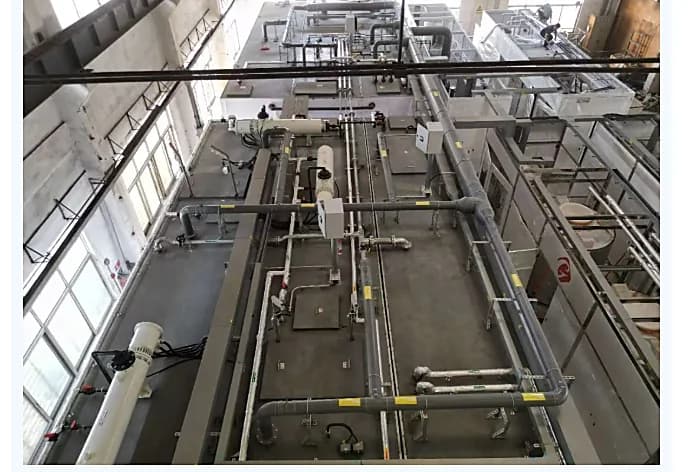
The featured photograph shows industrial wastewater equipment as manufacturing context; it does not identify a lamella unit or prove settling performance. Review the proposed equipment drawings and actual trial records when assessing suitability. A useful enquiry asks the supplier to expose its assumptions and describe an operable solids route. Those deliverables let the buyer evaluate the entire clarification boundary and decide which uncertainties must be resolved before committing to fabrication.
Questions buyers commonly ask
Does adding more plate area guarantee clarified-water quality?+
No. Settling behaviour, upstream chemistry, flow distribution and reliable sludge withdrawal all affect the result.
Can a lamella clarifier remove dissolved salts?+
Gravity settling removes suitable solids. Dissolved salts require a treatment route selected for the actual ions and use point.
Why include the sludge outlet in clarifier acceptance?+
Accumulated sludge can disrupt separation. Demonstrate withdrawal with representative solids and the installed downstream interfaces.
When should flotation also be evaluated?+
Consider another separation route when trials show persistent buoyant or poorly settling material; compare evidence on the same feed.
Turn the guide into a project brief.
Final process selection and performance commitments should follow the complete feed-water analysis, application requirements, site utilities and approved technical agreement.