RO concentrate management begins with a destination and a constituent balance, rather than an assumption that reject water can enter any available drain. The receiving system must be evaluated against real flow, chemistry and intermittent waste conditions before RO capacity is committed.
Start with the receiving route
Identify where normal RO concentrate is proposed to go and who owns that receiving system. Possible routes require different site and engineering evaluations, and none should be assumed available from a generic equipment quotation. Obtain the receiving party's current acceptance requirements through the site's responsible team. Keep this as a project interface rather than inventing a legal discharge limit. A clear concentrate route is necessary even when the RO product-water requirement is straightforward.
The US Bureau of Reclamation identifies concentrate management as a constraint in inland desalination development. This supports resolving the route early, not a conclusion that a particular disposal method is appropriate for this factory. Define which alternatives are credible at the actual site and what evidence each needs. If no route is confirmed, retain that as an unresolved design condition instead of allowing a small reject connection on a skid drawing to imply that disposal is solved.
Build water and constituent balances together
Start with representative feed flow and analysis, then account for product and concentrate streams using a consistent basis. Include individual constituents that matter to the receiver, not only bulk conductivity or total dissolved solids. Rejection differs by constituent and operating condition, so avoid assuming that every substance increases by one identical factor. Ask the process supplier to state the model or measured basis and its uncertainty.
Distinguish instantaneous flow, average flow and daily load. A receiver with a suitable average hydraulic capacity may still be affected by a short concentrated discharge. Keep unit conventions and analytical reporting consistent between feed, concentrate and receiver requirements. Include temperature where it matters to storage or downstream treatment. Review the balance whenever feed composition or RO operation changes, because a new product-water objective can alter the residual stream even if the installed pipe size remains unchanged.
Send the feed-water analysis, target quality, required capacity and operating profile. We will help structure the next engineering questions.
Send your project inputsSeparate routine concentrate from other wastes
List startup flushes, membrane cleaning solutions, preservation liquid, filter backwash and chemical-system wastes separately from normal RO concentrate. Their chemistry and timing may differ substantially. Identify which can share a route only after the responsible site team evaluates the combined stream. A common drain header can conceal incompatible or unexpectedly concentrated events. The enquiry should show normal and intermittent streams with their own expected conditions before combining them into a site balance.
Define sampling and isolation at each important boundary. If cleaning liquid is retained for separate handling, identify tank capacity, transfer method and release responsibility. Do not dilute an unresolved waste merely to make an average concentration look acceptable. Evaluate both constituent mass and receiver capacity. Keep any reuse proposal tied to the actual receiving process, because water that is unsuitable for one use does not become suitable for another simply by being described as reject reuse.
Evaluate chemistry changes during holding and transfer
Consider precipitation, suspended solids formation and other changes as concentrate moves from the RO outlet to storage or another process. The actual risk depends on composition, temperature, pH, residence and chemical additions. Request appropriate analysis or trials where the route is uncertain. A stable membrane outlet sample does not guarantee that a storage tank or long transfer line remains free of deposits under different conditions.
Include antiscalant and other process additives in the receiving-stream review where relevant. Avoid assuming that an additive suitable within RO has no consequence for a downstream reaction or reuse process. Identify material compatibility for tanks, pumps, seals and piping using the actual concentrate envelope. A generic brine label is too broad for equipment selection. Where composition is variable, ask the supplier to identify conservative design assumptions and the conditions requiring a new compatibility assessment.
Size storage around real operating scenarios
Calculate useful holding volume for the events the tank must accommodate, including transfer interruptions and unavailable receivers. Distinguish working volume from nominal tank volume and maintain appropriate operating margins under the approved design. Show the high-level response and the physical consequence for RO operation. A concentrate tank that fills without an achievable shutdown or alternative route does not provide a complete operational buffer.
Review mixing, drainage, inspection and solids removal if the chemistry can create deposits. Show overflow and containment destinations as required by the site's design, with no assumption that an overflow is an acceptable operating outlet. Include peak transfer flow and the receiver's available capacity. A large pump can empty a tank quickly while creating an unacceptable downstream shock, so coordinate the transfer programme with receiver acceptance instead of selecting it only for short unloading time.
Compare further recovery with residual handling
If additional membrane treatment, evaporation or another concentration stage is considered, compare complete water, constituent and energy boundaries. Higher water recovery reduces one liquid volume while changing the remaining stream and creating other duties. Ask for pilot evidence where fouling or chemistry is uncertain. Do not describe a staged treatment train as zero discharge unless every residual liquid and solid route is actually defined and supported by the relevant project evidence.
Include cleaning, downtime, solids handling and any condensate-polishing duty in the comparison. The linked MVR condensate guide concerns one possible recovered-water interface, not an automatic recommendation to install thermal equipment. Evaluate the actual receiving requirement and operating resources. A smaller residual volume is not necessarily a lower total installed or operating burden when the associated materials, utilities and maintenance are counted. Keep economic conclusions tied to reviewed site-specific quotations and assumptions.
Define sampling, monitoring and operating authority
Choose analyses and sampling frequency suited to the receiving route and the variability of the stream. Conductivity can provide a useful trend but does not quantify every constituent of interest. Provide representative sample points before mixing or transfer where needed. Keep flow, source condition and operating state with each result. This allows the site to interpret a change in chemistry and decide whether the proposed receiving route remains within its accepted boundary.
Specify responses to an unavailable receiver, abnormal chemistry, high storage level and failed transfer equipment. Identify who may authorize release and how pending laboratory results affect operation. If the RO must stop, coordinate that response with product-water storage and user demand. The concentrate boundary is part of supply continuity, not a disposal afterthought. Test those operating states during commissioning so staff know how to preserve both water quality and a controlled residual route.
Prepare a concentrate-management enquiry
Send Baihuipu feed analyses, proposed RO operating states, constituent balances, routine and intermittent waste schedules, site layout and receiver requirements. Request an offer that states normal concentrate conditions, assumptions, materials, storage, transfer and any additional treatment scope. Keep receiver acceptance with the responsible site parties and make outstanding evidence visible before committing to the final system arrangement. This supports a reviewable design without claiming an unverified discharge authorization.
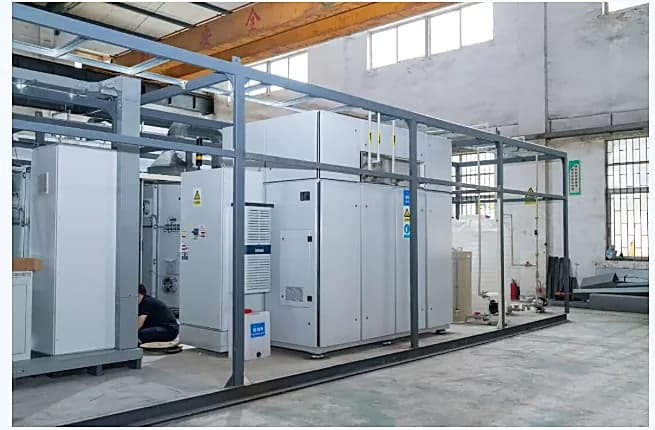
The photograph shows an industrial MVR evaporator during factory assembly as equipment context. It does not demonstrate the suitability of evaporation for this concentrate or establish a zero-discharge result. Assess the actual route using analysis, trials, accepted interfaces and the complete residual balance. The related RO recovery article addresses a different operating decision. Both matter, but a sound project keeps water production and the disposition of its concentrated constituents equally explicit.
Questions buyers commonly ask
Is RO concentrate described adequately by conductivity alone?+
No. Identify constituents, flow and loads relevant to the actual receiver, including additives and variable operating conditions.
Can membrane cleaning waste use the normal concentrate route automatically?+
No. Separate its chemistry and timing in the balance, then obtain a site-specific evaluation of any proposed combined route.
Does higher recovery remove the concentrate-management requirement?+
No. It changes volumes and chemistry. Every remaining liquid and solid stream still needs a defined handling and receiving boundary.
Can this article establish discharge permission?+
No. The site must obtain current requirements and acceptance from the responsible receiving parties. Keep that evidence in the project design basis.
Turn the guide into a project brief.
Final process selection and performance commitments should follow the complete feed-water analysis, application requirements, site utilities and approved technical agreement.