RO permeate remineralization is a use-point decision for industrial utility water, not a default addition to every pure-water plant. Some branches need defined alkalinity, calcium and pH after desalination, while high-purity processes may require those constituents to remain low. Establish the branch duty before comparing calcite contactors and chemical dosing.
Confirm that the utility branch needs mineral adjustment
Begin with the receiving system and its approved water-quality requirements. Identify the distribution materials, operating temperatures, storage and any downstream chemical programme. Low-mineral RO permeate may need conditioning for a particular utility application, but the correct decision depends on the complete chemistry and system. Obtain the process owner's targets instead of assuming that any low conductivity value means the water is suitable for every connected service.
Separate this branch from high-purity process water on the flow diagram. Adding calcium or alkalinity can conflict with the purpose of EDI or other polishing stages. Show the point of separation, isolation and backflow prevention appropriate to the plant arrangement. Define where the conditioned water is sampled and released. A post-treatment package should supply a specified utility-water service without allowing its chemicals or minerals to enter a branch that requires demineralized water.
Establish pH, alkalinity and calcium targets together
List the target range for each relevant parameter and agree consistent reporting units. pH describes one aspect of water chemistry; it is not a substitute for alkalinity or calcium concentration. Include dissolved inorganic carbon and temperature information where needed for the design review. Ask the responsible engineer to assess the chemistry across the expected operating conditions and identify any additional measurements required for the receiving utility.
Avoid treating a single saturation index as a complete corrosion guarantee. Distribution behaviour also depends on materials, oxygen, temperature, residence time and other constituents. If the project uses an index or equilibrium model, document its inputs, applicability and limitations. Set acceptance around measurable agreed water properties and defined operating conditions. Do not promise that a particular pH or mineral dose prevents every form of corrosion or scaling throughout an industrial site.
Send the feed-water analysis, target quality, required capacity and operating profile. We will help structure the next engineering questions.
Send your project inputsCharacterize permeate and operating variation
Obtain representative RO permeate analyses with pH, alkalinity, calcium, conductivity and other relevant constituents. Record source-water changes, RO operating modes and any upstream acid or caustic addition. Dissolved gases and post-RO storage conditions can influence the chemistry presented to the conditioning package. Specify the actual inlet boundary rather than assuming that a membrane projection alone describes water after an open tank or a long transfer line.
Give bidders minimum, normal and maximum flow cases, including intermittent demand and restart. Identify whether a tank decouples generation from utility consumption. The conditioning package must handle its own flow range and residence conditions even when the main RO skid operates steadily. Include the available pressure, downstream backpressure and temperature envelope. These details determine whether a contactor arrangement, a metered dosing system or a combination deserves further evaluation.
Evaluate calcite contactors from chemistry and hydraulics
A calcite contactor uses mineral media whose dissolution contributes calcium and carbonate-system alkalinity under suitable conditions. Lenntech documents a remineralization package using calcite-loaded columns downstream of demineralized water. That example establishes a possible process arrangement, not a universal design for industrial utilities. Require the proposed supplier to assess dissolution conditions, feed chemistry and the resulting product-water profile for the actual project.
Ask for the media specification, vessel arrangement, contact basis and expected pressure loss across clean and operating conditions. Review how flow variation, carbon dioxide conditions and media depletion influence the result. Define inspection and replenishment procedures, media access and initial rinsing. If backwashing is proposed, identify its purpose, water demand and waste route. Do not assign a fixed contact time or replenishment interval without a justified design or representative operating evidence.
Compare chemical addition on an equivalent boundary
Chemical conditioning can offer another route to a defined product-water composition. Require the supplier to identify each chemical's purpose and calculate its contribution to the final ionic balance. Raising pH alone does not establish that calcium or alkalinity targets are met. Review the complete formulation and potential interactions with downstream treatment rather than comparing only the capital price of a dosing pump with a contactor vessel.
Define dosing control across the actual flow range, with suitable injection, mixing and measurement locations. Ask how the system responds to no flow, loss of chemical, sensor failure and restart. Include chemical preparation, storage and containment within the scope where required by the project. Use the selected chemical supplier's instructions and site procedures for handling and compatibility. A nominal pump capacity is insufficient evidence of accurate addition at the lowest demand condition.
Coordinate storage and distribution interfaces
Show whether conditioning takes place before or after storage and how that affects sampling, mixing and water residence. Carbon dioxide exchange and other changes in a tank can influence the measured outlet chemistry. Locate acceptance points where the water represents the service promised to the utility. If blending is included, identify both source compositions and flow controls, then calculate the delivered mixture on a consistent basis.
Review isolation and operating modes with the plant team. Decide where out-of-specification water goes and how the utility remains supplied during maintenance. A standby arrangement is useful only if valves, controls and available capacity support the required service. Identify whether untreated permeate can be used temporarily and obtain the receiving system owner's decision. Do not allow an undocumented bypass to become an assumed acceptable operating mode during a media refill or chemical outage.
Verify quality and operating transitions
Write acceptance tests for the agreed pH, alkalinity, calcium and other properties at the specified sampling boundary. Use suitable measurement methods and sample handling, particularly where gas exchange can alter results. Verify minimum and maximum flow cases as well as normal production. Record the stabilization conditions and treatment settings with each sample so a pass can be related to a defined operating envelope.
Test no-flow interlocks, start-up diversion, chemical exhaustion or low-media responses where applicable, and the return-to-service procedure. Factory tests can demonstrate controls and assembly; site-water tests establish the delivered chemistry. Include clear responsibilities for adjusting the package and investigating failed results. Retain the commissioning baseline for future reviews after source-water changes, membrane replacement or modification of the receiving utility system.
Prepare the remineralization enquiry
Send Baihuipu the utility application, receiving-system materials, approved water targets, RO permeate analysis and full demand profile. Include tank arrangements, available utilities and drawings showing the high-purity and conditioned-water branches. Request a route assessment comparing calcite contactors and chemical addition on the same outlet chemistry, with supply exclusions, consumables and acceptance evidence visible. Use the linked pure-water and distribution guides to coordinate those interfaces.
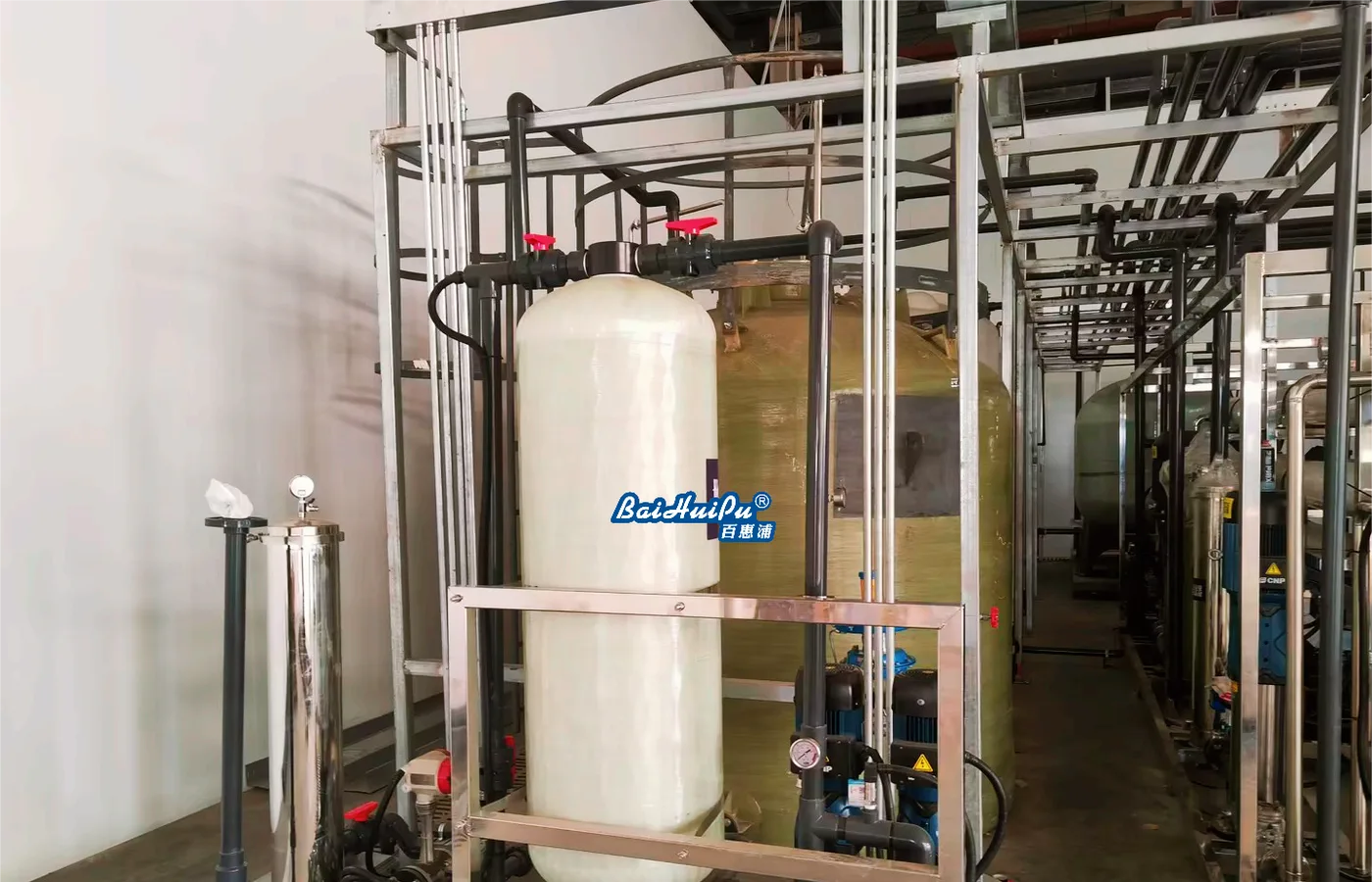
The featured photograph shows industrial treatment equipment, vessels and storage tanks; it does not identify a calcite contactor or prove stabilization performance. Keep the procurement decision focused on the required utility-water composition and maintainable operating arrangement. Successful conditioning means meeting the agreed branch specification under defined conditions, with a monitoring plan that detects change. It should never be presented as a general reason to add minerals to every RO or ultrapure-water application.
Questions buyers commonly ask
Should all RO permeate be remineralized?+
No. Decide from the receiving application. Adding minerals can conflict with high-purity water requirements.
Does increasing pH prove adequate alkalinity and calcium?+
No. Specify and measure the required properties separately and review them together in the complete water chemistry.
Can a calcite contactor guarantee corrosion prevention?+
No universal guarantee follows from the technology alone. Evaluate water chemistry, materials and operating conditions with the responsible engineer.
What is needed for a remineralization proposal?+
Provide the utility duty, approved outlet targets, permeate analysis, flow and temperature cases, storage arrangement and separation from high-purity branches.
Turn the guide into a project brief.
Final process selection and performance commitments should follow the complete feed-water analysis, application requirements, site utilities and approved technical agreement.