UV and hydrogen peroxide advanced oxidation should be evaluated against named contaminants and the actual industrial water matrix. A defensible purchase connects treatability testing, optical conditions, oxidant delivery and residual management with the requirements of the downstream reuse process.
Define a compound-specific treatment objective
Identify the compounds that limit the intended reuse destination and establish appropriate analytical methods. Bulk COD and TOC can help describe the stream, but neither automatically indicates whether a named trace compound meets its requirement. Include concentration variation, production campaigns and upstream chemical additions. Specify which measurements are contractual and which are diagnostic. A purchaser needs a defined chemical endpoint before comparing advanced oxidation with adsorption, source segregation or another treatment route.
Distinguish destruction of a target compound from complete mineralization of all organic material. An oxidation process can transform a molecule without converting all its carbon into inorganic products. Evaluate the significance of transformation products and the destination of the treated water with appropriate specialists. Avoid specifying an undefined promise to eliminate every organic substance. The enquiry should identify the desired outcome and the evidence needed to show it for the actual industrial source.
Explain the offered oxidation mechanism
Trojan describes UV advanced oxidation as UV used with an oxidant to reduce chemical contaminants. UV/peroxide is one such process, with chemistry and equipment duties that differ from UV disinfection alone. Ask the supplier to identify the proposed reactor and the role of hydrogen peroxide. A reactor rated for a microbial application cannot be assumed to establish the chemical-contaminant treatment duty of a different source water merely because both systems contain UV lamps.
Request a process diagram showing pretreatment, peroxide injection, mixing, irradiation, residual handling and release. Define the analytical locations and where off-specification water can be held. Identify any assumed downstream biological or adsorption stage. Keep the treatment boundary explicit so a reactor outlet is not confused with the final reuse-water quality. A proposal should explain what the oxidation stage demonstrates and which remaining requirements are assigned to other equipment or to the owner.
Send the feed-water analysis, target quality, required capacity and operating profile. We will help structure the next engineering questions.
Send your project inputsCharacterize optical conditions and competing demand
Measure UV transmittance using a stated wavelength, path length and method appropriate to the assessment. Include colour, suspended material and upstream variability. Ask how the proposed reactor design responds to changes in the optical matrix. A clear-looking sample is not sufficient evidence of favourable UV transmission. Record temperature and any relevant dissolved species that may affect oxidation chemistry or oxidant demand, using representative samples rather than only the cleanest available filtrate.
Review whether pretreatment can stabilize the matrix more effectively than increasing oxidation duty. Particles, deposits and changing dissolved constituents can alter the relationship between electrical input, peroxide addition and the target endpoint. The supplier should identify critical feed limits and the consequence of exceeding them. Keep these limits visible in the operating philosophy. An AOP package should not receive unlimited responsibility for unknown industrial discharges simply because it is positioned near the end of the treatment train.
Use treatability testing to define the envelope
Agree trial objectives, sample handling and the analytical programme before testing. Include untreated controls and operating points that help distinguish treatment response from sampling or storage effects. Record UV exposure conditions, peroxide addition and the relevant water matrix. Ask what evidence supports translation from the test apparatus to the offered reactor. A favourable laboratory result is a basis for engineering review, not automatic proof of full-scale hydraulic distribution or long-term optical cleanliness.
Include difficult but credible feed cases and the intended range of target concentrations. Evaluate residual peroxide and relevant transformation-product questions alongside disappearance of the selected compound. Retain original laboratory data and uncertainties. If pilot testing is needed, define its decision criteria before starting. The purchasing team should know what outcome would justify proceeding, changing pretreatment or rejecting the route, rather than receiving a trial report whose only conclusion is that additional equipment might improve an unspecified result.
Coordinate peroxide delivery with actual flow
Specify supplied-product concentration, storage conditions and compatibility with the proposed wetted materials. Obtain an engineered handling and dosing arrangement using the chemical supplier's requirements. Include injection, mixing and verification of delivered chemical. A metering-pump command is not a measurement of peroxide reaching the water. Identify how empty supply, loss of feed flow or a dosing fault affects the release state, and define an approved response rather than continuing an unverified treatment sequence.
Consider low-flow operation, standby and restart, including water held in the reactor and connected piping. Request an approved commissioning method for checking dose delivery without creating an unsuitable residual in the receiving process. Account for chemical inventory and turnover in the procurement comparison. Do not copy a peroxide dose from another application. The useful dose and operating window belong to the tested source water, target compounds, reactor conditions and downstream limits established for this project.
Define downstream residual and by-product acceptance
State the receiving equipment's peroxide and other chemical limits. Determine whether residual destruction, adsorption or another approved conditioning step is needed before reuse or subsequent treatment. Specify sampling that measures the appropriate residual at the actual release point. Keep compatibility with membranes, resins, biological stages and process chemistry under review. A reduction in one target contaminant does not establish that the oxidized water is suitable for every downstream material or production operation.
Trojan's AOP guidance identifies that oxidation by-products depend on the process and water chemistry. Use a project-specific analytical assessment rather than transferring a by-product statement between different oxidants and matrices. Define which results trigger investigation or hold. Include any spent media, rinse water or residual-destruction duties in the overall balance. The commercial comparison should cover the complete route to acceptable reuse water, including the evidence and equipment needed after the irradiation stage.
Specify monitoring, cleaning and valid operation
Obtain the reactor manufacturer's operating envelope and required instruments. Include flow, UV-related condition monitoring, lamp status and other measurements needed to establish a valid treatment state. Determine how the control system distinguishes a warning, a failed signal and water that has not received the required treatment. Avoid assuming that a powered lamp proves chemical treatment. The release decision needs the coordinated conditions stated in the approved process design and demonstrated during commissioning.
Review sleeve cleaning, fouling inspection, lamp replacement and access. State how maintenance affects availability and what checks authorize return to service. Include electrical input and auxiliaries on a common comparison basis, with trial uncertainty kept separate from measured site consumption. Any economic assessment should use the actual operating profile and chemical requirements. A manufacturer example from another water matrix should not become a guaranteed energy or reagent saving in the buyer's specification.
Prepare an AOP enquiry with clear decision criteria
Send Baihuipu the target-compound list, methods, source analyses, optical data, flow profile and intended reuse limits. Include treatability evidence, downstream residual constraints and available holding capacity. Request a coordinated process boundary, trial interpretation and acceptance plan. Separate mechanical completion from demonstrated chemical treatment. Define test conditions and the handling of source excursions so acceptance remains meaningful when production differs from the sample used during early feasibility work.
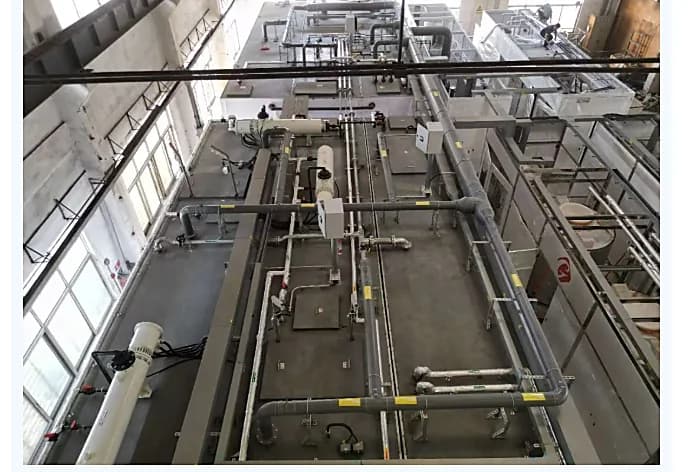
The featured photograph shows industrial wastewater equipment as context, not a UV/peroxide reactor or proof of contaminant destruction. Use offered reactor documentation, analytical evidence and installed operating records for acceptance. The related UV and TOC articles address separate equipment and measurement duties. Keeping those boundaries clear helps the purchaser assemble an operable reuse train without claiming that a disinfection rating or a lower bulk-carbon reading proves every compound-specific oxidation requirement.
Questions buyers commonly ask
Is UV disinfection equipment automatically suitable for AOP?+
No. Establish the chemical target, matrix, oxidant and reactor duty through the appropriate design and treatability evidence.
Does target-compound removal prove complete mineralization?+
No. Transformation and complete mineralization are different outcomes. Define appropriate endpoints and assess relevant transformation products.
Why measure residual peroxide downstream?+
The remaining oxidant can affect receiving equipment and process chemistry. Define its limit and any required destruction step at the actual release point.
Can one peroxide dose be used for every industrial source?+
No. Use representative trials and an approved operating envelope for the specific contaminants, water matrix and reactor.
Turn the guide into a project brief.
Final process selection and performance commitments should follow the complete feed-water analysis, application requirements, site utilities and approved technical agreement.