Automatic disc filtration is a procurement decision about retained solids, available cleaning energy and usable outlet flow. A micron label alone does not establish whether a filter battery will remain operable on a variable industrial reuse stream.
Define what the filter must intercept
Identify the receiving process before specifying a disc pack. Protecting spray nozzles, reducing coarse solids before UF and preparing general wash water can require different evidence. Collect particle observations alongside suspended-solids results, and record fibres, sticky precipitates and biological fragments separately. Their behaviour can be more important to cleaning than a single aggregate concentration. Describe intermittent slugs and startup conditions instead of offering only an average sample from stable operation.
Distinguish particulate filtration from removal of dissolved contaminants. A disc filter does not provide desalination, and its rating should not be treated as a guarantee of downstream membrane fouling behaviour. Ask the supplier to define the proposed filtration grade and its test basis. For a critical downstream process, use appropriate filtered-water measurements in addition to the element description. This establishes the actual duty without asking the package to solve unrelated chemistry.
Explain the disc mechanism in the enquiry
Amiad's industrial catalogue describes compressed grooved discs and a cleaning sequence that releases the pack and flushes retained solids. That mechanism is useful background for evaluating this equipment class. The published design is a named manufacturer's arrangement, not evidence that every alternative uses identical components or achieves the same outlet. Request a sectional drawing of the offered assembly and an explanation of its own compression and release mechanism.
Identify the water path during filtration and cleaning on the proposed piping diagram. Show where clean backwash water originates and which valves establish reverse flow. Ask what happens if a pack fails to decompress or a cleaning valve remains partly open. An automatic controller is useful only when the hardware can complete its sequence under the installed pressure conditions. Include access to the disc stack so inspection remains possible after repeated automatic cycles.
Send the feed-water analysis, target quality, required capacity and operating profile. We will help structure the next engineering questions.
Send your project inputsTest representative solids and cleaning recovery
Use water collected across the sources expected in service. Preserve sample descriptions, temperature, feed concentration and any upstream chemical settings with the test record. Compare inlet and outlet conditions using methods suited to the receiving process. Ask for differential-pressure trends, cleaning frequency and the condition after each cleaning event. A short demonstration on clean water can establish valve operation but cannot demonstrate sustainable filtration of the actual solids.
If deposits are sticky or strongly attached, investigate manual cleaning and material compatibility as well as routine hydraulic flushing. Ask which failure would trigger removal from service and how the spare capacity covers that event. Document trial limitations explicitly; a laboratory screening exercise may not establish the final battery's hydraulic distribution. Where that uncertainty matters, request a continuous trial at an appropriate scale before accepting a firm cleaning or availability commitment.
Verify pressure at the cleaning state
Provide minimum and maximum inlet pressures, downstream backpressure and the elevation of the drain connection. Check these conditions while another pod supplies the process, rather than at an isolated nominal duty point. Backwash demand can change the pressure available elsewhere in the battery. Request the vendor's required cleaning flow and pressure at the relevant connection, with the measurement location clearly marked. Pressure at a distant pump is not necessarily pressure at the filter.
For externally supplied backwash, define water quality, storage, pumping and return-prevention scope. For cleaning from the common filtered header, demonstrate that sufficient pressure remains at minimum process demand. Include a response to an unavailable cleaning supply. Repeatedly starting an ineffective cleaning sequence can consume water while leaving solids in place. Decide whether the package alarms, isolates a pod or reduces delivery when the required hydraulic condition is absent.
Calculate net water delivery and drain duty
Compare gross filtration flow with useful water available after cleaning, flushing and any other routine losses. State whether the quotation's capacity is instantaneous or averaged across normal cycles. Include the operating arrangement with one pod cleaning and, separately, one pod isolated for maintenance. This makes different battery configurations comparable and prevents the purchaser from discovering that the advertised flow excludes a necessary operating state.
Show peak drain flow and event duration at the site connection. A drain sized only for average daily water loss may back up during a short cleaning discharge. Confirm whether the receiving tank can accept the solids and whether returned water recycles them to the same filter. Keep any reuse of wash water within the wider solids balance. Water recovery has little operational value when the separated material simply returns to the inlet unchanged.
Specify materials and service access
Review disc polymer, seals, housings, fasteners and valve internals against actual process chemistry and proposed cleaning agents. Include temperature excursions and outdoor exposure where relevant. A broad chemical-resistance description should be supported by the offered material grades and the actual concentrations expected. Request handling instructions for disc stacks and seals so maintenance personnel can restore the intended assembly without changing its compression or damaging filtration surfaces.
Reserve the physical space required to open each housing and withdraw its internals. Show safe isolation, pressure indication and drainage before access. Include spare elements, seals and any special tools in the quotation comparison. Ask which parts can be cleaned on site and which must be replaced. These details affect continuity of supply and should be assessed alongside the purchase price, especially when the filter sits on a shared industrial utility line.
Make automatic operation observable
Define pressure measurements, cleaning triggers, maximum sequence duration and the event log needed for diagnosis. Time initiation and differential-pressure initiation can serve different purposes; agree how they interact. Provide a way to distinguish a dirty element from an instrument fault or a blocked pressure tapping. Trend normal cleaning recovery after commissioning so later changes can be interpreted against a baseline rather than a remembered operator impression.
Test failed valve feedback, unavailable backwash water, a persistent pressure alarm and power restoration. Confirm the outlet condition during transitions and prevent uncontrolled bypass from becoming the default response. If process continuity requires a bypass, identify its filtration consequence and authorization state. The controller should make reduced protection visible. An apparently running package can otherwise conceal an open flow path that defeats the purpose of installing the filter.
Assemble an evidence-based disc-filter RFQ
Send Baihuipu source descriptions, particle and solids data, flow variation, available pressures, drain details and the protected equipment's requirements. Request a proposal covering trial evidence, filtration grade, net delivery, cleaning interfaces, materials and maintenance clearance. Agree acceptance around repeatable operation on the defined feed, including successful cleaning and restoration of outlet duty. Keep untested feed conditions visible as exclusions or further trial requirements.
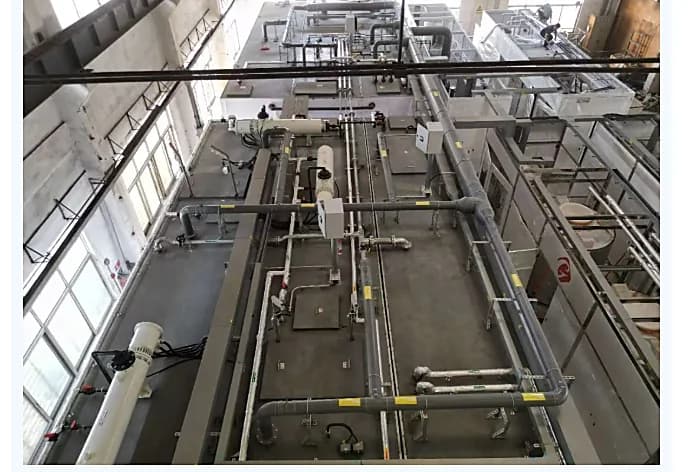
The featured image shows industrial wastewater equipment as manufacturing context; it does not identify a disc-filter model or prove particle removal. Use approved drawings and test records to establish the actual offered scope. The related bag-filter and multimedia guides support comparisons with different filtration mechanisms. A useful buying decision explains why automatic discs suit these particular solids and how the installed plant will supply, observe and maintain their cleaning sequence.
Questions buyers commonly ask
Does a disc filter remove dissolved salts?+
No. Its particulate duty is separate from desalination. Select dissolved-contaminant treatment from the actual water analysis and receiving process requirements.
Is inlet pressure alone enough to approve backwash?+
No. Verify the cleaning flow and pressure at the specified connection under the lowest credible operating condition, including downstream and drain effects.
Should quoted capacity include cleaning losses?+
Specify both gross flow and net usable delivery. State the availability arrangement during cleaning and maintenance so offers can be compared consistently.
Can automatic backwash eliminate manual inspection?+
No. Include access, cleaning limits and inspection procedures for deposits that the normal hydraulic sequence cannot remove reliably.
Turn the guide into a project brief.
Final process selection and performance commitments should follow the complete feed-water analysis, application requirements, site utilities and approved technical agreement.