Powdered activated carbon is a dosing and solids-management decision as well as an adsorption decision. Procurement should establish which contaminants are targeted, how the selected carbon performs in the real wastewater and how the added particles are captured before water is released.
Name the adsorption target and decision
Identify the organic contaminants, colour-related substances or other adsorbable constituents that limit the intended wastewater route. Agree analytical methods and the required endpoint. A change in bulk COD alone may not describe the behaviour of a specific process chemical. Include production campaigns, background organics and cleaning events. The enquiry should explain whether powder dosing is intended for routine treatment, campaign-specific control or a bounded contingency, because those uses create different inventory and contact requirements.
Compare source segregation and upstream control before assigning the full duty to adsorption. Some industrial streams contain constituents whose removal by the proposed carbon remains uncertain. Request evidence for the actual target and matrix. Avoid describing activated carbon as a universal barrier for salts, metals and every dissolved organic compound. The purchasing decision should rest on demonstrated suitability and a clear residual route, with additional treatment identified where adsorption alone does not establish the required water quality.
Select carbon grade through actual-water tests
Calgon Carbon describes powdered carbons with differing pore structures and adsorption properties. That supports evaluating a suitable grade rather than assuming all powders are equivalent. Ask bidders to identify the offered product, quality documentation and characteristics relevant to handling and separation. Do not select solely by an unrelated catalogue adsorption index. The industrial wastewater mixture and target compounds should determine which grades deserve comparative testing under representative contact and analytical conditions.
Agree a treatability programme covering carbon addition, mixing, contact time and the method used to separate carbon before analysis. Include untreated controls and a consistent sample preparation procedure. Fine carbon left in an analytical sample can complicate interpretation, so document filtration or other separation and its possible effects. Preserve original results and test conditions. A statement that a sample became clearer is insufficient evidence of target-contaminant removal or the carbon dose required by a continuously operated plant.
Send the feed-water analysis, target quality, required capacity and operating profile. We will help structure the next engineering questions.
Send your project inputsTranslate contact time into an operating vessel
Define the process flow and mixing arrangement that will provide contact between carbon and water. Identify short-circuiting, variable liquid level and peak-flow conditions in the proposed layout. Nominal tank volume divided by average flow does not describe every particle's contact history. Ask how the offered design maintains suspension and establishes a practical operating envelope. Include the minimum operating volume and the route used when the contact tank is unavailable for inspection or cleaning.
For batch operation, define filling, carbon addition, contact, separation and release as an explicit sequence. For continuous operation, identify the demonstrated hydraulic basis and any buffering needed before downstream separation. Keep adsorption-contact evidence distinct from settling or filtration evidence. The powder must have an opportunity to contact the target compounds, and the spent particles must then be removed by an appropriate barrier. Completing only one of those duties does not establish an acceptable final effluent.
Make receiving and slurry preparation practical
State the expected delivery form and handling frequency, using the site's actual logistics. Review bulk-bag or smaller-package unloading, enclosure and dust control with the supplier and responsible safety personnel. Obtain product-specific handling requirements rather than treating a carbon powder like a harmless granular media refill. Include storage protection, identification and access. The installed receiving arrangement should allow the intended carbon grade to be handled consistently without uncontrolled spills or improvised manual transfer.
Specify wetting, slurry concentration and agitation on the basis of the offered powder and equipment. Ask how lumps, floating powder and settled material are managed. Include water quality and the destination of washdown liquid. A nominal preparation-tank volume does not establish a homogeneous and pumpable slurry throughout the withdrawal period. Request startup and return-to-service checks so operators can confirm that the dosing system receives the intended material condition rather than a changing mixture from an inadequately mixed tank.
Verify the actual carbon feed
Define dosing units clearly, including whether the controller reports dry-carbon mass, slurry volume or a calculated dose relative to wastewater flow. Establish calibration and verification using an appropriate measured basis. Slurry concentration can change through settling, dilution or preparation errors, so a pump stroke or speed command alone does not establish dry-carbon delivery. Include sampling or inventory reconciliation where appropriate to the process and the required operating evidence.
Review pipe routing, abrasion, dead legs and the proposed flushing procedure. Include the response to loss of mixing, blocked delivery and no wastewater flow. Ask which components can be isolated and serviced while maintaining an approved plant state. If dosing is intermittent, define how a stopped slurry line is returned to service without introducing an unverified concentrated slug. The purchase should cover repeatable carbon addition over the real operating schedule, not merely the nominal capacity of a slurry pump.
Demonstrate spent-carbon capture
Identify the downstream separation method and test it with the selected carbon and actual wastewater. Coagulation, clarification and filtration may interact with the added particles, so assess the complete proposed route. A carbon particle can carry adsorbed contaminants; releasing it downstream undermines the intended treatment boundary. Define appropriate outlet measurements and what evidence establishes acceptable retention. Do not infer capture simply because an existing clarifier or filter already removes a different solids mixture.
Account for increased solids loading, chemical conditioning and backwash or sludge production. Include peak powder dose and the consequence of interrupted separation. Where a membrane is proposed, review compatibility, fouling and cleaning against manufacturer requirements and representative trials. Keep useful permeate or filtrate output separate from gross feed flow. The complete process comparison should include the capacity and maintenance impact of removing the newly added adsorbent as well as the original wastewater particles.
Define residual handling and operating limits
Estimate spent-solids production from a documented balance and verify it as operating evidence becomes available. Include captured wastewater solids and any conditioning chemical, rather than counting only purchased carbon. Ask the responsible site team to establish characterization and disposal requirements for the actual spent material. Avoid describing spent carbon as automatically nonhazardous or reusable. Its appropriate destination depends on what it has adsorbed and the applicable receiving requirements for this industrial installation.
State which feed excursions require holding water, changing an approved operating setting or stopping release. Include depleted inventory, preparation faults and separator unavailability in the cause-and-effect review. A visible dosing pump run signal should not mask the absence of usable carbon or capture capacity. Keep operating adjustments within the tested envelope, and define how a new production chemical or carbon grade is reviewed before it becomes part of the routine treatment programme.
Prepare a complete powder-carbon RFQ
Send Baihuipu target-compound data, representative wastewater samples, trial results, flow histories and existing separation information. Include carbon-receiving constraints, preparation utilities, residual destinations and the desired operating schedule. Request a coordinated adsorption, dosing and capture proposal with clear acceptance measurements. Separate mechanical completion from process evidence. The supplier should explain which test results support the selected powder and what remains to be demonstrated at the installed contact and separation boundaries.
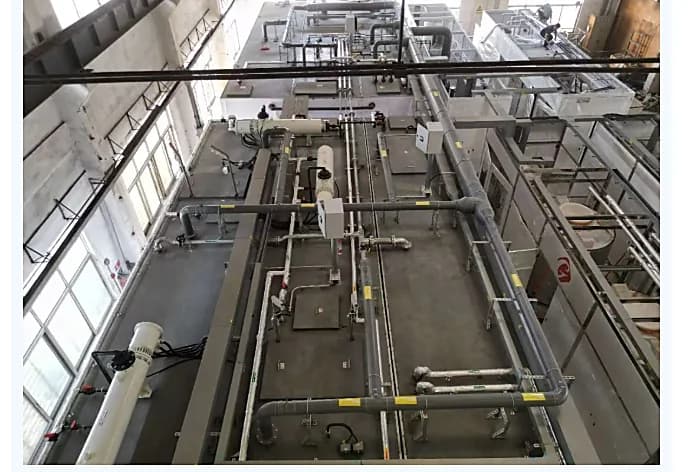
The featured photograph shows industrial wastewater equipment as manufacturing context, not a powder-carbon installation or proof of adsorption performance. Use actual grade documentation, trial records and installed measurements for acceptance. The linked GAC article provides a distinct fixed-bed option, while the clarifier guide addresses a possible separation boundary. Compare complete routes using the same contaminant objective, including chemical supply, contact conditions, spent-carbon capture and disposal rather than comparing adsorbent purchase price alone.
Questions buyers commonly ask
Is powdered carbon interchangeable with granular carbon?+
No. Powder is dosed and subsequently captured, while granular carbon commonly operates in a fixed bed with different hydraulic and media-management duties.
Can one generic adsorption index select the powder?+
Use it only within its proper product context. Select against actual target-compound and wastewater testing, including contact and separation conditions.
Does a slurry-pump command prove the carbon dose?+
No. Verify slurry concentration and actual delivery on a dry-carbon basis using an appropriate calibration and operating procedure.
Why test the downstream separator?+
The added carbon must be retained. Existing separation equipment may respond differently to fine carbon, conditioning changes and the increased solids load.
Turn the guide into a project brief.
Final process selection and performance commitments should follow the complete feed-water analysis, application requirements, site utilities and approved technical agreement.