A membrane autopsy can support an RO investigation when its sample and questions are well chosen. Specify the service around operating evidence, element position, preservation instructions and laboratory deliverables, so the report informs corrective action without claiming that one removed element represents every cause across the plant.
Start with a diagnostic question and alternatives
Describe the problem in measurable terms: changing product quality, reduced production, rising pressure loss or another observed condition. Include when it began, how it developed and what changed nearby. Define the decision the laboratory work should support, such as assessing a suspected deposit, evaluating cleaning options or investigating physical damage. Ordering an autopsy without a question can produce an interesting list of findings while leaving the maintenance team uncertain about the next action.
Review basic operating and instrument evidence before removing an element. A valve problem, incorrect signal or changed feed can require a different investigation. Ask the membrane supplier whether non-destructive testing or a system assessment should come first. DuPont's diagnostic-services description distinguishes several testing approaches, including element performance tests and physical analysis. Use that distinction to request an appropriate scope rather than assuming destructive examination is always the first or most useful service.
Build the operating evidence package
Provide the laboratory with a process diagram, membrane models, element arrangement, installation dates and known maintenance history. Include feed analyses and relevant trends before and after the problem appeared. Identify instrument locations and note calibration limitations. Raw observations should remain available alongside any normalized trends. A laboratory can examine material on an element, but interpreting why it appeared requires context about the water, operating state and events experienced by the installed system.
Include chemical products and approved operating conditions for dosing, cleaning and preservation where relevant. Record excursions, unexpected shutdowns and changes in source water without assuming that any one event caused the failure. Distinguish confirmed records from operator recollection. Provide laboratory and site contacts who can resolve questions before tests begin. A clear evidence package reduces the risk that the final report relies on an unstated assumption that the service team could have checked with the plant.
Send the feed-water analysis, target quality, required capacity and operating profile. We will help structure the next engineering questions.
Send your project inputsSelect elements with a stated rationale
Identify the exact train, stage, vessel and position of every proposed sample. Explain why those positions represent the question: a lead element and a tail element may experience different conditions. The responsible engineer should approve selection with the membrane supplier and laboratory as appropriate. Do not remove a convenient spare or arbitrary element and present its findings as representative of the installed train without documenting the limits of that inference.
Consider whether comparison samples or deposits from other boundaries are useful. Define their purpose before adding them to the scope, and use handling instructions suitable for each analysis. If the investigation concerns a localized product-quality change, preserve the relevant operating evidence before reconfiguring the system. Sampling should support a specific hypothesis and alternative explanations. More samples are not automatically better; the important requirement is a defensible link between their positions, condition and the decision under investigation.
Agree handling before removal and shipment
Obtain written laboratory instructions for draining, packaging, preservation, labelling and transit before the element leaves service. Different analytical objectives may be affected by cleaning, drying, preservatives or contamination introduced during handling. Do not apply a generic shipping chemical without approval for the intended work. Identify who removes the element, how orientation is recorded and what photographs or condition notes are needed. Preserve serial numbers and location labels through the entire handover.
Check transport, receiving and any necessary handling documentation with the receiving laboratory and logistics team. Use the site's procedures and the supplier's instructions for equipment isolation and removal. This article is a procurement guide, not a removal procedure. Retain a chain-of-custody record documenting who handled the sample and any deviations. If an element was already cleaned, dried or damaged before shipment, state that fact so the laboratory can qualify its conclusions instead of treating the received condition as original.
Define the order of laboratory tests
Ask the laboratory to propose a sequence that preserves evidence for the agreed question. Non-destructive inspection and performance testing may be useful before cutting or extracting samples. Destructive examination changes what can be tested later, so the buyer should approve the sequence and decision points. List methods, sample preparation and reporting limits in the quotation where relevant. A service described only as complete autopsy may leave important methods or interpretation outside the purchased scope.
Choose deposit, surface, elemental, organic or microbiological analyses according to the hypotheses and laboratory capability. Avoid requiring every available test without explaining how its result will affect the investigation. Ask how contamination, detection limits and mixed deposits will be handled. If cleaning trials are proposed, define their purpose and the before-and-after evidence. A positive laboratory result for one substance does not automatically establish its amount, origin or role as the controlling cause of plant performance loss.
Set limits on interpretation and warranty claims
Separate observations, analytical results and engineering interpretation in the report. A visible deposit or detected element is an observation; identifying the operating mechanism requires additional evidence. Require the laboratory to discuss alternative explanations and the limits of the sample. The buyer should understand which conclusions are well supported and which remain hypotheses. This is particularly important when several changes occurred together or when handling may have altered the material being examined.
Coordinate destructive work with applicable warranty or supplier-review requirements before authorizing it. Obtain the relevant supplier's current instructions rather than assuming a standard laboratory sequence preserves every contractual right. Do not ask the report to assign commercial responsibility without an agreed evidentiary basis. A useful diagnostic service can identify likely contributors and corrective options while leaving unresolved causation explicit. Keep claims about membrane condition and responsibility proportionate to what was actually tested and documented.
Request actionable and reviewable deliverables
Specify a report containing sample identity, received condition, photographs, methods, raw or summarized results and clearly labelled interpretation. Require links between each finding and its sample location. Ask for a review meeting where the site team can compare findings with operating records and resolve questions. The purchase should include a readable summary for decision-makers as well as enough technical detail for a membrane specialist to assess the reasoning independently.
Request recommendations as a prioritized investigation or corrective-action plan with assumptions stated. If a cleaning approach is suggested, obtain approval from the appropriate equipment and chemical suppliers before site implementation. If replacement is suggested, distinguish irrecoverable damage from uncertainty that needs more evidence. Do not turn a laboratory observation into a guaranteed production improvement. The deliverable should make the next decision concrete, with proposed verification and responsibilities visible to the maintenance and process teams.
Integrate findings into the operating plan
Review the findings alongside pretreatment performance, chemical records and normalized operating trends. Assign actions that address supported causes, with owners and completion evidence. Where several hypotheses remain, define the least ambiguous follow-up measurements or trials. Retain the original baseline and report so future maintenance can assess whether the same issue returns. An autopsy creates value when its findings change a justified operating or design decision, rather than when its photographs are filed without review.
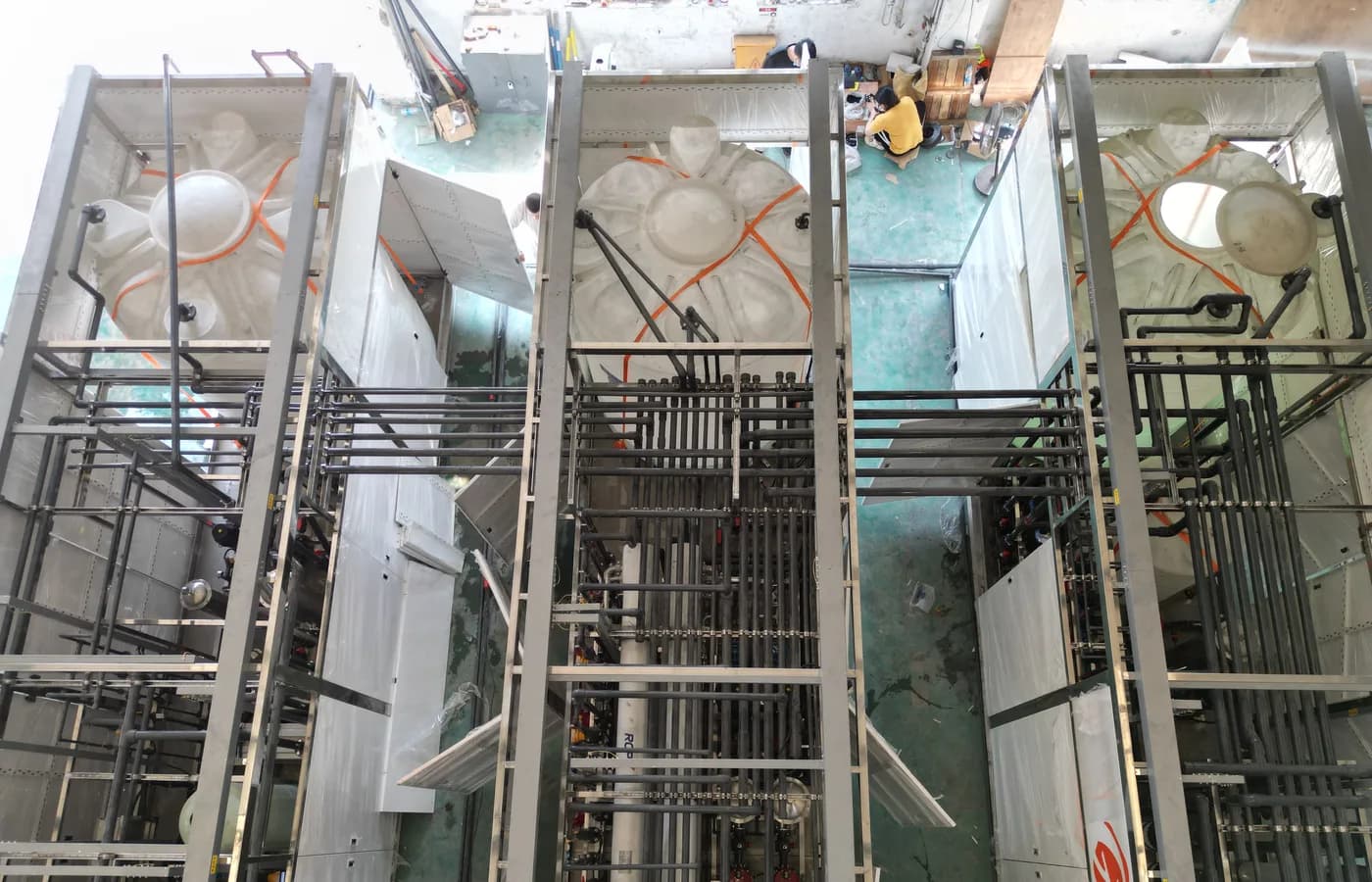
Send Baihuipu the process history, symptoms, sample positions and intended decision for a diagnostic-scope discussion. Request laboratory capability, handling instructions, test sequence, turnaround assumptions and report contents before shipment. The featured photograph shows an RO train during assembly; it does not show a failed membrane or laboratory result. Use the related cleaning and shutdown guides for adjacent interfaces. A well-scoped investigation preserves evidence and makes uncertainty visible, without inventing a failure cause or promising a universal membrane-life extension.
Questions buyers commonly ask
Should every RO problem begin with destructive autopsy?+
No. Review instrument and operating evidence and consider appropriate non-destructive tests before selecting a laboratory scope.
Can one element represent the entire RO plant?+
Only within a justified sampling rationale. State its position and the limits of applying its findings to other equipment.
Should the element be cleaned before shipment?+
Follow the laboratory and membrane supplier instructions for the intended tests. Unapproved cleaning can change the evidence.
Does detecting a deposit prove the root cause?+
No. Interpret the finding with operating history, test limitations and alternative explanations.
Turn the guide into a project brief.
Final process selection and performance commitments should follow the complete feed-water analysis, application requirements, site utilities and approved technical agreement.